As I’ve said before, the time spent on wrapping an ikat design is all on the front end. Weaving goes pretty fast, especially when compared to tapestry. And I am not experienced enough yet to know if all my math calculations are correct. That
 will be discovered in the weaving process, but if I don’t keep trying, I won’t gain that experience. When the design calls for gradual angles, it is necessary to measure the yarn in smaller bunches, which, in turn, means that the design has to be enlarged lengthwise to compensate. For a piece that is going to be 60 inches wide, the cartoon could be twice that length, or even more. Fingers crossed!
Category Archives: Design
Tuesday and Wednesday
How I spent Tuesday and Wednesday….measuring out ikat and wrapping.
 Plus all the have-to stuff, although I have yet to unpack my suitcase. Does anyone else have a problem doing that? And why would that be? I took this section off the board last night and then measured out a new section. Interesting…after taking this picture this morning, I see a couple of mistakes.
 Wonder whether I would have noticed them without the picture. If only all mistakes were as easy to correct as this one!
I mentioned trying some new things–this is not really new, but it’s different than what I’ve been doing. The problem with experimenting is not the possibility of wasted material, but of the TIME involved. There’s never enough.
Miscellany
mis·cel·la·ny
/ˈmisəˌlānē/
Noun
- A group or collection of different items; a mixture.
- A book containing writings by different authors.
It’s probably time for me to really give up on this idea that I can have a somewhat balanced life. In an ideal world, I would weave, work on other projects, take care of the housework, etc, all in one day. So far, that just doesn’t happen. Instead I spend the day weaving, then guess what’s waiting for me to do. Yep, housework! But it does feel good to weave! And something else I should do–reallythink, while I’m designing, about how many butterflies will be needed at one time. Geez! They get all tangled up, there are so many!
Several weeks/days ago I read about an art exhibit that sounded interesting. It’s called Drawn to Nature at Wave Hill. Several artists’ works are exhibited, each with a different take on their inspiration from nature. Because I’m a dyer, this quote from the NY Times article caught my attention.
Ellie Irons keeps her eyes to the ground in her Bushwick, Brooklyn, neighborhood. She is looking for plant life, invasive species that pop up beside tree roots and between cracks in the sidewalk. She plucks what she finds and, back in her studio, researches their identities and their origins. Then she crushes them to produce colors she uses to paint maps tracing their journeys to New York. I love this idea! Look at what she’s done with this idea here. Hate to say it, but my first thought is about how to get color from those plants. Some plants look like they would give wonderful color, but just give drab brown. And because of my kind of obsession with clouds, I love these small watercolor and charcoal paintings of Samm Kunce.
And for a last bit of miscellany, this just shows you how crazy we Texans are about our bluebonnets. This year has not been a banner year so far, but it’s also been cold still. We had 37 this morning, but the drought is the biggest culprit. People stop anywhere to get a picture of their kids sitting in the bluebonnets. Nuts! They hop fences, take no notice of private property (but that’s a topic for another day), even sit on cows. And those fields of bluebonnets get smushed. But I have to admit, when I see the first bluebonnets in the spring, I feel like everything is going to be better, that life is good.
Morphed and things I’ve learned about wedge weave

Before

Now
You can see from the pictures above that this piece has changed. I don’t usually change mid stream, but I couldn’t continue to weave all those various colors. Stressful! So hard to decide on the next color! 😉
Wedge weave is also known as pulled warp, according to Peter Collingwood. I have his rugweaving book, but wanted just the few pages on wedge weaving to carry to the loom with me. So voila! Since he allowed his books on rugweaving to be placed in the archive at the University of Arizona, I didn’t have to try and fit that huge book on the scanner. Links for download can be found here. I prefer the term wedge weave because I think of pulled warp as a whole ‘nother critter altogether, like here, here, and here.
- Somehow the back and forth of the triangles confused me, and I added to that confusion by trying to vary the width of my shapes. Actually, they are probably parallelograms and not triangles. I am directionally challenged—see below
- Slant up towards the left when starting on the left, slant up to the right when starting on the right
- This technique really does pull the warp at the selvedge, and it’s hard to beat in for about an inch or so there. A generous bubble of weft helps.
- Obviously, due to the nature of the technique (pulled warp), a hand beater is necessary—something I hadn’t considered when starting this project.
This is amazing!
–to me, anyway. We all know about golden ratio, proportion, etc and we’ve seen pictures of the man with all those lines around his body. But look at this from ArtDaily. Do you find this as interesting as I do?
I took Jennifer Moore’s workshop Mathemagical, and frankly some of this stuff is mind-boggling to me. Yesterday I was reading about more places for online education and decided to read further about this one:
Geometric Folding Algorithms:Linkages, Origami, Polyhedra – Web Site –Erik Demaine, MIT
Take a look, tell me what you think when you read the list of lectures. I saved this information for later, but my head was swimming just looking.
Being behind, at least I was weaving, and a book
The holidays are inching closer and I’m feeling very behind. During the first stage of house renovations, I moved things out of two rooms into the back bedroom, otherwise called the guest room. The major stuff has found a new home, but there’s still some piddly things that need to be addressed. After all, I am going to have guests, and they need a place to sleep. And the washer needs to be fixed. And I can’t wash some yarns I dyed for a friend until it gets fixed plus there’s regular laundry. Yes, I’m kind of whining.
We’re having perfect weather for building a fire in the stove and weaving, so that’s what I did today. I cut the wedge/squares piece off, and I still don’t love it–picture later. But it was really important that I was weaving. Sometimes you just have to just jump in and do it. This cold weather is supposed to be gone in a day or two. Then I will go outside to continue with the other Great Sort, make more trips to Goodwill, and make my garbage men love me. But I have found three boxes that I can take to the shredder. Yippee!
Besides color, I constantly look at shapes and patterns. The shadows of tree leaves on the walk, the lines of the upholstery in the waiting room, advertising, whatever. Here’s a book with some interesting patterns in it: 100 Diagrams that Changed the World. I want this book! I don’t care what the review says about the text. I only want to look at the pictures. If I want more knowledge about one of the diagrams, well, there’s always Google. Below is a picture from the book, stick navigation chart from the Marshall islands. Love the lines in this! And Google has already come to my rescue, along with Wikipedia.
Parade magazine had an article about the book on a Sunday several weeks ago.
More wedges

The wedge the me continued…..
I woke up and had the idea of stacking the wedges. I cut out a wedge from the piece I wrote about earlier and traced around it in a way that I found attractive. I then scanned the drawing and colored the wedges with shades of blue in Photoshop. These aren’t the exact colors that I would use in a weaving, but the best I could come up with in that program. If I decide to actually weave this, I’ll work on the colors more. Maybe change to shades of red?
Below is the result of using the wedge motif in multiples but smaller. This would be done with weft-faced ikat. I’m kind of itching to do a little ikat.


I really love the ideas that come in moments of non-thinking. I also like the feeling of looking at things differently. I know I’ve mentioned this before, but this is my only experience with an art class–in a long ago photography class, our first assignment was windows. That was it. I looked at every window I came across. Shadows in windows, reflections in windows, cracked, broken, jagged windows, the shape of windows, flaking window sills and the wood that divides windows. That class was ages ago and I still think about it and look at windows. I’m hoping the same kind of thinking will possess my brain again–after the holidays!
Spring Equinox
The picture above reminds me of one of my favorite trips. Many years ago, I went to Chichen Itza for the spring equinox. At that time there were no huge crowds as seen in the picture above. You can see the serpent climbing the steps of the pyramid (or going down–I can’t remember which). Design inspiration, anyone? Below is the quote accompanying this picture, which came from ArtDaily. I am also including a few links about this Mayan site below, if you’re interested. And none of them have anything to do with that whole Mayan-calendar-and-the- end-of-the-world thing!
CHICHEN ITZA.- Local and foreign visitors gather before the Kukulkan Pyramid during the celebration of the Spring Equinox in Chichen Itza, Mexico, 20 March 2012. Hundreds of people gather to observe the descent on earth of a serpent shaped with the shadow of one edge of the pyramid, during the beginning of the Spring equinox, that in ancient indicated to Mayas the sowing season. EPA/Jacinto Kanek.
http://thingstodo.viator.com/cancun/celebrate-a-cosmic-spring-equinox-at-chichen-itza/
http://www.world-mysteries.com/chichen_kukulcan.htm
http://www.mayasites.com/equinox.html
http://www.starteachastronomy.com/mayan.html
Inspiration, Museums, and Computer Lessons
Here in Fort Worth we are very fortunate to have some really great museums. One that I hope to visit soon is the Amon Carter Museum, which, locally, we usually think of as the museum of Western art. The Carter has an extensive collection of Remington and Russell paintings and sculptures. In addition, they have over 45,000 photographs in their collection. Right now, they have an exhibition of Ansel Adams.
Oak Tree, Snowstorm, Yosemite Valley, California
May 29, 2010–November 7, 2010
Ansel Adams: Eloquent Light
This exhibition of forty landmark and lesser-known works by the renowned artist-photographer is drawn from the Carter’s holdings and a private collection.
So, with these kinds of collections, it is always kind of surprising to me when the offerings are somewhat different. Currently, an abstract exhibition has just opened:I love going to museum exhibits, even an exhibit of works that I don’t particularly like. Besides being good for the soul, art frequently inspires me with ideas and/or color combinations.
Joe H. Herrera (1923–2001)
Untitled, 1951
Oil on canvas
Jonson Gallery Collection, University of New Mexico Art Museum, Albuquerque, NM
You can see the painting referenced above here. It reminds me of lessons that I used to do with my elementary students in computer class. Using a simple drawing program (Paint in Windows), draw a rectangle, the vertical and horizontal lines.

Then use the drawing tools to form ovals, circles, squares, rectangles, triangles, and freeform shapes. This was good exercise for the kids in mouse skills and using some keyboard techniques, like getting a perfect square or circle by holding down the shift key while drawing. The same with lines—straight lines are obtained by holding down the shift key while drawing.
 Now, for the most fun of the whole thing! Use the paintbucket to “paint” all of the shapes. The example below is not finished, but you get the idea. And sometimes, a good idea comes out of doing mindless exercises like this. You can isolate a part of the whole or use the whole design. This lesson also taught the kids about the curved lines which, if too curved, let the paint leak into places where it’s not supposed to go. That’s another reason for drawing the large rectangle and letting the vertical and horizontal lines extend past the boundaries of the rectangle. Lessons that were hard-earned by some students! Another lesson about using Edit>>Undo. The colors available in Paint are basic, although you can add others.
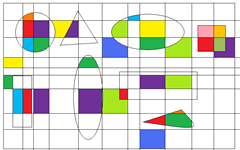


Simplified (or not) designs similar to the above can certainly be woven on the Mirrix loom, or any other loom. Look at some of Claudia’s tapestries on the Mirrix Pinterest page or the blog, and you get the idea. They have since redone their website, so warning–many of the links on Pinterest are dead links. You can enjoy the pictures, though!
Today I am going to start on text on my last rectangle-like square. Hopefully I will have some pics tomorrow, but I have to admit, the 4th of July has interfered with my schedule, so if not tomorrow, then Wednesday.
Website: http://sherriwoodardcoffey.com