Category Archives: Design

Geez!

Door-card
Not a great picture because of the angle being wrong, so parts look weirdly odd sized. Forgot I need to get to the photographer.

Ever had those days when you sit down to do a project, and before you know it, it’s getting close to 5:00 PM? Welcome to my world! I decided that, since I had ArtWalk coming up, I would feel so much better if I crossed some things off the to-do list. You know, little things Illusion-cardlike the hanging boards, postcards, etc.

One of the things I noticed last year was that visitors to my booth would take a postcard but not a business card. So getting postcards done was one of my goals for the day. And as it turns out, the only goal for the day.

I’ve heard great things about Moo, so I gave it a try. For me, there was a learning curve in the designing my own process. Postcards (and other printing projects) have safe areas, bleed areas, cutting line, etc. I would get a design done, upload it and realize the words are too close to something or other. So, a do-over. Another thing that I’ve heard folks talking about is that you can get a mix of designs with one order, but I finally gave up on that idea, and just ordered cards. There comes a point….

Tomorrow? Cut and paint boards. Woo hoo!

Weaving and experimenting

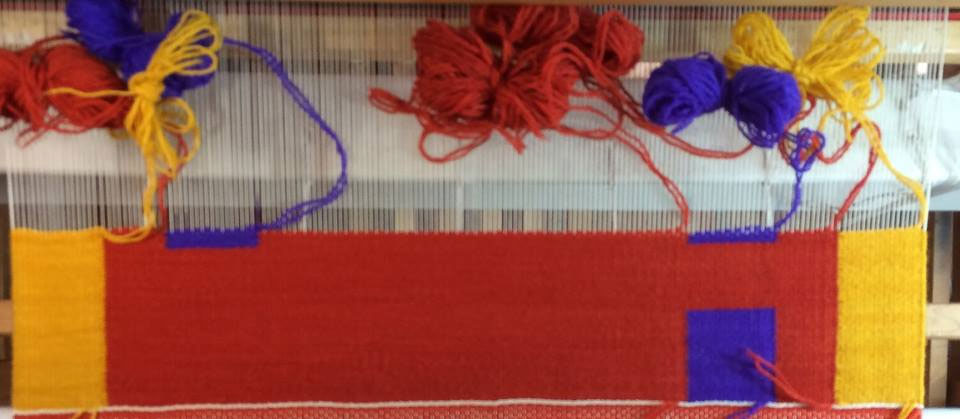
Untitled-1This is what I’m working on right now, and I already think I’m going to have to dye some more yellow. Plus, I made a design error, at least according to my drawing. After going back and redrawing the design, I elected to continue rather than take out four inches of weaving. Wonder why!

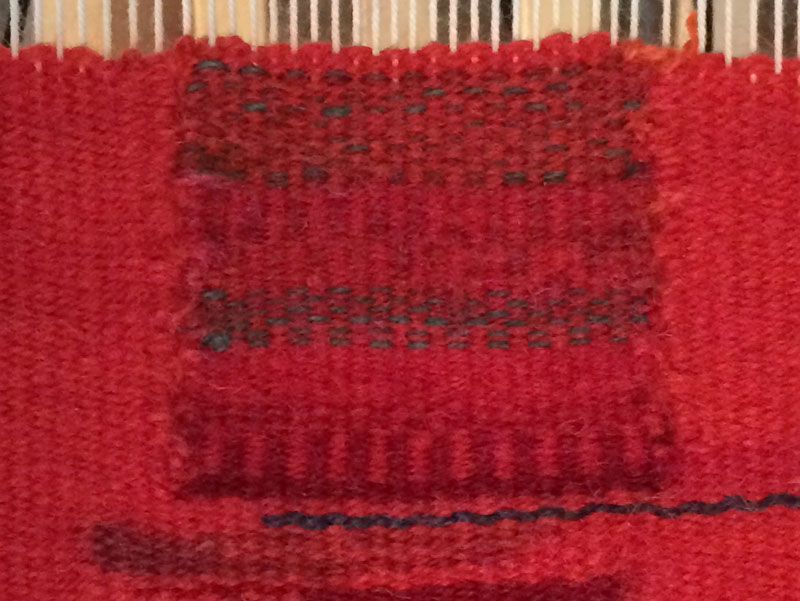
I’ve also been experimenting on the Baby Wolf. Part of the current weaving is going to have a rectangle, and I want it to look kind of like a shadowy door. I’m embarrassed to show these pictures, but I guess I have  no shame.ShadingShading-detail First of all, the Wolf doesn’t get enough tension for this purpose, but it is just a trial and error, so I continued. Originally, the little square was woven by itself. Then I went back in to weave the parts on each side. The sides were then stitched together just to see how these different techniques would look next to the background. The stitching is really messy, but that’s not the point. I’m still not sure what I’ll do when I get to that section of the weaving, but I do know what I don’t like.

Mid-week musing

ShuttleYes, this is still what’s going on around here. Stoke the fire, weave, walk around for a few minutes, weave, stoke the fire….. I’m actually using a timer and trying to walk around a bit every 30 minutes. The design was changed fairly drastically, and when it comes off the loom, I’ll know whether that was a good idea or not. I do think the selvedges are getting better with this weft-faced ikat, so that’s an improvement. I am taking careful notes, including information about the dyeing.

In the meantime, I’m getting antsy to weave something with a bit of tapestry and lots of color. Have several ideas, and therein lies (is that the correct form? I always get those mixed up.) the problem. So many ideas, so little time. Does this happen to everyone? More ideas than you know what to do with?

Piano Pavilion

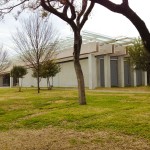
PianoOn a cold, rainy day last week, I went to a members’ tour of the new Piano Pavilion at the Kimbell Art Museum. I usually talk myself out of these ventures when the actual time arrives, but not this time. The tour was wonderful and so interesting! And the building is beautiful! This visit was good for the soul.

As I was seeing all of the attributes of the  building, I was thinking about how much planning and foresight has to go into a design. It’s not just a beautiful building, but it has many innovations. The ceiling inside much of the lobby is glass. Well, when I see glass, I immediately think of all our hail storms. This glass is of a very heavy-duty type, and it also has levers on top that can close if needed. The levers are normally in position to bring in as much northern light as possible. This is also a green building, with columns to harvest the rainwater. In the front galleries, the floor is wood, just as in the Kahn building, but they are placed so there is a bit of space between each board, which allows heat to radiate up from below. Other “green” features are thermal wells and using half the electricity of the Kahn building.

I’ve never paid much attention to the walls in a museum before, but after listening to an interview with Renzo Piano, and another interview with an art critic, the concrete walls were one of my must-sees. The color is a soft, blue/gray, and they are as smooth as silk, which is in fact, what they call this type of concrete. The art critic was talking about how the art pops against these walls, mentioning specially a terracotta bust. Mr. Piano told about how he had seen this concrete in Venice, found out how to make it, and brought it not only the “recipe,” but also the workers from Venice to Texas to make this wondrous stuff.

View from the Asian section to the Will Rogers Memorial.

View from the Asian section to the Will Rogers Memorial.

One of the statues in the Asian wing. Love the shadows behind the statue!

One of the statues in the Asian wing. Love the shadows behind the statue!

Another feature is the Asian section–It’s all underground! Many of the scrolls can’t handle the bright lights so it’s all kind of dim, with strategic lighting. The atmosphere is mysterious and inviting.

The hill above the Asian wing, looking toward the Will Rogers Memorial.
The hill above the Asian wing, looking toward the Will Rogers Memorial.


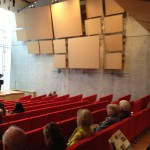
Kimbell-acoustics2There is also a new auditorium. An acoustics expert advised to have a balcony, so there is one. These panels are on both sides to also aid in acoustics.

No picture of this, but there are also great studios to have classes, with running water and everything.

Here are some links to pictures that are better than mine:

In the real world here in ikat land


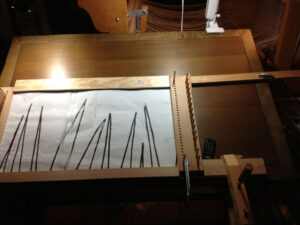
Here’s my latest configuration for the ikat board. So far, so good.Ikat-configuration-Dec-2013 This is part B of the section done previously. I didn’t think this would work because of how the right top board sticks out from the edge of the table, but since it’s holding so far, this could also be the answer for the varying widths of designs.
Last thoughts

I’m still thinking about all the planning and the thinking ahead that an architect has to do in order to build a new building. Yes, we all have to think through a project, and often we learn the hard way that we didn’t think enough, but our projects are not nearly so grand. I am having to remind myself, yet again, to document, document, document. That will help having to learn all over again.

What’s your planning process like? Or do you go forth by the seat of your pants?
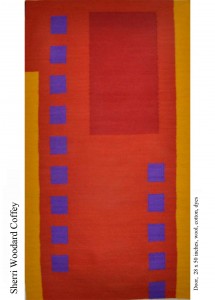


It’s winter!

Icy-Trees

Icy trees

Let me say right off, I’m not a big fan of winter. I may have mentioned that before. For sure! Winter did arrive, even here in Texas, although it did not live up to the predictions of the weather folks. The streets were fine here and I could walk out to get my paper without falling. Of course, I had to duck the tree branches hanging down from their load of ice. Even though I prefer to not have winter, the ice on the trees is pretty, as is snow. But for us here in Texas, snow and ice bring huge problems because we just don’t deal with it as often as, say the northeast.

New tool

Ikat-Fall

Measuring ikat

I usually look upon these winter storms as a time to hunker down and hibernate, making art. I get the wood burning stove going in my studio and either weave or work on the ikat tying. Which brings me to that subject–ikat tying. I had a small disaster while measuring the yarns. The whole shebang just disconnected itself from the very carefully placed boards, c-clamps, and whatever else was holding it in place. I have done a search for other forms of clamps, and in fact, went to town to get one kind. I’ve learned some of the vocabulary necessary to discuss clamps. What I needed was one that had a long reach throat. Unfortunately, this one doesn’t work and will be returned tomorrow. The only other thing I can think of to do is to drill holes and use bolts to hold things in place. But I’m going to think about that for a while.

Fall

Fall colors

This is what I’m working on right now. This is to be fall grasses, and yes I know that fall grasses (above) are not this bright, but it’s representational. You can see the top part of the cartoon sticking out above the yarns. I’ll move that down after finishing this section. Notice how on the right the loops have been taken off their pegs and tied with a string to outside pegs. That’s because the tying will go to the edge and there’s no other way to totally tie that area.

Happy Thanksgiving! May we all be grateful for what we have, our families and friends, and what we are. So, I will be grateful for winter. I hear that the cold is good for reducing the population of West Nile bearing mosquitos.

Where’s a blue zebra when you need one?

Untitled-1

Drawing

The design

Here’s the drawing of what I’m working on, except that I decided to make all the solid blue stripes the same size. I had to do this because of the way I measured and wrapped the zebra stripes, based on another design entirely.

IMG_1471

Weaving

The Weaving

Here’s the piece being woven. Now I’m not so sure about those solid stripes, at least not sure about the color. In the drawing, they are a darker blue, but when I put those yarns and the zebra stripe together, they didn’t look good. I tried several other colors and decided to just go with the blue you see. If I really don’t like it when I take it off the loom, I’ll do some surface embellishment. What I am happy about is the zebra stripes themselves. They are really weaving up nicely. And easily. Of course, it took lots of sampling before the right warp width could be found. Then I was worried that after weaving all the bottom magenta portion, that those zebra parts wouldn’t fit. So, yippee! AND I am to the top of the design, ready for the next color block.

Update

This turned out to be a horrible piece, which I can see from the drawing that it was destined to be. My only possible defense is that I really wanted to practice ikat.

White pens

White-SharpieHow do you do design work? I use several ways, but mostly a sketch and if I like that, I go to graph paper, and in the last year or so I have then been scanning the graph paper drawing and playing around with color in Photoshop. Sometimes though, through all of that drawing on graph paper, I might ink it in and realize that the scale is off or a motif is in the wrong place. That’s when I want a white pen. It’s easier to get those stray marks out of the way before going into Photoshop, at least for me. Maybe my fine motor mouse skills are just not very good. So, Monday I went to our locally owned art store and checked out the white pens. And, boy, are there a lot of them since I last looked. A few years ago, the only thing I could fine was a really big one, maybe to use for your graffiti or something. I bought a couple of fine point Sharpies and two different brands with medium point. I really like the fine point pens, all of them. The only pen that I didn’t like is the very last one on this list. It has two different “brushes.”

So, back to designing—those who do designing—how do you do it? I’d really like to know.

Playing around in Photoshop

Final-circle-lines-red-blkPuppet warp. Never heard of it. Until I saw something about puppet warp on Lynda.com’s Facebook page. Hmmm, sounded interesting, and I really wondered if it was available to me because I had never seen it. Well, it’s there, but missed it. There’s a little video explaining how to improve a photo, in this case, remove Line3_Athose love handles. I’ve been experimenting with variations on a line (see the result of the drawing on the right here), and had something I kind of liked with circles Circle drawingmade of dotted lines. I decided to use this drawing and play with this. The first step is to “lasso” it. Then you make another layer and go to puppet warp. It makes all those little triangles all Circle lines-dotsover the design. You then put in some dots that are going to be the places where you drag to change the design. From there you push and shove and play around with those dots until you finally think you’re done. When you go to “save as,” you are asked if you want to apply the changes. Below is my final result, not great, but there are possibilities. From Untitled-4what I can tell, not being much of a really good user of Photoshop, the puppet warp gives you more places to make changes than does “free transform.” Fun stuff to think about, though.

Inspiration

The Fort Worth Weavers Guild biennial show is hanging now at the Fort Worth Community Center. For Fall Gallery Night, the crowds fill the halls and galleries, looking at the art and participating in the various food (and drink) offerings for opening receptions. There were many beautiful and interesting works to see, and I got a nice surprise. First, I should explain that in all the guild shows until the last one, there was no judge and/or critique. We started having a judge with the last show, with an emphasis on the critique part. No prizes. I had actually forgotten about the judging, and was very pleased to find that both of my pieces had wonderful handwoven ribbons hanging next to them. The theme for the show is In the Eye of the Beholder. Everyone was expected to turn in an inspiration photo when their work was delivered. Many times the pieces were made, and then there was a desperate search for “inspiration.” This time I was able to follow the directions exactly. Both of my pieces had inspiration.

The-zebra-in-my-head2For “The Zebra in My Head,” I used a really bad picture I took at the zoo. “Zebra” received the HGA award. The other piece, “Headin’ Home” was Headin'-Homeinspired by all the times I have seen birds either flying out in the morning or heading home to their roosting spot in the evening. By the way, this design is the result of an online class Working in a Series that I took with Lisa Call. I was thinking about the many variations of a line that might be possible, thinking dotted line, and so evolved this design. In fact, I don’t think I’m through with this idea. For the guild show, no work could be larger than 1440 sq in–an unusual parameter for me.

I think about inspiration a lot. Sometimes inspiration comes from a picture, or colors in a painting, a feeling, etc. For me, sometimes inspiration is as mundane as a desire to experiment with a technique. More on that later.

By the way, for a really beautiful tapestry with birds flying, look at the American Tapestry Alliance’s website.  There’s a piece by Evelyn Campbell, who won the ATA Award for Excellence in Tapestry. Beautiful!

What’s your inspiration? Or an artist that you admire. What was the inspiration? How was it translated into art?

Getting ready

The Show-postcard-frontguild biennial show is coming up soon. The gallery reception will be September 7, Gallery Night. The theme of the show this year is In the Eye of the Beholder. Each item in the show is to include a photo of the inspiration for the weaving. Should be interesting. I love seeing inspiration and process.

Drafting-tablePlywood-tableWhen I decided to take these pictures and, I really didn’t realize that they would appear almost identical. They are very different though. Trust me! On the left is the plywood that was being used as my ikat table. After the last measuring/wrapping session of days, I decided something has to change. On the right is the drafting table that has finally been assembled. It’s tall enough that I can stand and work or sit. The top slants to make it easier to reach the back sections more comfortably. This is the desk from World Market–the one the directions said two adults are needed for assembly. I hate that, not being able to do things by myself.

The next batch of yarns are out and ready to be measured in a palette much different than my usual. No bright colors, some shades of beige, rust, and black.