Category Archives: Ikat

Not much

Ikat in progress

Ikat in progress

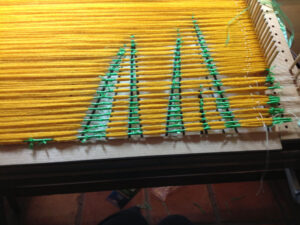
Really not much going on around here. The ikat piece that I’m working on is going to be part of the idea for a prairie series. I had the cartoon enlarged to 120 inches, but after winding and tying the first section, I measured the actual vertical space available (Duh!) and cut the rest of the enlargement into 13-inch sections. Keeping my fingers crossed that my math is correct! As you can see, the ikat part is pretty simple–vertical lines, spread out. My process for this is pretty simple also. I have two huge cones of the wool that I use, so I wind a ball with doubled strands on my wonderful new ball winder, then measure on the ikat board, then tie. It takes about 300 grams for each section. Knowing that will make the dyeing more precise later on. Now if I could just get all my water faucets to behave themselves!

Shuttle, Spindle, & Dyepot

SS&D-award Just in case you missed it–and I know it’s of vital importance (ha ha)–here’s a picture of a couple of pages from Shuttle, Spindle, & Dyepot‘s latest issue. I always look forward to seeing the pictures of the many varied works that others are making. Years ago, I was somewhat frustrated with these pages because it was so hard to find the description of the work. The picture would be on one page and the description pages after that. Now it seems to be more organized, at least as far as my brain is concerned.

The magazine can be accessed from HGA’s website, but I think you have to be a member to actually view the magazine. Oh, and by the way, Fort Worth is misspelled.

Evolution of a design, part 3

Grass-ikat-design change

Prairie Fire

Grass-ikat-1

Prairie fire

©Sherri Coffey-Prairie Grass

Prairie Fire woven

For the last couple of posts, I’ve been dissecting a design process that happens sometimes. The piece was originally intended to have three sections, each dyed a gradation of the previous one. When I decided a design change had to happen, it was back to the drawing board, or in this case, the computer. At least I could get a bit of an idea about proportions, etc that way. The purple stripes in the drawing? Those were added as I wove. Some things just have to be decided on the fly, so to speak. The sections just needed a bit of separation, but the actual purple is only a few picks.

A name change was definitely in order. Meet Prairie Fire.

Evolution of a design, part 2

1.5-hours The design I wanted to have is shown in the previous post here.  Executing the design is a different matter entirely. Grass-ikat The plan was to do this in ikat, which presents its own set of problems, at least in the learning stage I’m in. (About this supposedly being yellow grass–that decision came about because of the ikat portion of this equation. The yarns need to be a color that can be overdyed nicely)  After enlarging the cartoon, I started tying the weft yarns, which is not a problem, just time-consuming. The yarns are then dyed Shuttle again, ties removed and it’s ready to start weaving. And that’s where the problems begin.

In order to weave the design that’s tied into the yarn, the warp needs to be the right width. Unweaving and reweaving happened over and over before the “real weaving” could begin. And I wasn’t really happy with the real weaving result, so a design change was in order. Two sections of this design was ready, and I was not going to spend more time tying more ikat yarns if I wasn’t happy with the weaving. So, another design was born.

Do you have a weaving project that just didn’t work after you stated weaving? Did you change the design, leave it as is, or what? Sometimes I envy quilters who have design walls where they pin up their design. I do the next best thing I can think of, but maybe there’s a better way. Next time…


Mid-week musing

Shuttle Yes, this is still what’s going on around here. Stoke the fire, weave, walk around for a few minutes, weave, stoke the fire….. I’m actually using a timer and trying to walk around a bit every 30 minutes. The design was changed fairly drastically, and when it comes off the loom, I’ll know whether that was a good idea or not. I do think the selvedges are getting better with this weft-faced ikat, so that’s an improvement. I am taking careful notes, including information about the dyeing.

In the meantime, I’m getting antsy to weave something with a bit of tapestry and lots of color. Have several ideas, and therein lies (is that the correct form? I always get those mixed up.) the problem. So many ideas, so little time. Does this happen to everyone? More ideas than you know what to do with?

Experimenting, part 2

Ikat

Even my weaving is an experiment. I really should be “sampling,” but I just go all out, so weaving is not the refuge that it usually is. I took out all the weaving that I pictured last week and started again. It seems to be going better this time around. I’ve decided I’ll complete the first section and then make a decision—cut off or continue.

Giving up?

I told myself that I would experiment with this for three months, so giving up is not a good option. However, I could go back to only rectangular shapes until I have a better handle on what is measured on the ikat board and what actually weaves up. Hmmm…

What I’ve learned this go-round

Detail-center

Weaving

Detail

Woven

Section-1

Woven

One of the things that I’ve learned is to try to center the next pick with the one before it. That means forgetting those marked warps and trying to weave the design according to those. By centering the wefts in this way, they make the shape they’re supposed to make. On the left is a section woven in this manner. Now, that doesn’t mean they’re as good as I would like, but an improvement over the bottom picture–which I took out.

Dyeing

Yellow-yarns

Trying all of those WashFast colors that I have is another experiment. After my initial disappointment, I’m really liking the colors. I’ll put them all in a pile and take a picture soon. Also need to make sample sheets, since the samples that I received are dyed at different percentages. Above are two yellows. The skeins are WashFast and the ball is the yellow from my usual dyes. The new yellow has a greenish cast, although not as severe as in this picture. Below is an adjusted picture. Not much better after all….just believe me!

Yarns-adjusted

Photo adjusted

Ikat Dyeing

More on this later, but experimentation here also. I’m not even dyeing the other tied sections until I decide the fate of this piece.

What to do…continue or not?

Section-1 This is what I’ve been weaving the last few days, off and on. I’m not happy with it, but can’t decide what to do. Cut off? Continue? Unweave and try again? What I may do is weave this half of the first section (up to the top of the lines drawn on the Grasses-section-1 warp) because that will give me another number to develop a formula for MY ikat measuring. The drawing on the right is what this section is supposed to look like. I realize the colors aren’t the same, but obviously, improvement needs to be made, either in the ikat itself or the weaving. So, maybe go back and weave this as tapestry?

Tera Muskrat is a New Mexico artist who paints large pieces inspired by Mexican calendar girls (or New Mexican). I think only certain generations will know about calendar girls, but maybe I’m wrong. For some reason, the name Jane Russell comes to my mind, but maybe I’m wrong about that too. Marilyn Monroe, even not from the 30s, might be another example. They may have also been called pin-up girls.  I have to admit that one of my favorites is is a woman holding a Chihuahua against here bosom.  I also like Channeling Calendar-Muskrat Georgia. Maybe the attraction is the humor in her paintings, I don’t know. I would have bought one, but they are large, and I don’t have a place for a large painting. So, I did the next best thing–I bought her calendar for 2014 on Etsy. I like that it’s in Spanish (I’m really hoping to refurbish my Spanish this year–not using it plays havoc) and has large pictures for each month. Calendar-page Calendar-Octubre The page below is for Octubre. The text along side it is La Viuda, the widow.

Ready

Close-up of my ties

Close-up of my ties

Two of the ikat sections are untied, which really only equals to one of three parts of my design. There are several steps to this process:

  1. Using a seam ripper to cut the knot
  2. Unwrapping
  3. Soaking in water to “re-fluff” the yarn, which has been compressed by the tape.
  4. Either balling the yarn, or if the section is fairly small, winding it directly on a shuttle

I tie the ikat tape in a double knot, being very afraid it will come loose and I will have bleeding dye. However, I know that ikat tying experts use a bow. I’m thinking that my confidence might be enough now to practice bows for the next sections I tie. Or maybe I will tie the double knot with a bow. That way I can test how the bows hold up to the dye process. Or maybe not use the bow–I just reviewed this video of ikat tying. Will search for others another time.<>

Gratitude

Grass-ikat After doing all of the ikat tying, you get to untie all those resists. Here’s 1/2 of one section only partially untied. It’s kind of a mindless activity, ideal for keeping one’s hands busy while watching a movie or mindless TV. The dyeing on this is actually a mistake, so Plan B is now in force. At one point I had it in my head exactly how I was going to dye each of the sections so that the background (in this case, the orange part)  would be gradate from light orange to a more intense orange. Totally forgot when I went out and threw dye in the pot, do the plan has been revamped.

There are still spots of ice here and there, but it should all be gone soon, with temps reaching 60s and 70s this week, only to drop down again by the weekend. I am really glad I filled the dyepots yesterday, because today, the water was frozen in the hose.

And speaking of weather–I realized that my mindset had to change, or I was going to be miserable in winter and summer. The weather is here to stay, and I have to readjust to the conditions I live in. Probably because I am older, these extremes of temperatures bother me more, and I have always been sensitive to many days without sunshine. Not sensitive enough to warrant one of those special lamps, but … So, I went out and dyed when it was 35, and felt better for doing it! In addition, I am going to work on my thinking. Journal I have a bitty journal that I am writing down five things that I am grateful for each day. Many days recently I have been grateful for the warm fire in the wood stove. Or that I am capable of taking a pickax and breaking up the ice and make a path to the woodpile. Knowing that I am going to have to make my grateful list makes me think about this during the day. And truly, we all have things to be grateful for. Why let the weather affect that?

Piano Pavilion

Piano On a cold, rainy day last week, I went to a members’ tour of the new Piano Pavilion at the Kimbell Art Museum. I usually talk myself out of these ventures when the actual time arrives, but not this time. The tour was wonderful and so interesting! And the building is beautiful! This visit was good for the soul.

As I was seeing all of the attributes of the  building, I was thinking about how much planning and foresight has to go into a design. It’s not just a beautiful building, but it has many innovations. The ceiling inside much of the lobby is glass. Well, when I see glass, I immediately think of all our hail storms. This glass is of a very heavy-duty type, and it also has levers on top that can close if needed. The levers are normally in position to bring in as much northern light as possible. This is also a green building, with columns to harvest the rainwater. In the front galleries, the floor is wood, just as in the Kahn building, but they are placed so there is a bit of space between each board, which allows heat to radiate up from below. Other “green” features are thermal wells and using half the electricity of the Kahn building.

I’ve never paid much attention to the walls in a museum before, but after listening to an interview with Renzo Piano, and another interview with an art critic, the concrete walls were one of my must-sees. The color is a soft, blue/gray, and they are as smooth as silk, which is in fact, what they call this type of concrete. The art critic was talking about how the art pops against these walls, mentioning specially a terracotta bust. Mr. Piano told about how he had seen this concrete in Venice, found out how to make it, and brought it not only the “recipe,” but also the workers from Venice to Texas to make this wondrous stuff.

View from the Asian section to the Will Rogers Memorial.

View from the Asian section to the Will Rogers Memorial.

One of the statues in the Asian wing. Love the shadows behind the statue!

One of the statues in the Asian wing. Love the shadows behind the statue!

Another feature is the Asian section–It’s all underground! Many of the scrolls can’t handle the bright lights so it’s all kind of dim, with strategic lighting. The atmosphere is mysterious and inviting.

The hill above the Asian wing, looking toward the Will Rogers Memorial.
The hill above the Asian wing, looking toward the Will Rogers Memorial.


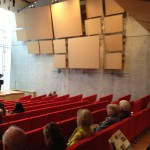
Kimbell-acoustics2 There is also a new auditorium. An acoustics expert advised to have a balcony, so there is one. These panels are on both sides to also aid in acoustics.

No picture of this, but there are also great studios to have classes, with running water and everything.

Here are some links to pictures that are better than mine:

In the real world here in ikat land


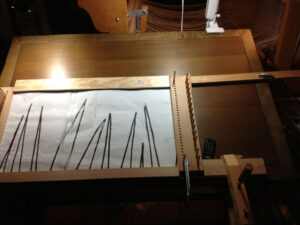
Here’s my latest configuration for the ikat board. So far, so good. Ikat-configuration-Dec-2013 This is part B of the section done previously. I didn’t think this would work because of how the right top board sticks out from the edge of the table, but since it’s holding so far, this could also be the answer for the varying widths of designs.
Last thoughts

I’m still thinking about all the planning and the thinking ahead that an architect has to do in order to build a new building. Yes, we all have to think through a project, and often we learn the hard way that we didn’t think enough, but our projects are not nearly so grand. I am having to remind myself, yet again, to document, document, document. That will help having to learn all over again.

What’s your planning process like? Or do you go forth by the seat of your pants?