Winter, books, museum, ball winders

Shibori-book

Shibori book

Something I’ve never done before–used the interlibrary to request a book from my local library. Wow! Worked great and fast! I can’t remember why now, because I’m probably not going to do shibori any time soon, but I put the Karen Britto book Shibori: Creating Color & Texture on Silk in one of my wishlists in Amazon. The book may be out of print, which may explain the price, but before spending $35, I wanted to see it. Thus the interlibrary. After looking at the book, I may spring for the $$$. Ms. Britto talks about the two kinds of dyes I’m currently using, but more importantly for me, there’s a chapter on using the Munsell color system. I already have those chips and would like to use them effectively. The problem for me is the dye samples. I will have to figure out some way to dye small batches of possible colors with the equipment I have. Well, and find time too.

Seems I spoke too soon about our fall weather–winter is scheduled to arrive with a vengeance tomorrow. I hope it doesn’t bring that “wintery precipitation” with the winds. The Kimbell Museum is set for members’ tours of the new Piano Pavilion. I have listened to a couple of programs about this new space on the radio. Evidently the concrete used for the walls is a special type and seems to be a better background for many of the artworks. Doens’t that sound strange? Something I’ve never thought of. Maybe I’ll get to see for myself soon.

And a totally off topic question–Do you have a ball winder recommendation? I have a really old plastic one that works, but frequently the gears click as I wind, so the writing in so on the wall. Some of these ball winders are REALLY expensive, so I want to hear feedback from anyone about ball winders.

Fall, finally!

Fall

Fall colors at my mother’s.

It’s pretty boring around here–dye, weave, dye, weave, … and work on getting outdoor clean-up projects done. Boxes of shred material will go to the shredder soon, too. The weather is nice right now, so those things are the priority.

I know we don’t have fall color like the northeastern part of the country does, but our fleeting color is still pretty. A couple of hours after taking this picture I loaded it on my computer and realized that for me, the grasses are almost as pretty as the trees. I love trees, but I’m a prairie girl. When I take road trips to the east, claustrophobia sets in. It’s so frustrating to not be able to see areas off to the side of the road!  Here we have wide open spaces, not like farther west, but still mostly open. In fact, I’ve heard visitors from the northeast say that they feel so exposed. By the way, to get the full effect of the picture, click on it. And speaking of grasses and prairie, that’s my next weaving project.

Yarns

What about these colors!

So, here are the fruits of my labor so far. The WashFast dye colors from left to right are:Turkey Red, Magenta, Red, Tiger Lily, Chinese Red, Deep Purple. All were dyed at 1%. I dyed the red and magenta first, and they were disappointing to me. But I continued on and gradually came to like these colors. The really interesting part will be to start mixing colors. The blues and another purple will be next. Dyeing in this way means that I can use the same water over and over, which not only saves on water, but also on all the additives that go into the pot.

Research? Of course not!

Magentss I’m doing some dyeing with new-to-me dyes. I know of other weavers who use these WashFast dyes (labeled Nylomine), so I thought I’d give them a try, but that wasn’t the main impetus. It was because of the pairing of WashFast dyes and the Pantone forecast for spring 2014. It’s a PDF, so I can’t post the exact link, but it’s first on this page.

I’ve ordered the dyes, made a plan for getting samples done, and started Sunday. Right away, I was concerned. But first, going back a bit, I have the wool color card from ProChemical for these dyes and had noticed that nearly all of the colors were dyed at a 1.5-2% solution. Most all of the dyeing I do is at 1%, so that’s how I’m doing my samples. From the first weighing of the dyes, I noticed that it seems to take more dye to reach that 1% amount. I also noticed that when the dyes are added to the water in the pots, they look anemic. So, I decided to do a little research about the difference between WashFast dyes and the Lanaset-type I’ve been using (ProChem calls them Sabraset). That led me to Paula Burch and her All About Dyeing website. What I have discovered is that these dyes may not be as washfast and lightfast as the Sabraset dyes. I’m going to forge on though. Dyeing all the reds now, but then I’m going to clean out those pots and start with yellows, moving up the list to darker colors.

By the way, I knew about Paula’s dyeing website but had forgotten about what a wealth of information it is, from descriptions of dyes to methods to book reviews, it runs the gamut. Check it out.

Where’s a blue zebra when you need one?

Untitled-1

Drawing

The design

Here’s the drawing of what I’m working on, except that I decided to make all the solid blue stripes the same size. I had to do this because of the way I measured and wrapped the zebra stripes, based on another design entirely.

IMG_1471

Weaving

The Weaving

Here’s the piece being woven. Now I’m not so sure about those solid stripes, at least not sure about the color. In the drawing, they are a darker blue, but when I put those yarns and the zebra stripe together, they didn’t look good. I tried several other colors and decided to just go with the blue you see. If I really don’t like it when I take it off the loom, I’ll do some surface embellishment. What I am happy about is the zebra stripes themselves. They are really weaving up nicely. And easily. Of course, it took lots of sampling before the right warp width could be found. Then I was worried that after weaving all the bottom magenta portion, that those zebra parts wouldn’t fit. So, yippee! AND I am to the top of the design, ready for the next color block.

Update

This turned out to be a horrible piece, which I can see from the drawing that it was destined to be. My only possible defense is that I really wanted to practice ikat.

Death of a Dyer

I wrote about Death of a Dyer here. Briefly, the book is a mystery set in 1796 in which the main character is a traveling weaver. That fact and the title compelled me to check the book out and start reading.

Within the first chapter or two, I had to do a little research, and that always takes me down a few rabbit holes. Here’s what I’ve learned:

Nankeen-a quote from Wikipedia. If you follow the link, you will see a picture and a bit about stencils and indigo on nankeen cloth.

Nankeen, also called Nankeen cloth, is a kind of pale yellowish cloth, originally made at Nanjing from a yellow variety of cotton, but subsequently manufactured from ordinary cotton which is then dyed. Also in the plural a piece or variety of this cloth.

Southern Exposure Seed Exchange had nankeen cotton seeds before they were destroyed by a fire. I was glad to be reminded of this company because they have lots of interesting seeds there—worth a look.

As the title says, there is the death of a dyer, so dyestuffs are mentioned, like Spanish Red. I’ve heard of Turkey Red, but not this one. That is, until I looked it up. Spanish Red is actually cochineal. The Spanish settled in the Americas long before the pilgrims came to North America, so the red dye was already in use. Like cacao becoming a desired food, cochineal was a valuable dye material. So, even though I am familiar with cochineal, I still found some articles that are interesting. There are a few of them below.

This Washington Post article by Diane Ackerman is really a book review, but it’s still interesting. The book is A PERFECT RED: Empire, Espionage, and the Quest for the Color of Desire by Amy Butler Greenfield.

I recently was in Arizona (I spent one night with Barb Nelson) and saw a type of prickly pear that’s purple. I wish I had taken a picture of one that was covered with cochineal bugs, but we were driving down the street. If you’re interested, you can see a picture here..

Scutching was mentioned, and I was pretty sure that it has something to do with linen, or rather flax. But scutching knife? There was one that was sold on eBay.

I finished the book, although I really did not enjoy it very much. Turns out that a travelling weaver has a loom that breaks down quickly. Hmm… One small complaint—the dyer had been using local plants to find a green that was all the rage. That’s a problem since most greens from natural dyes are actually a two-step process using indigo (or woad) and overdyeing with weld or another yellow dye. Again, Wikipedia has a nice article about natural dyeing.

La Grange

Quilt-wall3 After returning from Arizona, I got a phone call inviting me to HarvestFest which was being held in Fayetteville, Texas. This is a fund raiser for ART, Arts for Rural Texas. I’ve mentioned this group before. They are dedicated to bringing the arts to rural Texas, not only visual arts, but also opera, ballet, etc. I was in ArtWalk last May and plan to go again.

This time I stayed in La Grange (you may have heard of the “chicken ranch“), and since I arrived before check-in time at the hotel, I decided to find the town square and explore. As I drove by, I spotted a wall of painted quilts. They were amazing! I went around the block and found a parking spot. Quilt-wall2 One whole wall of the building was painted with quilts so that they looked like they were hanging on a line. There were even dark areas so that it appeared to be a shadow behind the quilt. In front of the quilt wall was an enclosed garden, the cottage garden type that may Quilt-wall2 have been in grandmother’s house. Turns out that the quilt wall is on the building that houses the Quilt Museum. Walking down the sidewalk I spotted the sign for Quilted-skein Quilted Skein (clever name, right?). Inside was a treasure of yarns, fabrics, quilting and knitting paraphernalia.  Quilted-skein-inside


The courthouse was a beautiful building and much like other small town La-Grange-courthouse courthouses. I was told later that that the inside is beautiful, right out of To Kill a Mockingbird. They took one of the chairs original to the courtroom and copied it until they had enough chairs to fill the room. Guess that will have to wait for my next trip.


Guild meeting-Kay Sekimachi

Sekimachi Nagare VII1970 Kay Sekimachi, born San Francisco, CA 1926 woven nylon monofilament 80 x 9 x 9 in. (203.2 x 22.8 x 22.8 cm.) Smithsonian American Art Museum, Museum purchase 1972.183.* I read that she did quadruple tubular forms. I’m not sure if this is one of those, but it looks like it could be. You can see pictures of more work that is in the Smithsonian Collection here. None of them are on view currently. I wonder if you could see them if you made an appointment.

Our guild is doing something a little different this year by having a couple of programs about weavers who do notable work, but may not be well known locally. The program was given by Sarah, and she did a great job. It happens that I was actually familiar with this Kay Sekimachi, having read about her in American Craft magazine. What I remember most from the article is how organized her “stuff” is, becoming art in itself by being placed on a shelf with nothing else. Take a look at her worktable here. Is that the way your worktable looks? Not mine! Of course, maybe that helps explain her success and her work.

Kay was born in San Francisco in 1926. During WWII she was interned with her family. Later, after seeing one weaving class, she bought a loom. Her oral history interview can be found here; I found it very interesting.

You can always do an Google search to find images. Here are links to a couple of galleries that either have or have had her work: Jane Sauer and Brown Gotta. I love her leaf bowls!

*Personal, Educational and Non-Commercial Use
Personal, educational and non-commercial use of digital images from our Web site is permitted, with attribution to the Smithsonian American Art Museum, for all images unless otherwise noted.

Mystery

While in the library to get abstraction books, I had to browse the mysteries. Who could resist picking up this one? Here’s the blurb from Amazon below. I added the color to draw attention to the career of the main character.
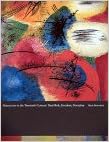
Will Rees feels at home. It’s been a long time since he last felt this way—not since before his wife died years ago and he took to the road as a traveling weaver. Now, in 1796, Rees is back on his Maine farm, living with his teenaged son, David, and his housekeeper, Lydia—whose presence contributes more towards his happiness than he’s ready to admit. But his domestic bliss is shattered the morning a visitor brings news of an old friend’s murder.

I don’t usually read period stories, much less period mysteries, but there you go, the title got me. Setting is Maine, 1796.


Yellow to violet

In that very large abstraction book  that I checked out from the library, Abstraction there was a piece titled From Yellow to Violet by François Morellet. It was a kind of squared spiral, with yellow in the center going to violet on the outside line. That got me thinking about all the colors in between. The handy Color Schemer came out again. Linear In “Mixer” I chose a yellow and a violet. The default gives you 52 colors, in this case from yellow to violet. I changed that to 21 and this is what I got. Notice that there are lots of browns and some not very interesting colors in the middle of this. Then I happened to notice the drop down menu beside Path. Evidently I’ve never done that before, but there are three choices in all: linear, radial clockwise, radial counterclockwise. Radial-counterclockwise The example above with the not-so-interesting colors is the linear path. Left is the radial counterclockwise. When they say radial, they are meaning on Radial-clockwise the color wheel. Here is the radial clockwise. Both of these schemes are interesting to me, maybe even a little exciting. These color palettes look like they could be for the abstraction book. I love them! After all, they have purple.

This and that

I took way too many photos, but I think most of us do that in this digital age. They’re so easy to get rid of. The day that I drove to Tombstone and Bisbee, I stopped for gas and saw this sign. I definitely knew I wasn’t in Kansas anymore. I find it interesting that there’s no smoking in this establishment. Marijuana-sign

Pretty parasol, not sure if it would do much good. In a Tombstone window.

Pretty parasol, not sure if it would do much good. In a Tombstone window.

Just like this green swirl.

Just like this green swirl.

Self-Portrait

Accidental self-portrait with pottery in the Museum of Northern Arizona, Flagstaff.

Beer caps on door in Bissbee

Beer caps on door in Bisbee

Random sighting at the Burger King near Bisbee. I love the juxtaposition of this man, his backpack, and his laptop.

Random sighting at the Burger King near Bisbee. I love the juxtaposition of this man, his backpack, and his laptop.

Saguaro-drawing

Botanical drawing of the saguaro cactus and the many ways it has been used.

We have lots of cactus in Texas, but I had never seen this purple variety. They were all over the Scottsdale area. Some even had cochineal growing on them.

We have lots of cactus in Texas, but I had never seen this purple variety. They were all over the Scottsdale area. Some even had cochineal growing on them.

Sonora Desert Museum

Sonora Desert Museum

Copper ore

Copper ore

This is the bark of some sort of palm in the Sonora Desert Museum. I love the soft colors and the shapes of the bark.

This is the bark of some sort of palm in the Sonora Desert Museum. I love the soft colors and the shapes of the bark.