A nice surprise

Razzle Dazzle, wool, dyes, cotton, 29 x 29 inches, $835 ©Sherri Coffey

I am pleased that Razzle Dazzle has been selected to be in the 12th Annual TAC Juried Exhibit at the Community Arts Center. Opening Reception is August 46-9 PM. The show will close August 30. So, if you’re interested in seeing it in person and are in the Fort Worth area, here’s your chance!

In progress

So I’m kind of working on two things at once: the piece that’s on the loom and finish work on the small pieces that have collected. One of the major pieces is the mounting of said pieces. I think I’ve determined that it’s going to take several different methods because they vary in size so much. I’m considering small stretched canvasses and using stretcher boards with my own fabric covering them. As they say, a work in progress…

Hemming

Where to start

Where do you start when there’s really nothing to say. The typical summer weather has arrived, so it’s hot; that makes it necessary to get out early. There’s been something to do daily, including weekends, which means I actually have to get dressed in real clothes.

Last Saturday

Sculptor at Art Aid Expo

The local art center held its first Art Aid Expo 2017, and the guild was asked to participate as an art group. We brought looms and examples of work. We had lots of folks stopping by and a couple of teachers who would like to do fiber-y things with their students. That’s something I would be interested in working with.

Coming up

Another teachers group has asked up to participate in an in-service type thing, where we will do a bit of hands on again. Plus, the art group that I belong to is suddenly having meetings! Real meetings! I’m glad about that, but like I said, putting on real clothes.

Weaving/studio

This is early in the piece. Another progress pic soon.

The piece on the loom is scheduled to be completed by the end of the month. I’ve calculated about how long I will need to sit each day on a hard loom bench to finish in time.

Rabbit Holes

Along the way there have been a few rabbit holes and I sent an extra email to my newsletter list because they are the first to see new work. If you’re interested, you can sign up here. The studio insiders get to see new work first, sometimes with special pricing before it’s published on my website.

And a rabbit hole: It’s a video a Facebook page called Tallercito de la Autonomía about dyeing with natural dyes in South America. Scroll down to find Process de elaboración de tejidos por artesanas Mink Chincher, June 12, 2016. It’s really quite interesting.


The results are in

Piece that I cut off

First of all, if I EVER think about weaving two things at once, hit me over the head! Hard!

I cut off one of the pieces I was weaving, even though it was intended to be longer, much longer. Here it is in all its un-steamed glory.

Now, for the results of the ikat experiment 

As a reminder, I dyed the tied ikat section and then put it back on the board. You can see how it’s uneven where the two colors come together. That’s a problem to be solved for next time. I’m pretty sure how to do that.

Back on the board

second dyeing

This is where you can see the consequences of that unevenness on the board.

Two different colors

When I dyed the second time around, I didn’t tie all the green sections. The darker areas are where it was dyed over the green.

What will I do differently next time?

The main thing is to maintain the order of the threads more carefully. And if that doesn’t happen, to err on the side of overdyeing the green, so that there won’t be areas of white between the color sections.

I always twine the section with a warp thread on each side to maintain order, but that will need to be done more carefully from now on.

Onward!

Dyeing, math, and reversal

Dyeing, dyeing, dyeing

Lots of dyeing going on around here, with some very specific colors in mind. I opened my dye spreadsheet, copied and pasted all the formulas from one sheet to another, added the WOG to my, printed it, took it and the yarn to where the dye pots live, and went to work.

Math!

That’s when I discovered that when I corrected some of the formulas in my copy and paste, I put in the wrong numbers. Specifically, instead of 5% in decimals being 0.05, it was 0.5. That’s a huge difference in amounts!
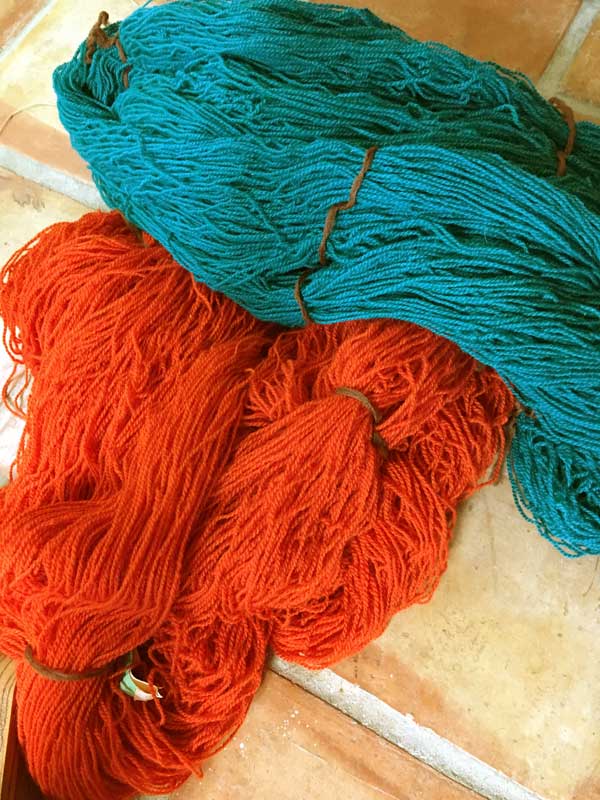
Red orange and blue green (kind of)

The second thing I did was to reverse the colors when I got to the dye pots. What was supposed to be 0.05, but in reality was 0.5 in scarlet, became mustard. What was supposed to be 0.95 in mustard became scarlet. So instead of a yellow orange, I had an red yellow, as seen above. 

For the blue green, the larger 0.5 skewed the color, still a nice color, but not exactly the one I wanted. I can’t get the colors in the image to look right, but you can definitely tell this is more blue than blue green.

The next day of dyeing was to get the real yellow orange. It finally happened when I changed
5% scarlet/95% mustard to a 10/90 ratio. Whew!

Next up

A new batch of the corrected blue green to dye is next up. Then there is red violet and a really deep shade of violet.

Ikat experiment

It will not be necessary to reinvent the wheel for this project. I have a bit of ikat yarn already tied, so that is going to be the ikat experiment.

Already tied

It will be dyed and untied,

and then put back on the board. Then the green parts will be tied, and the white parts dyed again. I will probably leave parts of the greens untied just to see what happens to that color when it’s overdyed with another color. Stay tuned…

What happened to weaving?

While the dyeing is going on, I need to retie the warp and maybe increase the width. Once the blue/green is ready, I will ball up all the yarns and start. Maybe I’ll weave two narrow pieces at once. Hmmm…..

Some help, please

I’m kind of overrun with greens now, after the overdyeing experiments. How should I use them? Any ideas? Or maybe just sell them because they are pretty greens.

overdyed with turquoise

overdyed with blue

Sometimes it just doesn’t work out

Black and white in progress and it’s demise

So, you may remember the black and white I was working on, you know, the one with the slits. That was just not fun weaving, and I struggled to drag myself to the loom. Plus, I didn’t like the way the black yarns had turned out. So, I woke up one morning and thought, “This is it. I’m cutting it off!” I felt a huge relief in just thinking those words. 

Research

But then I got Kathe Todd-Hooker’s book Line in Tapestry, and got to reading and looking at pictures. You can get the book on Kathe’s website and on Amazon. Kathe’s book has lots of treatments for slits. So, before cutting off, I experimented. One of the first things I read about using slits is if they’re going to be very long, consider turning the weaving the other way. Makes sense. Maybe that works for smaller pieces, but 58 x 30, not so much. This is a vertical design, so that would mean that the visible warp finishing would be where the selvedges usually are after it was hung. I don’t like that much better than slits.

My copy of Russell’s tapestry book

I had also read about using a heavy duty sewing thread every few picks, but I couldn’t find much information about it. Then I looked through one of Carol Russell’s tapestry books and found a picture. It becomes practically invisible within the weaving, and that’s the one I think I like best.

Isolated locking weft

If there are ever any long slits again in my life, that’s the technique I’ll use.

Baby’s got a new box of crayons!

Weaving Southwest yarn bale

These came from Weaving Southwest, one of their Yarn Bales. Aren’t they beautiful? They are
2-ply tapestry yarns. I think the bales became such a huge project, that they are not planned to happen again.

For the next couple of weeks the dye pots will be working overtime. And there’s an ikat experiment in my future. Stay tuned…

Is it vacation yet?

Brittle Star bloom

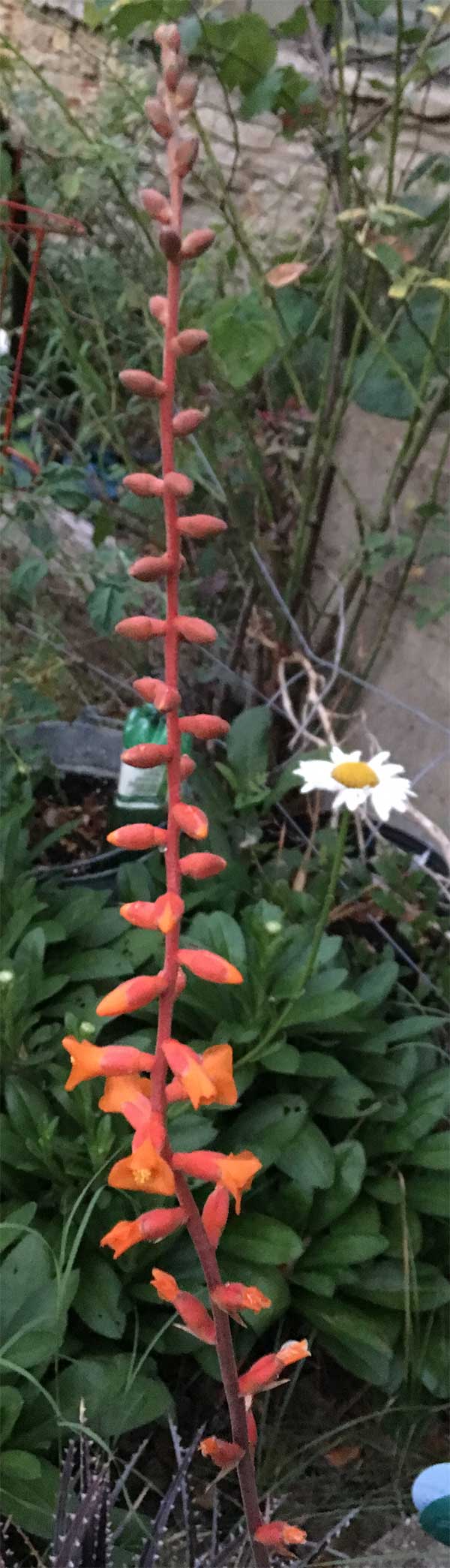
A surpriseThis flower greeted me Tuesday morning when I walked outside at 6 AM. I won’t even touch this plant, so it has survived through benign neglect. The points on the leaves are very painful, and with the way the plant grows, it’s hard to pick up without touching.

So, after seeing the bloom, a little research was in order. I thought it was a cactus of some type, but no, it’s a bromeliad. Well, guess that still puts it in the category of cactus and succulents. Who knew?

Brittle Star plant

In the dyeing department

Here are the results of the overdyeing with turquoise. Nice huh?

Turquoise overdye

In the weaving department

It’s slow-going with the piece on the loom. It’s got a lot of white rectangles on a black background, so I didn’t like the sawtooth effect of interlocking. That means it’s a slit kind of weaving, something I’m not enjoying very much. At first I tried not sewing them up, but when the pattern began in the middle of the piece, that was no longer an option. So now I’m weaving and sewing slits. How many inches can I do a day? This is not the week to find out, since I’m in a social whirl of a week.

In the miscellaneous department

This picture popped up on my Facebook recently. It’s from last year when the boys and I did some tie-dyeing. I still kind of like those socks!

Unfortunately, they’ve become too old to want to visit for two weeks now. You know, girls, etc. I knew it was going to happen, but I’m still sorry. Well, kind of. I really just want a vacation right now! It seems like I’ve been working really hard, but there’s not much to show for it.

Tie dye socks 2016

And since it was just Father’s Day, I thought I’d share this photo. This is my father with my daughter (the mother of the above big feet and tie-dyed socks). This is the essence of my father-kids and horses. He really loved to have all his family around, especially if he could also get in some horses along with them.

A mistake, but at least I caught it early

Mistake

Do you see it? The mistake. It had to come out because the dimensions of the piece would be affected.

Despite having to take out an inch and a half of the black and white piece, one of my goals for the week was to actually take scissors in hand and cut into the Color-aid paper. The design above is not what I started out to do, but I found that once I had some shapes cut out, it was fun to move them around and see what would happen if

I kind of like it; maybe I’ll weave it.

Design with Color-aid paper

Commitments, commitments

Something else that I committed to for the week was to finally overdye the rest of the greens with turquoise. (I did the overdye with blue weeks ago.) I’m not sure that these greens are going to be a great deal different from the ones overdyed with blue. Anyone need some really pretty greens?

Green samples

Results

Finishing

Because of several upcoming events, I need to get to the finish work, steaming, making hanging boards, Velcro, etc. so that they can be photographed. So this is my day: weave a few hours, do finish work a few hours. At one time I timed the finish work, just to get an idea of how much time to estimate for a job. I have since forgotten that number, but maybe I’ll do it again.

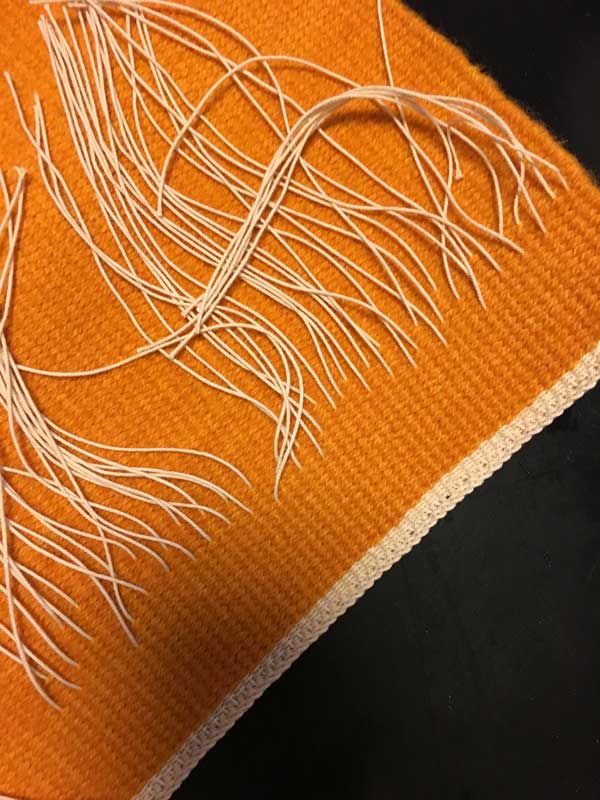
However, I think I’ve finally decided on the type of finish to do now. Everything has been tried, but I’ve settled. While on the loom, I do one round of soumak, then six picks of warp, reversing that when I’ve come to the end of the weaving. Then I do a woven edge, using five warps. This leaves the ends up towards the body of the piece. Then those ends have to be needle woven in.

Getting started. The right side has the woven edge done.

Needle woven into the piece.


A weaving conference Texas style

Shopping at the RedFish booth

This past week was a busy one with learning, visiting with friends, shopping, and listening to inspiring talks. The biennial weaving conference of Contemporary Handweavers of Texas was held in Sugar Land, Texas, a place I’ve never been, even though I’ve heard of it all my life. It’s close to Houston, an area I avoid–traffic, you know.

Wedge weave/4-selvedge

Wedge weave

As soon as I heard about the workshops for this year’s conference, I knew I had to go. I may have mentioned my attempts at wedge weave a time or two, so Michael Rhode‘s class of wedge weave/four-selvedge weaving was a must. Wouldn’t you know it, though…I left my loom at home. Thank goodness Michael had some frame looms for sale, quite nicely designed too. Turns out I was doing wedge weave correctly but I need lots more practice. One of them problems was not leaving enough weft before beating down. Michael brought many of his own pieces for us to examine. He’s an excellent teacher.

Wedge weave

Color

Mary Zicafoose was teaching several classes, so I took a couple. One was using Color-Aid papers to do some color exercises. Now I’ve had a set of these papers for years, but have only used them once to design. After all they are expensive, and I certainly don’t want to get them out of order. You realize how silly that is, right? So, my goal is to actually use my papers and practice putting those scissors into them and cutting. Maybe try designing a bit.

Mary also did a seminar on symbols, which is something that I love. I can’t tell you how many books I have on symbols. So, more inspiration there, and a desire to go back to those symbols.

The theme

The conference theme is Connecting Threads, Crossing Cultures. Deborah Chandler , who has spent a great portion of her life working with weavers in Guatemala, gave a great keynote talk about this topic. On another evening, Mary talked about her first connection to textiles, expanding farther to textiles in many cultures with most of the photos from her own travels. Michael gave the closing speech, but I’m sorry to say I missed that one. However, he too has done much travel and seen weaving in many countries.


Deciding

Which Size


Which size?

So, here I am, just happily weaving along, when I reach a length that mathematically speaking is supposed to be pleasing to the human eye. That’s the drawing on the left. It was not pleasing to me, so back to the drawing board. I added enough inches to the drawing to equal a dynamic rectangle size. That one pleased me, but I put it out on Facebook and Instagram. The majority agreed with me, so weaving continued.

By the way, since the first drawing seems to be in the land of the missing, I scanned the photo, increased the canvas size to add the simulated inches, then filled in with color. This solution came to me during my morning walk.

While doing the weaving, I filled my quill and measured to see how much weaving this quill could handle. The piece is 36 inches wide and this filled quill wove three inches. My bobbins for the other shuttle will only weave about an inch, so this is a good thing.

Filled quill

The piece is off the loom, the warp is ready for the next project, a black and white piece. Below is a picture of just a bit of the mess around my loom bench, times three. Why times three? Because this image is representative of the studio clean up that has to happen, if sanity is to stay intact.

The mess


Butterfly Weed

More morning walk

Above is a picture I love, but it was not taken during my morning walk. Below is the morning walk picture. The consensus is that these are puffballs.

Puffballs


Color changes and walks

Coreopsis

Morning musings

I hate to even say this out loud, so to speak, but I’ve started doing some walking–don’t want to jinx it. Many years ago, I walked 5 miles a day, and it was wonderful. All kinds of inspiration and problem solving happened during those walks. I have used the excuse that my knee hurts not to walk, but after the trip to London, where we walked for miles and went up and down stairs in the Underground, that can’t be an excuse anymore. Now, it’s time to increase distance.

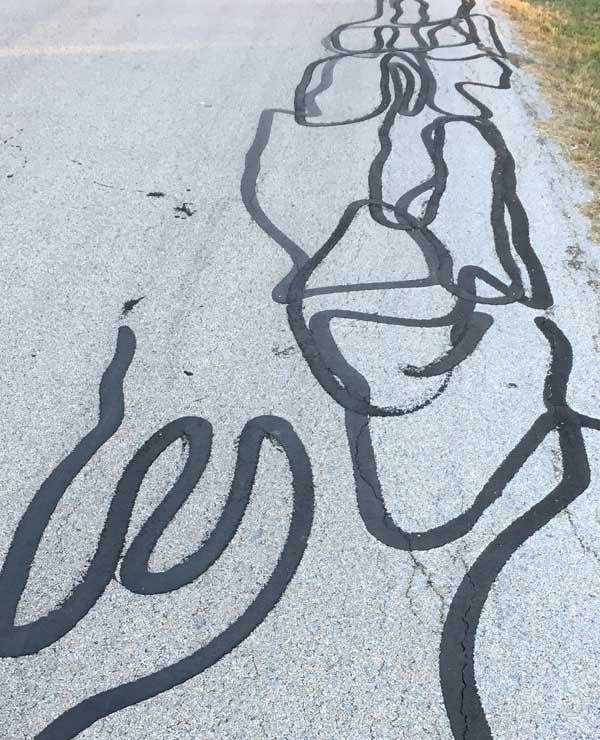
Stops for snapping pics with my phone is also happening. These street repairs always fascinate me. Surely I can figure out some way to use those. Street writing. The coreopsis above are one of my favorite wildflowers. Of course, the fact that these have yellow and red might be a factor. The balled up yarns from last week?

Street art

Back to the weaving

I’m trying to finish up the piece on the loom by the end of the month, and I’m ahead of schedule. However, I still haven’t dyed the yarn for next month’s project. That has to get done this week.

The beginning of this piece was posted last week, and here’s another part. 

Another section

With all the color changes, there are ends to weave in. I prefer to do them while on the loom.

Ends

Walking elsewhere

Purple Clover

These beauties are at the Fort Worth Botanical Gardens and Botanical Research Institute of Texas. The beds may be shared by the two organization, but I’m not sure. BRIT has a prairie planted on one side of its building, and these are native plants.