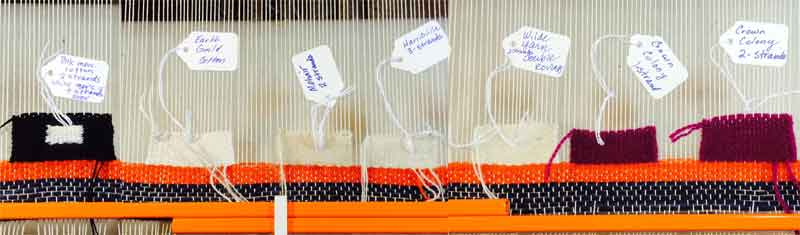
 Now that I’ve put a new warp on the loom at a different sett, I’m testing weft yarns. You can see the testing above. I put string labels on the different bits so that I could remember what the yarns are later. Starting from the right is my regular Crown Colony from Henry’s Attic, far right is 2 strands used together, then 1 strand next to it on the left. I’m testing some Wilde Yarn double roving, Harrisville singles, my own mohair, some cottons, Mobelatta, and and another that I don’t remember what it’s called. After I finish with these samples, I am going to go ahead and start weaving–after I make a couple of warp adjustments.
Category Archives: Materials


Proper–y’all come
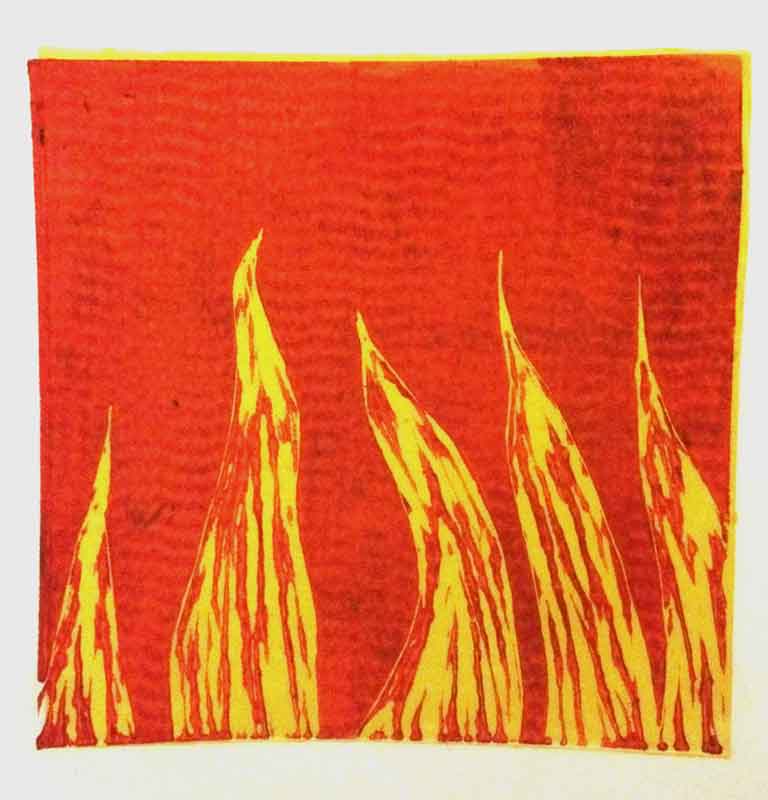
 Proper on Magnolia hangs art, choosing new art every two months. So that’s where I’m hanging out through March. There will be a small reception Thursday, February 5, 7:00 PM.
Above is a simulation (since I couldn’t get a good picture) of the pieces hanging on the wall. In Fort Worth, we have two up and coming streets that are THE place to be–Magnolia and West Seventh. Both have lots of new restaurants, bars and other nice places to hang out. Magnolia is an old street with lots of two-story red brick buildings. I’ve long thought about using one of those buildings to have a studio. Well, not any more. Real estate in that area has exploded.
These pieces couldn’t be hung in the usual way, since nails could not be used. They have a rail at the top with some sort of covered wire that hangs from the rail. At the end of the wire is a hook that slides up or down as necessary. So, I put D-rings on the back of the boards, but I now wish I had put screw eyes on the top of the board because I think they would hang better that way. Live and learn, as they say.
Tangled Velcro
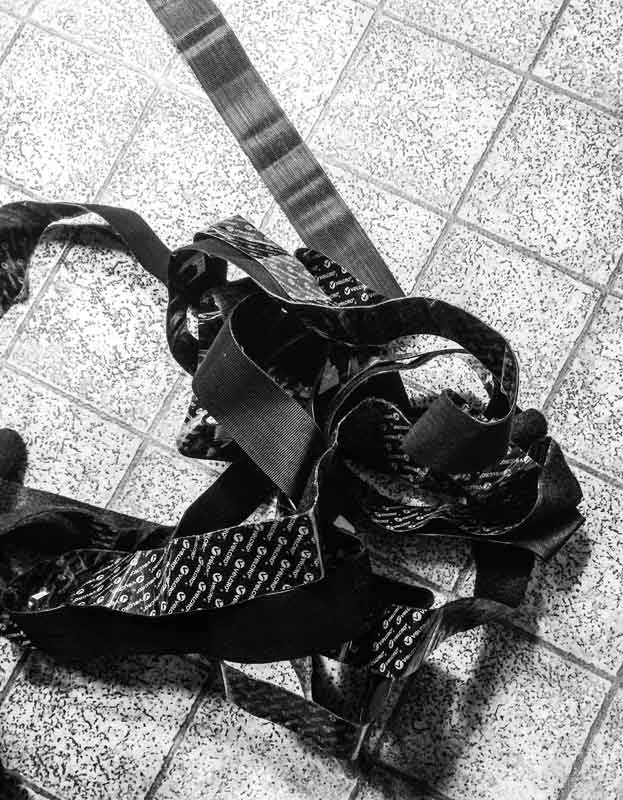
The piece on the left has always hung vertically, but I decided to change that up. Doing that means cutting a new board and attaching Velcro. Someday I’m actually going to order Velcro from Uline, because you can get just the hook part. You can see my Velcro mess here. You would think it would be simple, but it took a bit to get this mess untangled.
In between doing other things, I have warped the Mirrix and have begun testing some yarns. Thinking about making a change. I’ll post pictures next time.
The perils of warping
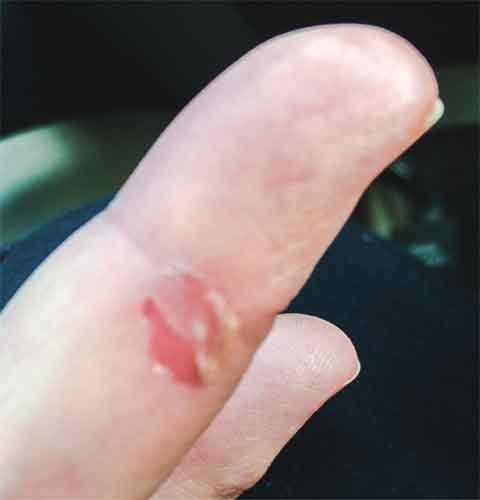 I’m really not making a rude sign in this picture. In the middle of retying the linen warp for the next project, I noticed this big friction blister that had already had the skin rubbed off. This warp had so many problems that I investigated ways to warp differently. Katie Reeder Meek’s book Warping with a Trapeze and Dance With Your Loom came to mind first. Here’s a bit about her technique from a participant in one of her workshops. Purrington makes a trapeze that fits all looms. I also read some articles about a “warping valet, which is kind of the same principle as the trapeze. Warped for Good is a blog that has pictures and a video. She also has an Etsy shop.
Laura Fry has several posts on her blog about her “warping valet.” I’m going to peruse all of those more closely if the new tie-on doesn’t solve my problems. So far the warp looks good, with no loose ends drooping down in slackness. It’s going to be a while before weaving starts because the next piece is going to be ikat, and that requires tying, dyeing, and untying. I’m looking forward to weaving it though.
Now for the good news about this linen warp–I really like the heft it gives to the finished piece and the sheen and the smoothness (sometimes called slippery by me) of the yarn. Ends will be woven in today.
In the fiber world
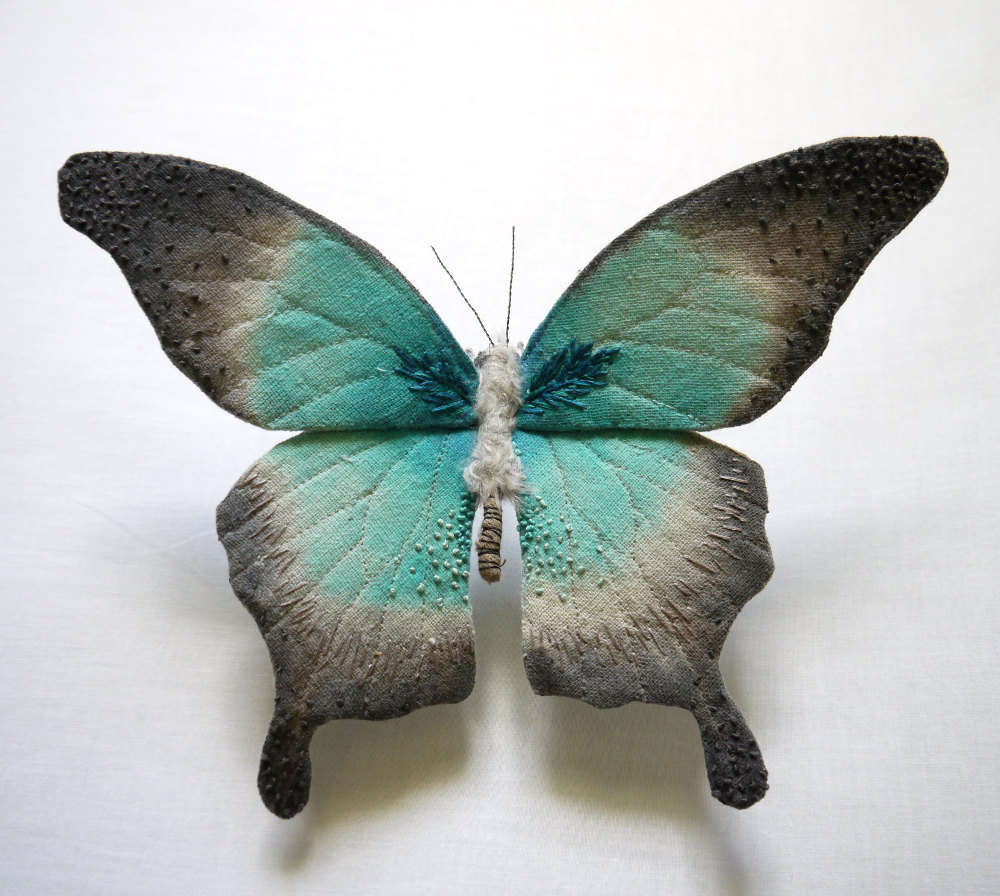
It seems that lately I’ve seen some interesting and beautiful objects of fiber. One is a woven shelter by Abeer Seikaly. On his website there are many pictures of the shelter from the outside and inside, in the desert and in the snow. There are also diagrams showing the structure. The diagrams remind me of those honeycomb tissue paper decorations of snowballs. I want one in my yard!
The wonderful fiber insects by Yumi Okita are beautiful! The one pictured on the left has the materials in the caption–hand painted fabric. Look how those colors blend into the next. The link above takes you to an Etsy store that’s on vacation, but that’s the only link I could find for her. Perhaps it’s closed because everything has been sold Here’s her sold page. By the way, love the logo for her store! I want one of these too! Other places to see her creations are here, and here.
Erin Riley‘s tapestry process and time required for one piece of art are featured in this interview. Her landscapes not the usual tapestry subjects, but feature vehicles, highways and accidents. The piece Three Strikes is compelling for me, but I’m not sure why. Maybe it’s the anonymity of the characters, or perhaps it’s just the unusual subject matter. What do you think?
All of these works can be seen larger by going to the artists’ links. Take a look. You’ll be glad you did.
Ball winders
Progress was made on the current piece, but then a small disaster struck. My knee, which had been getting better, decided it didn’t want to do that. The earliest I could get an appointment with an orthopedist was next week. Back to the chair and ice packs. Weaving stopped, which brings me to ball winders.
I have had the same plastic ball winder since I first started to weave. It works, but my current weaving involves skeins that are about 1/2 pound each and hand-dyed. No matter what I do,
 they are more tangled than “store bought” skeins. That plastic ball winder works really hard and the plastic gears click and grind. I’ve been trying to decide on a new ball winder, and indecision means that no new ball winder comes to my door. I tried out the Strauch from Mohair and More during Fiber Fest. I like how sturdy it is, especially compared to the plastic ones, but wasn’t crazy about the orientation of the handle. So I did nothing with my decision-making. But
 now, because I am winding bunches of big skeins, the issue raised its ugly head again. Research again. Looked at comments on Ravelry and Weavolution. Fricke was mentioned (I had forgotten about them). And I took the plunge, jumped in with both feet. Nancy’s Knit Knacks to the rescue, or at least I hope so. It’s on its way! There is the option to put a motor on this gal, but with my tangled yarns? We’ll see.
Let’s weigh in on our favorite tools. Ball winders? Skein winders? Swifts?
Organized chaos

Lease stick holders from Hokett Would Work

This is how things looked after getting the warp on the beam and before tying to old warp.
I’m sure others can do this whole warping and tying on to an old warp in a much neater way. Maybe I’ll be able to do it also after another few dozen efforts, because I learn something NOT to do every time.
Before all the tying of warp ends, here’s what it looked like. A little less chaotic. The lease sticks had been inserted into the old warp and placed into the lease stick holders. Then the whole business of tying individual ends.

After all the ends are tied–total chaos!
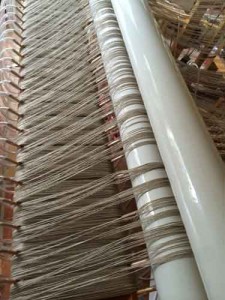
The linen is being used double and the old warp is single.
The tah dah moment after all the knots have passed through the heddles and reed. Doesn’t a warp look good on the warp beam coming over the back beam?
On and my careful calculations as for as warp needs? Wrong! But the error has been corrected for the future. My spreadsheet:
 So what did I learn this time?
Tying old warp to new
- Insert lease sticks while old warp is attached to apron rod and under tension
- Masking tape to hold ends down on lease sticks
- Use lease stick holders http://wouldworkifhewantedto.wordpress.com/2013/04/06/lease-stick-holders/
- Cut old warp in front of reed, knot in groups of 8
- Wind warp using warping wheel
- Wind extra end for each selvedge
- Trim ends of warp before taping ends to warp in section
- Tie each new end to old end
Had to add one last thing. Linen is very slippery. I had been told that but didn’t really consider it. This is the first warp that I’ve had that will just slip out of the heddles as you work on one of its neighbors!
Natural dyeing

Notes on dyeing with madder and osage.
I spent way too much time on Saturday searching for plants and/or seeds for natural dyeing. Long ago I bought madder plants from Richter Seeds in Canada. The madder plants did very well until the drought. Richter’s no long has madder plants or seeds, and evidently no one has plants. Looks as though I’ll have to start some from seeds myself. I’ve grown weld from seed relatively easily, but the leaves of the weld plant are used for dyeing. With madder, the roots are used, and it takes several years for them to get to a good size to harvest. So, is it worth it to grow them from seed?
I’ve also wanted to grow indigo, another plant to start from seed. I ran across a Donna Hardy’s blog about growing indigo in South Carolina, where there was an indigo industry a century ago. Until I read the blog, I had no idea that indigo could get so tall–9-10 feet! Botanical Colors is hosting a 3-day indigo retreat in Charleston, South Carolina. Check it out here. Donna is a part of the retreat. Botanical Colors has some interesting topics in their blog also.
Something I ran across while trying to find dye plants and seeds is this article from the NYTimes. Check it out. It includes many pictures with the article.

DFW Fiber Fest 2014

What’s on the loom
It was about this time last year, the time of DFW Fiber Fest, when I bought a new spinning wheel. I only wish I had known how stressful it would have been to put together. I had everything together but one pin that was supposed to go through the
 hub of the wheel and a hole in the crank (or whatever that’s called). I could not get it to go in. I finally had to put it aside because of all the other stuff going on. And it stayed aside for a year. Until Saturday. I took the wheel and the very kind husband of the couple who own the shop, fixed it. And there was a special trick to it. So there!

I also took some fleeces to Gail of Ozark Carding Mill, so that she can turn it into roving. There’s something sad about this, though. After my fleeces (2 churro and 2 mohair) are prepared, the mill equipment will be dismantled. Although this mill has Ozark in it’s name, it is located in Oklahoma, not too far from the Texas border. I wish there was a mill in Texas. Gail was there as Gail’s Fiber Delights, and she does have some really beautiful fibers.
Now for part three of this Fiber Fest saga. I met a really nice couple who are the owners of Mohair and More.
 I was excited to see their booth because they had ball winders that I’ve been wanting to try out. These ball-winder guys are expensive, and I certainly did not want to spend a bucket of money for one without trying it out. They forgot their business cards, so I took a pic of a label on a swift. This particular swift is metal with pegs that slide for different sizes of skeins. If I didn’t like my squirrel cage so much, I’d be tempted.
