Record Keeping

Records_samples

records, samples

Even though I don’t always do it, I’m a big advocate of record keeping. Sometimes I can be compulsive about keeping records and sometimes not. Often I will have a sheet like the above with the yarn samples hanging out in all their glory, but then forget to put it in the notebook. I’ll find it weeks (or months) later when I finally clean off my design desk. I should collect the dye sheets and put them with the sample sheet in a plastic page protector, but you know what happens with shoulds.

Speaking of dye sheets, here is one of the two sheets used for the above yarns.

image

Spreadsheet

Before dyeing, the skeins are weighed and labeled with the weight and dye formula to be used. After dyeing, rinsing, and drying, the skeins have to be balled up at some point. The balls of yarn are also labeled, either with the same label of the dyebath, or with a string tag purchased at Office Depot. imageThere have been many times that those little tags have saved me. I find THE perfect color for a particular project, and thank goodness, it has a label with the dye formula! I am trying to get in the habit of weighing leftover balls with their new weight, but that’s a work in progress!

The Common Cold

image

imageMolecular surface of one variant of human

After days of thinking my allergies are really bad this year, I have decided that it’s not allergies but a cold. How can one get so confused? Well, my allergies really have been worse this year, the worst in many years. And, since I am doing a presentation to an art group about dyeing today, I started thinking about the possibility of common cold eradication. If it were even possible, would that be a good thing or a bad thing? Do we want to eliminate another species, even if it’s one that we don’t like? Would the elimination of all the viruses that cause the cold lead to other, worse viruses filling the void? Way too scientific for my little brain! All of this speculation did lead me to the Top Ten Incurable Diseases, though.

To get away from the cold and back to something even remotely related to weaving, here’s another “color wheel.” It is from Joel Wolfrom. You can find this and a lesson to go with it here. I’m not a quilter, but I bought one of her books many moons ago and love it. Unfortunately, I don’t know where it is. Maybe when I finish organizing my shelves? I’m trying to restore order a little bit at a time, scheduling time every afternoon to work on the organization problem. But, for now, I am heading to the studio.

image

Fiery Pool:The Maya and the Mythic Sea

Note: Since this was written, many of the links for the images no longer functioned, so I have removed the images and added links to sites where they can be seen.

We went to the Kimbell Friday to see the Maya exhibit. It is probably the best Maya exhibit I have ever seen, and I’ve seen a few! There were many items of interest. I included the Crocodile Effigy (scroll down to see an image on this site) below because I always love the primitive quality of animals in pre-Columbian art and because of the coloring. You can read about that below:

A symbol of the primordial world, this crocodile is scored to evoke the terrestrial surface cultivated by the ancient Maya. Serving as both a whistle and a rattle, the creature is painted with a stable pigment of indigo and clay known as Maya Blue. It is thought to have sacred associations.

Crocodile effigy, AD 700–800, Jaina Island, Mexico. Ceramic, 2 x 3 3/8 x 7 3/8 in. (5.1 x 8.5 x 18.7 cm). The Metropolitan Museum of Art, New York, The Michael C. Rockefeller Memorial Collection, Bequest of Nelson A. Rockefeller, 1979. Photograph © The Metropolitan Museum of Art

I love the elegance of the pelican below. And can you believe it’s from stucco?

This architectural ornament comes from Comalcalco, an ancient city near the swampy coast of the Gulf of Mexico where pelicans have long thrived. The naturalistic sculpture features an accurately rendered round head, narrow bill, and featherless throat pouch. The ancient Maya would certainly have noticed the pelican, the largest and arguably strangest-looking bird residing near the sea. This imposing sculpture most likely came from the elevated palace at the site, the “Great Acropolis,” and formed part of a watery tableau.

The jade sculpture below is the national treasure of Belize. It is carved from a very fine jade. In person it almost appears pearlized.

The Maya revered both objects obtained from the sea and materials transported over the sea, such as jade. Jade arrived in Maya centers via the sea and bore associations with that sacred domain. This head, the largest work of art in jade from the Maya world, depicts a deity with characteristics of the Sun God. It is made from stone quarried in the Motagua River Valley in western Guatemala and was probably transported north by canoe. The polished green surface of this sculpture suggests the blue-green waters of the Caribbean.

Part of the afternoon was spent in a workshop called Jade: More Precious than Gold. Here is a description of the workshop:

Discover the historic significance of Maya ritual garb adorned with symbolic materials. Rare and beautifully crafted artworks in the current exhibition will inspire wearable art fashioned with faux jade and turquoise.

I look forward to the next workshop with block printing and glyphs. And, if you’re interested, you can play the glyph game here (no longer available).

Since the focus of this exhibit is the influence of water on the Maya, I learned several ways that symbols depict water. They may end up being designs in the future!


Weaving letters

Some may remember my sad effort to weave letters several months ago. I readily admit that I was trying several things I’d never done before, but really ….! Definitely in need of more practice.Text_Nikon

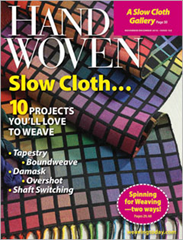
I got the most recent issue of Handwoven* on Sunday, and what do I see?

image

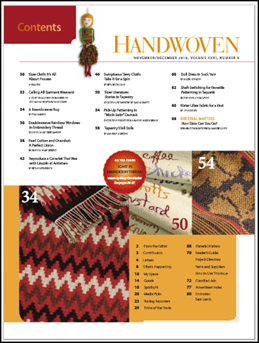
An article by Sarah Swett on weaving her grocery list. Of course, everything Sarah does is wonderful, and this is no exception. Wish I could show a picture here instead of the poor result of my weaving. I knew at the time that I wanted to try weaving letters again, but now I have more inspiration and few hints on how it should be done. In the small picture below you can see some of the tapestry letters in the center just to the right of the circle in the middle of the page. If you click on the Handwoven* link, it will take you to this page.

*Correction: The links currently will take you to the “buy” page for the digital edition.

image

Work in Progress

Square_2By the time this is posted, the plan is to have the weaving of piece two, in the series of three, finished. I took a picture of the work in progress with an interesting result. Below the breast beam, where the current piece hangs out during the weaving, the first piece is also visible on the cloth beam. The third piece is still being tweaked in design and color choices. As aside, my new camera is wonderful! The most important criteria for me is color, and the pictures that I take with this camera do not seem to need any fiddly stuff done to get the color right. A true pleasure. Now, if I could just learn what all the buttons are for!

Recently while thumbing through an issue of Martha Stewart’s Living magazine (maybe October?), I noticed a photo of an apartment hallway lined with these prints of Albers’s paintings. Here is a photo of the apartment in progress and below the final result. They make quite a statement.


A pile of color

Pile of color

For the last couple of weeks before my trip to Charlotte, I spent a lot of time with the dyepots. I love looking at all the colors after a dye session. All of the colors above were created with Sabraset dyes from ProChem. The usual dye formula is to use a 1% ratio of dye to the weight of goods. In this case I was taking that 1% and dividing it among the two colors that I was mixing, in this case violet and scarlet.

image image


As you can see, the colors on the bottom gradually change from more violet to more scarlet. the colors in the center are all scarlet, but the percentage of the dye to the weight of the wool changed. On the left is a 1% dyeing, then .0075, .005, etc. I obviously didn’t plan this picture well because the oranges are mixed in everywhere, but I did the same with them. The oranges are mixed with the scarlet and sun yellow. I am emphasizing the color names for the red and yellow because there is also a deep red and a mustard yellow, both of which are my favorites.

image

 image


image image


I will spend a few evenings watching mindless TV and winding the skeins into balls, carefully labeling each one with its formula. Having all this color in one place makes my day sunnier!

Panache Magazine

image

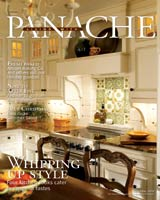
The online version of Panache magazine has been posted. The print version will be delivered with Friday’s newspaper. Below is the blurb that goes with the magazine, including all of its links.

Check out our November issue featuring tips on where to pick up the best baked goods for holiday dinners and get-togethers. Get decorating ideas for revamping your kitchen. See Susan Huston’s fashion tips for turning office wardrobe into glamorous evening garb. Make plans to attend the Elvis-themed If I Can Dream Concert, benefiting the Summer Santa program. Learn what to plant right now in our fall gardening story. Read about what to do and see in Asheville, N.C. Get to know artisan Sherri Woodard Coffey, a local weaver who makes gorgeous handwoven rugs and tapestries.
Read more:
http://www.star-telegram.com/592#ixzz1314UQo1o

Another Kind of Art

Gaggle-of-ghosts

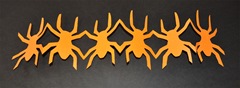
It seems that our family started a new tradition last year. I had a free subscription to Country Living magazine, and when the Halloween issue arrived, I was in hog, hmmm…Halloween heaven! So many ideas to try out with simple, easily found materials. This year I made a special effort to buy the Halloween issue before I traveled to Charlotte for a visit last week. The above gaggle of ghosts is made with those fold out honeycomb bells, construction paper facial features, and then covered with cheese cloth. The boys and I had experimented with paper cutting before and were excited to see these spiders. You can get the templates for the designs online. They’ve made it really easy!

SpidersThe fallen leaves would have made another great paper cut out like the spiders. A new take on cutting out paper dolls, something my grandmother was excellent at. My mother remembers her cutting out amazing things when she was a child, as do all of us grandchildren. You can read my mother’s remembrances here. She’s a very good writer.

Then, of course, there are the Halloween cookies to make. This year the whole process went much smoother. Amazing what a difference another year of maturity can make!Cookies2 Decorating-cookies A little fall gardening was being accomplished also. Here’s just one picture of a beautiful mum plant waiting its turn to be planted.Before

Wow! And I think tapestry is slow!

An unidentified man examines part of a mosaic, measureing around 9,700 square feet (900 square meters), in ruins of an 8th-century Islamic palace outside the West bank town of Jericho, Sunday, Oct. 10, 2010. Visitors to ancient Jericho are getting a rare glimpse at what archaeologists say is the largest carpet mosaic in the Middle East. AP Photo/Majdi Mohammed.

JERICHO (AP).- Visitors to ancient Jericho got a rare glimpse Sunday of a massive 1,200-year-old carpet mosaic measuring nearly 900 square meters (9,700 square feet), making it one of the largest in the Middle East. More ….

Art Attacks

If you could actually click on this image, the information below would pop up.image

What is an Art Attack?

Art Attack is a city-wide guerilla marketing campaign being launched by the Arts Council of Fort Worth and Tarrant County. Utilizing creative groups and individuals throughout the area, the campaign was created to promote the new online calendar being launched by the Arts Council, www.worthgoing.com. Throughout the campaign, Tarrant County can expect to see a number of artistic demonstrations that are completely unique and out of the box. image

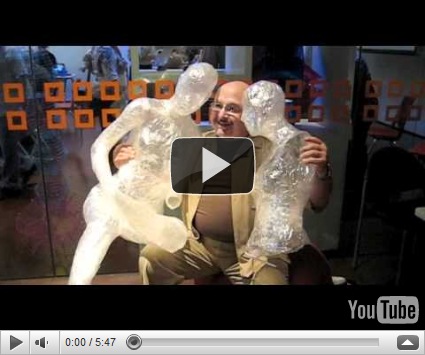
One of the Art Attacks includes a group of Tape People. Two of them are shown on this page. You can vote on the Tape People to win by going here. These were all designed and constructed by members of Art Educators of North imageTexas. Click on the link to see all of the Tape People. They are really quite wonderful.

Below is a YouTube video about their project. They say that they used a mile of packaging tape for this project.


<\/param><\/embed><\/object><\/div>“;” alt=”” />