More Soumak lines, warts and all

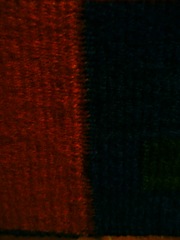
I have decided to set myself on a course of study within the parameters of things that I want to weave on the Mirrix. Below is a bad picture of some soumak lines.Soumak_lines

As you can see, there are a few problems with my practice so far—all fixable in the future, but not in this weaving. I’ll start with the vertical line in the center. First of all, there should be no gaps like what you see in the picture. Second, I forgot the direction of my wrap for the soumak and got a crooked line. On the left, there are two lines of soumak, back and forth. On the right, in the center of what should have been purple, there is a row of unlocked soumak, two picks of weft, then another row of unlocked soumak going the opposite direction. Now for my favorite one—the yellow triangle. I wove the angle, then a row of soumak along the angle. Kathe calls this soumak something on the order of the fixer because it hides the unevenness of the angle. That one row of soumak looked really good, and is something that I will use again, but then I decided to fill in the whole triangle with back and forth locked soumak. That section feels thicker, but really does not look thicker. The texture of that section is different from the rest of the cloth, though.

Just ordered three metal temples from Dawn MacFall. Better price than what I have paid before. I want to build up my size collection so that I can use a temple on each end of a piece (after cutting off the loom) to help with the draw in that results from needle weaving the ends back in to the cloth. I keep working on that, hoping that at some point I will have done the needle weaving and have a perfectly aligned piece! Yeah, like that’s gonna happen!

I am also seriously considering a skein winder from Crazy Monkey. I have been asked to dye some yarn for someone, so will need to make skeins. Skein-making is a seriously time-consuming task.

Website: http://sherriwoodardcoffey.com
Blog: http://sherriwoodardcoffey.blogspot.com/

Soumak

I’m getting a little bored with these squares, so I’m just going to get them done with as little fuss as possible. And I decided to experiment with a vertical line. From Kathe Todd-Hooker’s book Line in Tapestry, I found the vertical line section using soumak (page 46). Now, I have used soumak for ages, but usually as a base to start a piece and as a device to help hold the weft in place when it is cut off the loom. Also, since I am basically a rug weaver, I have not wanted areas of high texture, which might wear—probably not a problem since no one puts them on the floor anyway!

Below is a picture of the way I usually join a section with a dovetail. Since I weave across the whole of the cloth (not building up sections), each color goes around the “up” warp. Because of the weft going around the same warp thread, there is sometimes a problem with buildup in that area. To counteract that, I may alternate going around the common warp thread and NOT going around it, forming a teeny slit area. Dovetail

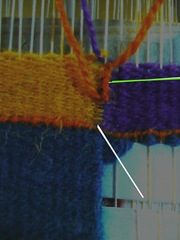
I decided to start my experiment with a vertical soumak line at the dovetail join area. In the picture below, the white line indicates the usual dovetail section. The green line shows the vertical soumak line. (You can also see the regular soumak line along the bottom edge of the color sections.) The orange yarn on the right is the tail of my starting spot, then the line, which looks just like a piece of yarn laying on the piece in this picture, then the tail of my working orange yarn. Right away I noticed a problem with doing soumak in this way—I have to remember direction. If you change the direction from which you go around the warp, you will get a wavy vertical line. At this point I don’t care about that, but it might be important later.

Dovetail_Line

This soumak could be fun, so I will experiment with some of the other soumak types while finishing these squares.

Website: http://sherriwoodardcoffey.com
Blog: http://sherriwoodardcoffey.blogspot.com/

Amy and her new Mirrix

IMG_0365

IMG_0363

Amy is a member of the Fort Worth Weavers Guild and a fairly new weaver (but you couldn’t tell it from the weaving she’s doing). She contacted me a couple of weeks ago about the Mirrix, and now she has her own brand-spanking new Mirrix 16-inch loom. While waiting for the heddles to arrive, she decided to do some bead weaving, which she has done before.  Below is a quote from Amy. As you can tell, she also had a little trouble with warping, but she has used a small loom before with some similarities.

OK so I figured out the warping for the Mirrix for bead weaving. It is very different from regular weaving. I really like it and am making some plans for bigger pieces, but the planning is complicated and going to take some time so I will start a regular weaving for a little purse and see how that goes. I do love this loom. It is just much more solid than …

Amy already has quite a collection of looms. We went to an estate sale of sorts to see some looms that had been closed up in the house for a few years. She got some real jewels from the son of the weaver.

Look at some of the bags that Amy has been making from all kinds of materials, including the bags that newspapers come in here. Here are some other weavings she has done. You can see larger pictures here.

image image

Here is Amy’s Facebook page.

I have been thinking about buying the heddles also, but will wait and see how Amy likes them.

Website: http://sherriwoodardcoffey.com

Blog: http://sherriwoodardcoffey.blogspot.com/

Blues

Blues I dyed blues on Monday and took a picture today. Even though I’m not happy with the picture, you can still get the idea. The ones I dyed are on the right, but in real life, the skeins are a really deep, rich blue. Usually, the standard is to mix a 1% solution for dyeing the yarn. In the picture above, the blues are, left to right, 1/2 of 1%, 1%, and 2%. My plan is to use the 2% yarn for an ikat project. After the pattern is wrapped, the overdye process will bring the unwrapped yarn to around 4%. I hope that won’t be too dark, but there are some things that just can’t be totally planned out in advance. I always think I can weigh my yarn in advance, wrap the ikat pattern, then weigh any remaining yarn, estimate the percentage of the yarn that is covered in ikat tape, and dye accordingly. So far, this has not been an exact science! But I keep trying…

I ran across this blog which has an article about Interactive Textiles. And then I read Lynne Bruning’s Weavezine article about clasped weft weaving with conductive thread and LEDs. Lynne is truly a “textile enchantress” and very generous with her help. She put me in contact with another weaver, Marie. All of this brings me to a new Weavolution group: eTextiles. I want to do some LED lights on a small piece on the Mirrix. Next week I will begin to search the resources and order some materials. Time, time, time!imageWhile poking around on Weavolution, I also discovered a dyeing group that will be using the  Munsell Student Color Set to train the eye to see colors and combine that with dyeing. At Convergence 2000, I took a master dye class with Michele Wipplinger of Earthues.

image The first part of the class was combined with Karren Brito (of Shibori fame) for the general discussion of color. We used the Munsell sheets to place the colors in the correct location. I learned that I can definitely use some practice in that area! The large group then broke up into two groups. I was in Michele’s natural dyeing group. After that workshop, I bought the student color set, but have yet to work with it. There is no answer key, but when I asked about that, Karren very wisely suggested that I place the color chips to the best of my ability, then come back the next day and check it, rearrange if necessary, before gluing down. I probably will get re-positional glue, if there is such a critter.

All in all, I’ve got a busy rest of the summer laid out!

Interesting flights

I flew to Charlotte today to deliver the boys back to their parents, definitely a bittersweet event. After meeting their parents in the airport, I then went through security again and caught my flight back to Texas. I really don’t mind waiting in airports. I’ve always got something to read and frequently take my sketchbook “just in case.” Both of the flights today were full. I have a vague recollection of flights with empty seats, but that’s a thing of the past. The lady across the aisle from me caught my attention because of the book she was reading, One Thousand White Women. A friend told me about this book years ago, and I found it to be a very interesting read. Below is a partial review from the Amazon page. What I found so astounding is that it reads like a true story. I had to keep reminding myself that the book is fiction. Anyway, the lady was reading this book for her book club, and we struck up a conversation, not the kind where you’re talking all the time, just occasional bits and pieces, the best kind to have with strangers.image

From Kirkus Reviews

Long, brisk, charming first novel about an 1875 treaty between Ulysses S. Grant and Little Wolf, chief of the Cheyenne nation, by the sports reporter and author of the memoir A Hunter’s Road (1992). Little Wolf comes to Washington and suggests to President Grant that peace between the Whites and Cheyenne could be established if the Cheyenne were given white women as wives, and that the tribe would agree to raise the children from such unions. The thought of miscegenation naturally enough astounds Grant, but he sees a certain wisdom in trading 1,000 white women for 1,000 horses, and he secretly approves the Brides For Indians treaty. He recruits women from jails, penitentiaries, debtors’ prisons, and mental institution, soffering full pardons or unconditional release.

When I arrived to my seat on the return flight (which was extremely slow in boarding because of all the carry-on luggage), an older couple was sitting in my seat. Them seemed a little confused when I told them that my seat was D, but I attributed that to maybe being a little confused about flying. This is one of those times when I could kick myself. At the end of the flight, and their naps, I noticed the gentleman looking at his tickets. So I casually asked where they were going. He told me he didn’t speak English, so I asked in Spanish. He beamed and said they were going to Phoenix, that his son lived there, that they’d left at 5 AM from South America, Quito. What a missed opportunity! We could have been having casual conversation also, but this time in Spanish! Quito is one of those places where I want to go someday, along with Perú. Oh, well…

Time to get back to normal around here—clean up toothpaste spills, go to the grocery store, etc. And of course some weaving. I’ll have pictures of the beautiful skeins of blue tomorrow or the next day.

From Soup to Nuts…

image Traditional West African Tie-Dye 401F, 401SA

from the HGA website

Instructor: Gasali Adeyemo

Learn to tie-dye in the West African tradition of Yoruba adire as you create a design known as “pigeon eyes” using cloth, dyes, and raffia.

In case you haven’t noticed, there is so much on the internet one could get seriously lost. From HGA on Twitter, I read about Abigail Doan, a fiber installation artist. Check out her interesting work here. One picture of her work is below.

imageAlso from HGA newsletter comes the news about the Art Sparks at Convergence. These look really interesting. Short one hour classes classes of hands-on learning with a carry-away product. There are several that I would love to take, but I’m most interested in the African tie dye (pictured at the top of this post) and the Shiva Paintsticks.

I also ran across this post about beating the post exhibition blues, but it seems that these ideas would work for any period of extreme activity and the let down that follows. That may not be a problem for others, but I always have that let down, and it takes a day or two to get back in the swing of things. That’s one reason that I always try to have the warp tied on immediately after cutting off and the next project planned. And I know that when the boys go home to North Carolina, there will be that let-down period. The trick is to make it as short as possible. In this particular case, we have had a really good visit and lots of fun. It’s interesting, that with all of the special things we did, the “best part” as stated by the oldest, is getting to be with family and play in the pool at Great-grandmother’s birthday party. Can’t get much better than that!

image My son and daughter-in-law live in Flagstaff where they are having huge fires. It seems that the second fire has now consumed 14,000 acres. As my DIL says, it better the the camping trip of a lifetime because no one will be camping there for years. Don’t people think? Was I just raised with extreme caution? Fire moves fast. What about pouring water over your coals? I just don’t get it.

Weaving and dyeing

June21_squares In this picture, strips of index cards are holding the spaces that will not be woven. This really does not work very well, so I am going to try cutting a couple of pieces of cardboard to hold the space. Or maybe plastic bag strips, something that will be “gripped” better by the warp. By the way, has anyone bought index cards lately? They’re now only slightly heavier than copy paper. Very disappointing. I would be interested in knowing what others do to hold space in a weft-faced weave structure. Ideas, anyone?

You can see my marking of space with the Sharpie (think I misspelled this yesterday), which I do instead of using a cartoon. The square above the blue one is going to have wavy diagonal stripes. I might practice clipping a cartoon on with that section so that I can see what works best for me from all of the suggestions that I posted yesterday.

I got some blues dyed yesterday. I decided to use a 2% formula for these yarns that I will then use for ikat. When I overdye, I am hoping that the tied portion will be a good 2% while the overdyed portion will be an even more intense blue. When I dyed the yarns for Peruvian Mask,
I had to try several formulas to get the colors that I wanted. I ended up using a 2.5% red and a 4% red.

How do you keep your cartoon in place? I forgot to ask that in yesterday’s post. I also meant to look up the link for rare earth magnets. Here it is.

Sherri Woodard Coffey

Blog

Website

Cartoons

June21_squares

On my large loom where most of my work is done, I don’t usually use a cartoon. Everything is drawn to scale on graph paper, and I work from that. I also mark lines and shapes with a Sharpee, as seen above. Occasionally, with curvy pieces, I find that a cartoon is more practical, but I still just hold a small portion of the total design in place and mark with the Sharpee pen. With some of the pieces that I plan to do on the Mirrix, a cartoon will be necessary. So, I was glad that the topic came up on the Yahoo group. I have found that weavers use lace, vellum, or interfacing to draw the cartoon in order to make it sturdy enough to stitch onto the warp. Other ideas for attaching the cartoon:

From Lany:

I’ve found binder clips (in various sizes) to be the duct tape of tapestry.  I’ve also used lapel pins and earrings (pierced, no dangles) to hold things in place.

Many years ago when I first started weaving and I still do on my Shannock I hold the cartoon ion lace with wine corks and thumbtacks.  With my designs I really need to keep the cartoon where I can see the outlines and make sure there is no shifting of the cartoon. I have never found a method that holds better then stitching through the vellum I use for my cartoons.

From Karen King of Aubusson House:

Someon in this discussion mentioned the problem of attaching cartoons on a mirrix loom.  I have been using rare earth magnets, which can hold a cartoon to the inside of the upper  or lower beams, or when used in pairs can hold a cartoon directly to the weaving.

I bought the 1/4 inch from Lee Valley Tools.  I have the 1/2 inch for my big loom, but you need strong fingers to use that size.

From Shelley

One of the things I do to help me with my cartoon is I pin it to the hem.. Carpet pins are great.. Recently I have been using packing tape on my transparencies to stabilize the weave structure before I pin the cartoon to the piece..

From Kathe

I can’t get my fingers between the two warps either without messing everything up. I stick something solid- half inch  thick  a piece of 1×6- between the two  front and back warps-not sheds  and use a curved needle. It isn’t the easiest thing to do, but it gets easier with practice.  If it’s a particular bad day I can use the board to shove the cartoon against the back of the tapestry so I can catch it with the curved needle. The board gives me something solid to push the curved needle against as it grabs the distance of the stitch. . I also  use really big curved needles because I have trouble with one finger grabbing and holding tight as I grab the curved needle. My longest part of the stitch is on the back, which is easier then doing all the smaller stitches evenly.

I have been known to start the stitching through a button and use the little clippers that you find at homed depot to hold the cartoon in place while I start the stitching.

Bottom line—we all have to find what works best for us. At least these ideas are a starting point for finding out what what method might be best.

I definitely plan on buying Kathe’s book So Warped.

image

I think it will have much useful information. And, as we know, I’ve definitely got a warping problem when it comes to the continuous kind! I couldn’t get the web page to load this morning, but do a search for Fine Fiber Press to find the book.

Back to normal—soon

I have had two young visitors for the last week. I planned some interesting activities for us to do, but I forgot just how busy little ones are. Silly me! I thought I’d be able to squeeze in a few weaving activities, but have not even been able to think about designs.

Saturday was an especially busy day. Since it was my mother’s birthday, we had a pool party with all the generations of cousins. I can’t keep up with first, second, or even once-removed cousins. All I know is that the cousins have toddlers now, and all the generations had fun in the pool.

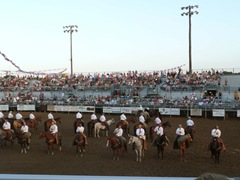
The Parker County Posse has had a rodeo for more years than I can remember. Each year, at the last performance, they honor members who have died the previous year. The memorial includes a riderless horse being led out into the arena by one of the members while the other members are “at attention” on their horses. My father was one of the  five honored with this memorial this year.

Memorial

Memorial2

The whole family went to the rodeo, the first time in many, many years for most of us. I was prepared for the boys to be bored with the events, but they loved it! They even went into the arena to participate in the calf scramble and the goat scramble.  CalfScrambleThey then thought they were ready for the mechanical bull and mutton busting!


My son-in-law sent me this picture. While having a hamburger at 11:30 PM, I explained this concept to the children.

image

A Great Day

image

We went to the MOLA today, Fort Worth’s new Museum of Living Art, otherwise know as a herpetarium. It’s a really great space with exhibits that are very well done. The boys asked what were my favorite animals, and I have to admit that the Komodo Dragon 

Komodo-dragon

and leaf frog  were my favorites. When the leaf frog is among dead leaves it is very hard to find.

image

It was challenging to find many of the camouflaged animals in their habitat settings. While we were there, one of the workers had a Woma python 

Python

out for the guests to touch. She said that a different animal would be displayed in this way about every hour or two.

After a lunch at home and a “quiet” time, we went to see the new Karate Kid.

image

I loved this movie! I was not expecting to enjoy it, especially since it is 2 1/2 hours long. I generally think anything more than 1 1/2 hour is too long, but this one moved fast and was interesting because the setting is in China. It has several good lessons embedded in the plot, of course, just as the old Karate Kid did. I had to do a little research on the origins of karate, kung fu, and tae kwon do, since this movie is really about kung fu. So, educational purposes, karate is from Okinawa, kung fu is Chinese, and tae kwon do is from Korea.