 I have small houseguests for the rest of the week, so will be taking a small weaving break. Instead I will be doing things like finding cardboard to make Ancient Greek props, going to the pool, seeing kids’ movies (who knew there were so many new ones right now), discovering the new MOLA herpetarium (and seeing Iggy), and going to the Museum of Science and History for the Da Vinci exhibit. I’m hoping to squeeze in a little time for measuring ikat and other small weaving work, but if you remember, children are quite busy all the time. Plus, the boys have been asking to weave, so will need to get the little loom set up. A busy week!
Friday Workshop
Joshua Reynolds, British (English) (1723–1792)
Portrait of a Woman, Possibly Elizabeth Warren
1759
Oil on canvas
93-3/4 x 58-1/4 in. (238.1 x 147.8 cm)
ACF 1961.02
Since there is no special exhibit at the Kimbell currently, the permanent collection is displayed all over the museum. All of the images here are from the Kimbell. The Friday workshop was about fashion as depicted in selected works in the permanent collection, and, as usual, was a great workshop. A guided tour by one of the wonderful docents gave our group information about the dress of the day from the fabrics used to the construction of the garments.
George Romney, British (English) (1734–1802)
Portrait of Mrs. Andrew Reid
c. l780–88
Oil on canvas
91-7/8 x 56-3/4 in. (233.4 x 144.2 cm)
ACF 1957.03


Frederic Leighton, British (English) (1830–1896)
Portrait of May Sartoris
c. 1860
Oil on canvas
59-7/8 x 35-1/2 in. (152.1 x 90.2 cm)
ACF 1964.03
Henri Matisse, French (1869–1954)
L’Asie (Asia)
1946
Oil on canvas
45-3/4 x 32 in. (116.2 x 81.3 cm)
AP 1993.01

This is one of my favorite Matisse portraits. I love the textiles and the bright colors.
The way the workshop was set up, we all met in the auditorium for an overview of the museum visit, then broke up into groups with a docent, and ended with the actual art project. Each person was to choose one the works of art, sketch it on paper, use gouache paints on our sketches, then use wonderful decorative papers to collage our own “works of art.” Instead of choosing one of the beautiful paintings shown here, I chose a colorless statue to sketch. (I believe that it is possible to tell which is the statue and the sketch without further explanation!

Attributed to Gian Cristoforo Romano, Italian (c. 1465–1512)
Portrait of a Woman, Probably Isabella d’Este
c. 1500
Terracotta, formerly polychromed
21-3/8 x 21-1/2 in. (54.3 x 54.6 cm)
AP 2004.01
I didn’t like the paper that I chose or method of applying the paper that I used, so I removed the paper from the sleeves when I got home. I will try again later with collage. I also did not paint my drawing accurately for the time, but, hey, it’s my sketch, right?
If you would like to see some good collage, look here at the work of Elizabeth St. Hilaire Nelson. I really like her work and plan to own one someday.
In weaving news, the latest piece has been cut off the loom. I have three weft-faced ikat pieces planned, which will take care of the remaining warp on the loom. At least I hope my calculations are correct! I spent some time at FedEx Office (formerly Kinko’s) making an enlargement of one of the patterns that will be used. I find that I will need to do a little dyeing for one section of the ikat before I can measure and tie.
Black Cloth Dolls

I recently read this book by Earlene Fowler. The main character is Benni Harper, a quilt expert who is head of a quilt museum in a fictional (I think) town in the central coast area of California. In this particular book, the plot centers around possible race issues and features a group of African-American quilters and black cloth dolls. I always find the subtle historical references interesting and was pleased to find the website and a source for information about black cloth dolls at the end of the book. Even though I don’t quilt, I own several old quilts, both bought and quilted for me by my aunts. All are the more traditional quilt designs that have been around forever. The ones quilted by my aunts contain many pieces of fabric from my childhood clothes—a visit down memory lane!
 You’ve heard that motto, “You’ve come a long way, baby.” Take a look at the slide show of women’s fashion over the years. When I look at the obituaries in the morning paper, I can often guess the women’s ages by their hair styles. It would be interesting to see a slide show of only hair styles over the years.
I am now going to work on designs for the afternoon. Once I get that done, I will know how wide the next warp should be. I estimate that I am going to be able to weave 2.5 pieces on the warp that remains on the loom. Gotta plan that 0.5 piece!
Working Small
 Peruvian Mask, hand-dyed wool tapestry, 47 x 79.5 inches
I’m a rug weaver. Or at least, that’s what I started out weaving, but nobody will put them on the floor. And rugs are big—at least 36 x 60 inches. So I’ve started trying to think smaller, but for me, that still means about 30 x 30 inches. Today while weaving on the Mirrix, I was thinking about how different it is to weave in a small format. The logical part of my brain doesn’t think it should make any difference, but it does. All movements are small and constrained compared to weaving on my large horizontal loom. I am not saying that’s a bad thing, but it is an adjustment. The Peruvian Mask piece at the top of the page is big. I had many more butterflies going than I usually do, and I was standing while weaving, just trying to get this one finished. This one talked to me until I wove it, but I though I’d never get it finished. Of course, the fact that some health-related, family issues were happening at the same time didn’t help!
Now, for a total change of subject—did you think you’d ever hear the words “Elton John sings at Rush Limbaugh’s wedding” used in a sentence? Evidently, it’s true. He’s 59, she’s 33, hmmm… it’s like coming from different countries.
Creativity–I love the creativity and innovation that artists have. Take a look at the jewelry of Kate Cusack, if you haven’t already. Zippers! What I want to know is where she finds metal zippers!
And from Eye/Hand you have these Oaxacan Wonders.


I have a couple of these that I bought in Oaxaca many years ago. Mine are not the mythical creatures shown here, but the common, everyday animals made mythical with their bright colors and geometric designs. The ones show here are by Jacobo Angeles Ojeda and Maria del Carmen Mendoza Mendez.
Trapezoidal Cube?

It seems that I am weaving a trapezoidal cube, which I’m sure is not possible, but we’ll see. Maybe I can call it a freeform cube. At any rate the above is my current experimentation with the Mirrix. The turquoise oval is made using 2 strands of Paternayan yarn. It is amazing to me how different yarns weave. The Paternayan yarn seems to have a mind of its own. Since this is the first time for using this yarn, I am not sure if there are different varieties of the brand or not. The small square is woven of some cotton that I found at Joann’s. I have also woven in some index card strips to the left of this trapezoid to hold the empty space for what is going above.
It will be time to advance the warp, so I am hoping that, finally, I have a correct warp in place. The picture on the right is the one that I’m working with now. Fingers crossed!

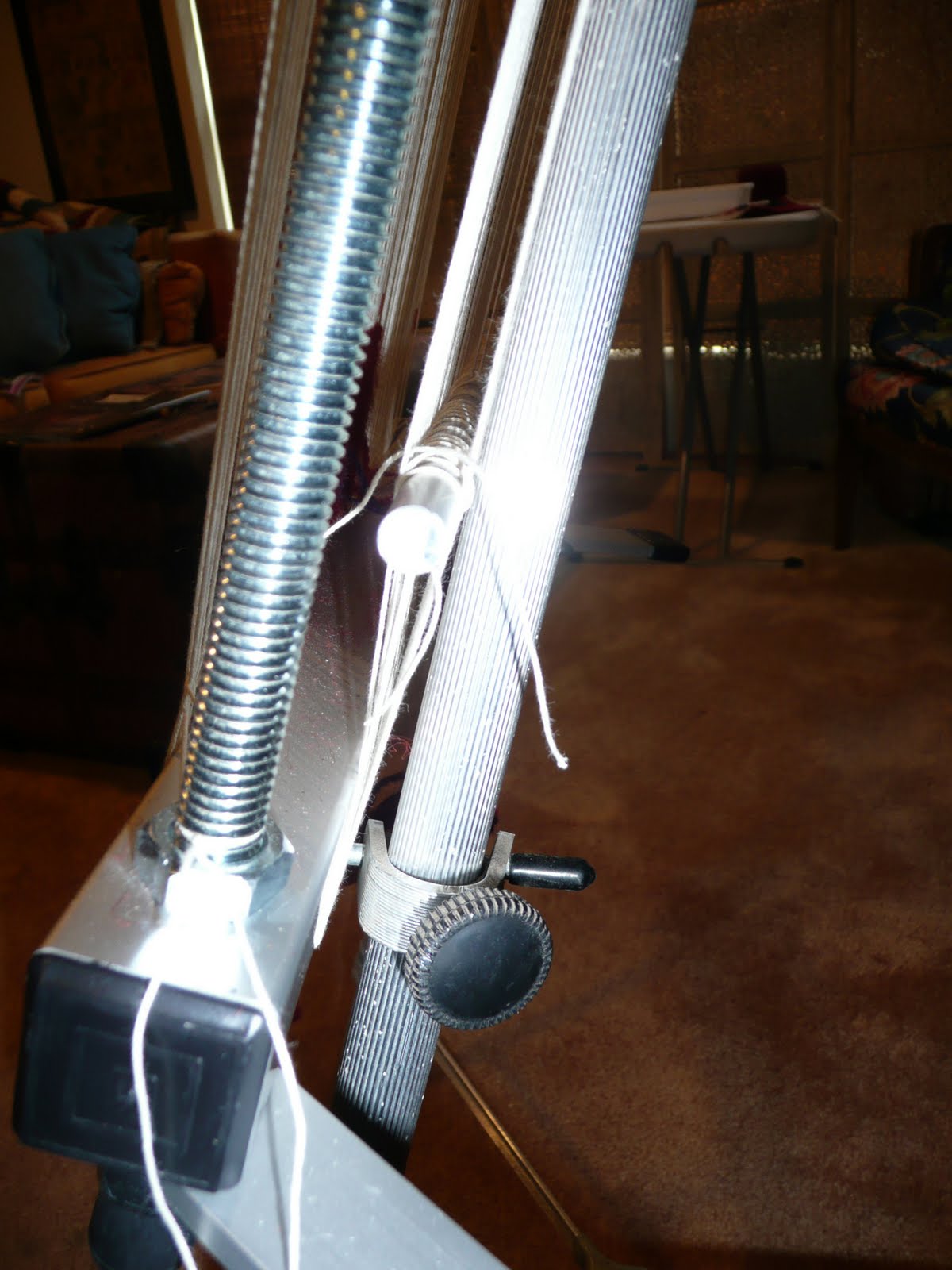
Our local arts organization sponsors various classes for artists, one of which is using Photoshop Elements. Elaine Taylor did an excellent job teaching the class, as always. It’s been a long time since I have looked at that program, but it’s a lot more robust than the original one that I tried out. My Photoshop program (the full version) is very old, and I’m sure that if I buy a new computer, it will need to be replaced. It is also very expensive, so Elements may be the way to go. The regular Photoshop also has way too many bells and whistles that I never use and don’t want to spend the time to understand.
Yarns, Yarns, and More Yarns
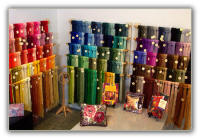 I see what is posted from “real” tapestry weavers about the yarns they use, and the one most often mentioned is Paternayan wools. Since I dye all my own wool, I really hadn’t paid much attention to these mentions, other than to notice the word—after all, it IS a pretty unusual word. One way that I hope to use the Mirrix loom is to experiment with a pictorial tapestry, something I’ve never done before. With that in mind, I made a little trip to my local needlepoint shop, The French Knot. This is not the needlepoint store that I remember from many, many years ago; it is NOT your mama’s needlepoint store. The type and variety of yarns now available is astounding! Besides the amazing number of silk, metallic, cotton, and Paternayan yarns, there are also some others that seemed quite interesting. Below are pictures of the types that I bought, but not the colors. I included a color chart for Gold Rush, so the variety of colors can be seen.


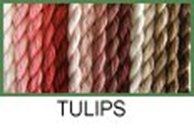
The yarn below from the Thread Gatherer comes in a very small skein. It’s 100% kid mohair. You can see the colors that this yarn comes in here. Another mohair yarn that I got is from Gumnut Yarns, an Australian company. It’s what they call their Tulips selection
 J. L. Walsh Yarns-silk/merino 50/50 blend. I couldn’t find a website for the company, but I did find this information from Caroline’s Thread and Canvas:
J. L. Walsh Silk
We stock Silk/Wool, a 5-ply 50/50 blend. It is an over-dyed thread with subtle richness and color variation. We currently stock the 50 most popular colors.
This yarn is overdyed, so there are color variations as one would expect. In fact, that’s one of the things I like about my own hand-dyed yarns—the little inconsistencies in the color. Those fascinate me and keep me engaged as I am weaving.
All of these yarns are worth experimenting with in a small way. I would not want to count on them for one of the big pieces without this experimentation, so I’ll throw them into whatever I’m doing on the Mirrix in order to test sett, feel, and appearance.
Body of Work and that “Behind” Feeling
 I am having a hard time keeping up with everything. I was thinking that I’d like to find someone to help with the needle weaving and finishing of pieces, making the muslin wrappers, etc, but I actually don’t know where to start. So, I began thinking of other areas that could use some help. First, there’s the yard, or rather, the jungle that surrounds me. Second, there’s the housework. I’ve decided that I like doing the yard work, even though I may gripe. At least when I mow there’s exercise involved, and you can look back and see what you’ve accomplished. The housework seems to never end or to be accomplished. So that’s where I’ll start with looking for help. That’s one “body of work,” just not the usual one we think of when we use that expression.
I have been thinking of that expression, though, for a while. Body of work…what does that mean really? Then I ran across this on Facebook:
Why are we so interested in art that is “new”?
Recently I have been doing a lot of thinking about the dilemma between creating a body of work versus the urge/need to create something “new.” Certainly there is a lot to be said for a body of work–there is the old adage that “Practice Makes Perfect.” If you hope to support your
source:the quilts of ann brauer
link:Full Article…


 I was hooked and had to read the full article. I have been trying to take a design and explore as many possibilities as I can. I did this once before with zigzags. I thought I was through with zigzags, but now I don’t think so. They keep coming back to my consciousness, and I am currently working on a couple of doodles involving zigzags.
I had forgotten about this company. Design your own fabrics with Spoonflower.
Mirrix warping PDF. Warning—it takes a long time to load, so don’t give up!
Waiting Rooms, Quilts, and Willows

I never mind waiting the requisite time at airports. When I need to get the oil changed in my car, I always go prepared to spend time—lots of it. Sometimes I’m out too soon and sometimes not soon enough, but I usually enjoy the forced quiet time. Yesterday the waiting room was full, so I settled in with a book and my bag of other things to do, in case boredom overcame me with the book. Waiting rooms are usually the same: there’s the ubiquitous TV playing at a volume that makes it difficult to hear or that is irritatingly loud. There are people who want to strike up a conversation with their closest neighbor and those who talk all the way across the room. Yesterday my attention was diverted from my book by the cast from Million Dollar Quartet on the Today Show. Made me want to hop on a plane, catch a few shows, go to a few museums, ride a few subways … There are more YouTube videos on the show’s website.
I love the subject matter of this quilt, as well as the way it appears to be constructed in sections. Read the article about Nellie Durand’s “orts.” You can see some smaller versions of the flowers here. And don’t you just love the title of this piece? That’s exactly what the prairie does every year. Nellie Durand shows off her quilt, “Prairie Performance,” hanging at Sherman Hospital in Elgin, Ill.
In Fiberarts magazine, there is an article about Bonnie Gale who makes living willow sculptures. Take a look at the pictures under Living Willow Structures and on the Fiberarts link. 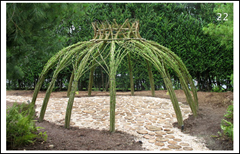 I enjoyed reading about the willow harvest on the blog Two Red Threads and directions for making a trellis of willow.
There is another article about the composted tapestries of Dorothy Clews and Linda Wallace—interesting concept.
EARTHY AESTHETICS
by Mary Lane
The buried and exhumed tapestries of Dorothy Clews and Linda Wallace unearth the transformative power of nature.
In glancing through the magazine, there are several articles that deserve more study. Which will happen another day…
Kandinsky, Magnets and Iggy

I bought these magnets many years ago and have only actually used a few of them over the years. They come in a sheet from which you have to remove the individual magnets. They appealed to me, probably, because of this Kandinsky poster available here.
Farbstudie Quadrate, c.1913
Here I have taken six of the magnets and put them into the shape, that when folded, would become a cube.
 The big news around here, besides the triple-digit heat— Iggy! This from the American Statesman in Austin.
People hooted, hollered and high-fived Tuesday afternoon when Austin artist Bob “Daddy-O” Wade’s 40-foot iguana sculpture was lowered by helicopter onto the roof of the animal hospital at the Fort Worth Zoo.
And this from the Dallas News, which gives a little history of Iggy. Will Iggy be happier in hot Texas than in cold Manhattan? This is a sculpture by Bob “Daddy-O” Wade, created in 1978 for a club in NY. All the pictures come from the Statesman.
I’ve kind of been knocked down the last few days with some kind of achy, indefinable physical ailment—just not feeling quite up to snuff. So, all plans for this week have gone out the window. Tomorrow will be oil-change day. Will take my sketching materials, a book and some research materials for my visit to the waiting room in the service department. I actually kind of enjoy those waiting times—up to a point. They’re kind of like enforced quiet time, with no choice but to enjoy. It will also be time to step outside and make a few phone calls that I’ve been putting off.
Tapestry in Shanghai

This article about tapestry weaving in China was posted in ShanghaiDaily.com and comes via weavespindye@twitter. In this picture, I immediately noticed the pile of yarns.
 A tapestry work hung in the Shanghai Hall of Beijing’s Great Hall of the People.
 Old weavers in Yangjing Community today still dye the wool themselves. There are more than 400 kinds of reds.
We took a short road trip to Comanche, Texas yesterday. It’s a fairly old town. and the drive is nice, through some pretty countryside. One of the town’s claims to fame is the fact that John Wesley Hardin, the old west gunfighter, shot and killed a deputy sheriff there in 1874. Until recently, the saloon where the shooting took place was still in business and (I have heard) was the oldest still-in-business saloon in the state. If you read the Wikipedia piece about Hardin, it’s hard to tell the good guys from the bad guys in the wild west days! It’s also interesting that, after prison time, Hardin went on to become a lawyer. As I think about it, maybe it’s still hard to tell the good guys from the bad guys; only the weapons have changed.
While walking around the square in Comanche, I came across this sign in a window. Love the juxtaposition of available items! But it did make me wonder: Are we talking about tanning of leather goods or human skin? Or is it one and the same?
Summertime temperatures have arrived here. Rainfall was good in April, but now we’re behind for May by 4 inches, a considerable amount. Off to water the vegetable garden and warm up the loom bench. Still listening to Shanghai Girls and finding it very interesting.