Green

Green Square, part of triptych (Private Collection) Interesting article in NY Times about the toxic side of green, both as a movement and the color. No mention of indigo in the article, but does mention how so many of the older greens faded to blue. Below is a quote from the article.

Even if they succeeded, the results often faded or discolored, as did green dyes. When the 19th-century British designer William Morris created wallpapers inspired by medieval tapestries, he copied the blue hues in the originals. But most of those “blues” were really greens, which had changed color over the years.

Exciting News

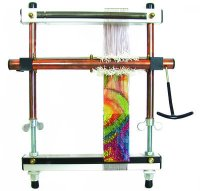
imageThe picture above is from the Mirrix Blog page. Just wanted you to see what they look like, except that i think everyone in the world is familiar with these looms.

I’m going to write more about this later, but after commenting about possibly making some smaller pieces in today’s blog comment section, I thought I should mention that I am going to have the perfect opportunity to do that. As part of the Mirrix Social Media project, I won a Mirrix loom, (Yippee!) so will have the perfect opportunity to work on smaller pieces. Because of previous commitments, I won’t be able to actually start until later this month, but the brain is whirling and thinking of the possibilities. Stay tuned for the list of weaving experiments that I’m considering.

Here’s the Mirrix Facebook page.

Arts Festival-Not!

DollsThis picture has nothing to do with anything. I just wanted a cheerful picture. It was taken in a Peruvian market.

Okay, maybe I’m just in a bad mood because getting the new water filter installed on my well did not turn out to be a simple process, and as I write this, I have no water. Running water is a beautiful thing! And I miss it! And I don’t enjoy the inconvenience lack of running water causes—even for a few hours. Grumpy me!

But—I recently received a notice from an arts festival with the following in their artist requirements:

Silent Auction: All artists are required to donate an item (value of donated item must be comparable to artist’s other pieces available in booth) to the Historic Nameless Arts Festival 2010 Silent Auction. Monies raised from this event are used to further promote interest in the Historic Nameless area. Festival staff will come by your booth at 10:00 am on Saturday to collect your auction donation.

I obviously substituted Nameless for the actual name of the arts festival. I also underlined and put in boldface the part about the value of the donated item. Now, admittedly, the booths for this even are not very expensive, especially when compared with other festivals. But even a booth in one of the “expensive” festivals would not be as much as the festival is demanding of the artist. When you consider that some pieces take at least three weeks or more to weave plus finishing time, the booth space is costing the artist a month’s work—or more!

Has anyone else received anything like this? Is it just grumpy me that considers this a ridiculous requirement?

Dyeing

YellowThe dye used is Pro Sabraset/Lanaset from ProChem. The color is Mustard, which has been a very useful color for me, even with the unfortunate color name. The Sun Yellow is a much clearer color. The greenish tags are the same ones that they use on plants. I write the weight of the yarn and the dye formula—100% Mustard or 50 Mustard 50 Scarlet—whatever the case may be. When they are balled up, the formula is written on a string hangtag and attached to the yarn, so that when there are bits and pieces left, I will know the formula for dyeing more.

A couple of months ago, I came to the bottom of one of the huge containers of yarn. I weighed and labeled what I needed for the current project, then did the same for the other skeins, which I left in a basket. I am so glad those skeins were ready and waiting today. All I had to do was wash them, use my spreadsheet to know the amounts of dyestuffs to add to the pots, and I was good to go. Since I use two wefts in my weaving, I nearly always dye in twos. Yesterday, I picked up two skeins which weighed 240 grams and two skeins weighed 239 grams. How lucky is that! Since I use two dyepots, I mixed up the numbers so that, theoretically at least, each dye run will be equal. I learned the hard way to mix the yarns from the two pots, even if they are the same color. If I don’t, there will be a barely discernable line running across the weaving when you start the second color run.

What Does it Madder?

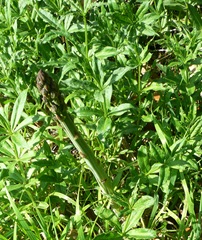
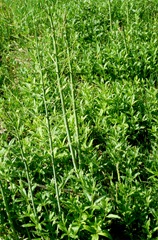
Madder_AsparagusI’m sure this picture is not very clear, but my madder has spread into the asparagus bed. It’s probably time to make a real effort to dig madder this spring. My fear is that the precious roots may have grown so far into the soil that I want be able to get them out without disturbing the lateral lines from the septic system. In fact, I’m not even sure where those lines go. Maybe they’re not even in this area at all. But it does “madder.” However, it’s for sure that digging madder will disturb the asparagus!Madder_Asparagus2
I’m mowing in stages, since everything has grown so much, seemingly overnight. I have a newly re-plumbed shower, of which I used for the first time yesterday after mowing. It was wonderful! I have a well, and ever since I had new hot water heaters installed, the hot water has been rather smelly, which seems to be worse when using the brass shower/faucets in the old clawfoot tub. The plumber could not get the anode rods out of the heaters, so I called my water filter guy. He tells me that I can install a different type of filter on my well that will take care of the problem. I really hope this works. ‘Twill be done Thursday.

Letting the Mind Go

I listened to this interview on NPR Saturday morning. It’s with Jakob Dylan and Neko Case. Part of the interview concerned songwriting. Mr. Dylan talked about writing songs for his latest album in three weeks, and said if he had three months or three years, he would take three months or three years to write the songs. Sounds like he works best under pressure. Ms. Case said some of her best songs come to her while washing dishes. Sounds like letting the mind go where it will helps her creative side. We all think, learn, work, and create differently. For me, sometimes it seems that there are so many ideas that they can’t be captured fast enough. At other times, I seem to have to force something—anything—to come to the surface. That’s why I’m taking a creative vacation, of sorts. I am freeing the mind to go where it will by doing mundane tasks that require little thought. Taking walks. Musing. This is hard for me to do, but I’m going to try for a while. And, oh, yes, I’m going to dye some yarns too!

The Redbuds are Coming! um…Here!

RedbudI love this time of year when the redbuds peak out—from hidden areas along the side of the road and from the woods. As I write, I am listening to the winds blow at about 27 mph. The forecast for tomorrow is rain. WhiteCrosses_purple_limeThe piece above was cut off the loom Wednesday, and I took this picture without consideration of how it will hang. The lime or purple sections will be top and bottom-or bottom and top—don’t know yet. So, turn your head to the side and help me decide which way it should hang. Here it is with lint, warps needing weaving, and hemming to be done.

I think I’m kind of in a funk weaving-wise. Can’t really focus on what I want to do next, so I think it’s break time. Time to tackle other things that are on the list. Maybe repetitive tasks like mowing, pruning, and—gasp!—cleaning will give my mind time to wander and THE idea will pop into my head. But, boy, do I hate to not be weaving!

My New Best Friends

Clips

Okay, I’m sure everyone has some of these clip things in the house somewhere. I’m also just as sure that you have multiple cables/cords that belong to various devices that go with your computer. Pictured above is the cable that goes with my digital camera. After using it, I would roll it up neatly and put it in its appropriate spot in the drawer next to my computer. But there are more cables than just the one, and invariably, they get tangled. I long ago labeled every cable/cord that comes into the house, so getting the correct one was easy, but also frustrating because when I picked up one, another one came along for the ride. Ta da! The clips moved from the kitchen to the office, and I clipped the neatly coiled cable. Works great!

Designing to Scale

Graph Paper Usually when I design, I use graph paper with the design drawn to scale. After the sketch, idea, whatever, is complete, I use 10 x 10 graph to transfer that idea to a scale drawing. I used to use colored pencils to color the design, mixing colors the best I could to duplicate the colors I wanted to use. I’ve gotten a lot looser with the coloring part but still use that to-scale drawing for the weaving process, clipping it to my loom, taking it down for reference when I come to the next part. Somehow the 10 x 10 grid is more intuitive for me than other sizes. However, I think I’m going to have to change my ways, or at least partly. From now on, I am going to take the design element and draw it out on 4 x 4 grid paper to more closely match the ends per inch that I am using. I am hoping that by doing that, my width in the reed will more closely represent the way I like to weave, that is, starting a design element with the first “up” thread up when I am weaving from the right. Another lesson learned and another work in progress. Life is full of ‘em! So, how do you design? What comes first? Last? Lessons learned?

Mirrix

imageThis is the picture that Mirrix uses on their Facebook Fan Page. I’m sure they’d be happy for you to become a fan.

Mirrix is doing a Social Networking experiment. I am very interested in this project because I have looked at their small looms before, but have held off, trying to find out from other folks how they liked to use their Mirrix looms for tapestry projects. I have several small project ideas floating around in my head that I would like to try out. Some would be 4 x 4 inch pieces that would be displayed together. Others are in the range of 12 x 12 inches. I would like to explore using slits as design elements in a small format—why use a big loom and all that warp for a project that might not work? A small format would be easier to undo and/or start fresh when adapting an idea. I have a couple of photographs that would benefit from a closer sett than my usual 4 epi and I would like to experiment with those. And silk! I have bits and pieces of silk to use by themselves or combine with the many butterflies hanging around in jars—good forButterflies these small projects.

Sometimes, the color of the yarn itself inspires the design. Using a small portable loom would be great for that type of experimentation. I keep thinking there must be some small weaving loom suitable for traveling and vege-ing out in front of the TV after a long day. I have tried making frame looms out of stretcher bars and have even used looms specifically made for small works, but the shedding device (or lack thereof) has discouraged me. I like the shedding device on the Mirrix, or, rather, I should say, I like the way it looks and what I read about it. Until I actually use it, I won’t know.