They were right

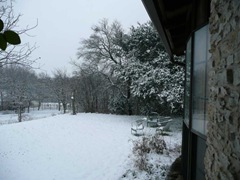
The weather forecasters got it right. It happened. Snow. Around 3 am I looked outside and thought everything looked white. It was snowing as I took these pictures this morning, but the small flakes are not visible in the pictures. As you can see, it’s only a couple of inches of white fluff.House_snow

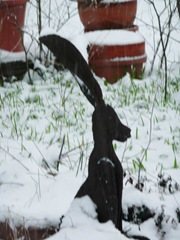
 firewoodGuess I’ll be dusting off my firewood today. Couldn’t resist this picture of the metal jackrabbit that sits outside. He always looks so alert.JackrabbitThe steaming, pressing, hemming, and pressing again is finished. The pieces are rolled up and ready to go to the photographer—that is if anyone gets out today. Two pieces are rolled around one tube. Covers come later. This finishing stuff is hard work! I was exhausted last night.

Pieces_rolled


Finishing

Finishing I have experimented with every recommended finishing technique around and still don’t have one that I’m entirely happy with. I decided, that since the pieces that I’m working on now are small and will never be used as rugs, that I would hem them. Don’t like it! Just don’t like the way they look. So, back to needle-weaving the ends back into the body of the piece for the next pieces. One part of the finishing that I am happy with is weaving the warp before either needle-weaving or hemming. That technique is in Collingwood’s book, page 498. I use 5-7 warp ends at a time—have done it with 3, but not with total success. The above is a phone picture, so usual caveat—not a great picture.

I am not going to complain about the weather. I am not going to complain about the weather. I am not going to complain about the weather. It is cold and dreary here, but so many people have it worse with feet of snow. And it’s hard for me to comprehend having to worry about roofs collapsing from snow. And digging out your car, much less driving it in all that snow. At least we saw the sun here yesterday! They say we may get some of that white stuff tomorrow, but probably not much. Keeping the fingers crossed!

Back to steaming, pressing, hemming…

Color Scheming

Picasso

 Guitar on a Table, Pablo Picasso, 1920, The Menil Collection, Houston

Several years ago I bought a downloadable program called Color Schemer. One of the things that I like about this program, is that I can import a photo, and it chooses colors from that picture. You can decide if you want 4 colors or 10 colors, and all the numbers in between. I am planning on weaving a piece in the future with blacks and browns. When I saw this Picasso at the Kimbell exhibit, I immediately noticed the colors, and wondered about including some blue in my piece. Using Color Schemer, I picked various colors from the picture.

PicassoColors  PicassoColors2


I am still undecided about what colors will ultimately be chosen, but this program is fun! There are other programs that one can use online, but I like having this one at my disposal all the time. It also gives you the color codes for RGB, CMYK, and maybe others that I know nothing about. But I can take those codes and use them in another program to get the colors I want to play around with, like, for instance, Photoshop. By the way, I love the Snip tool that is included in the Windows Accessories. That’s how these little “snips” came to be. Thanks, Lynn, for reminding me about that tool.

Museum Visit

After a morning of appointments and errands, we went to the Kimbell Art Museum to see their current exhibit. This is an exhibit of selected art from collectors in Texas. It was organized in order of period; going from room to room and moving forward in time. I found myself looking with more interest at the Impressionist era after reading The Swan Thieves. After reading about brush strokes and the style of the Impressionists, I was paying more attention and looking closely at brush strokes. As I strolled through the exhibit, I got out my small Moleskin notebook and made some notes about any of the paintings that drew my attention more than others.

Maurice de Vlaminck, Barges in Chatou, 1905

In person, the colors of this painting were very impressive.

I noted what detail attracted my attention, in many cases it was color. In some cases it was both color and design—my this time I was in the more modern period of Picasso, Mondrian, and others. The above is a Vlaminck painting of barges. I loved the color, not so much the actual painting. One of Monet’s Water Lilies is in the exhibit (how do they keep track of all of them?). This was a 1916 version with lots of blues, greens, violets and spots of orange. And, again, the brush strokes!

Guido Reni, Saint Joseph and the Christ Child, 1618-40

This seventeenth century Italian painting, by Guido Reni, was one of my favorites. I don’t usually gravitate toward this period of art, so my visceral reaction to this painting was a surprise to me. The look in both their faces, the lighting, the tenderness depicted—all was so apparent. Naturally, an online picture does nothing to portray the magnificence of any painting.

After completing the tour, I ended up buying the catalogue, something I rarely do. Now if I could squeeze in some design time while the inspiration iron is hot! I’m really looking forward to my workshop this month at the Kimbell.
Beginning Again

Surprise! The rumor is that we’re actually going to get one and a half days of sunshine!

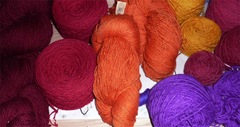
Next_project2 As the weather is a little chilly and wet around here, I would prefer to not do any dyeing right now. With that in mind, I have decided on the next two projects based on yarns on hand.  This is the palette for the next project. The colors are bright, in contrast to the gloomy weather around here. I’m really trying to work on my attitude and have tried to NOT mention weather for a week or so. But I have my limits! Next_projectIt will be similar to the picture above. The warp is tied on, spread, waiting for the knots, and the first rows of weft. There are some skeins to ball up, but basically, everything is ready to go.

Ta Da! Off the Loom

Crosses_scanned Crosses_off_loom

Now this is certainly not a great picture, but I’m excited to have these off the loom! They are still joined together, and, as usual, the colors aren’t true in the picture. My time will be spent doing finish work for a while—I’ve got five pieces now that need steaming, and either hemming or needle weaving. I am going to tie the warp back on the loom in the next day or two for the next piece (to be decided). Since I did several designs of about the same sizes, I can tie on and then make the decision of what to weave. And, hey, maybe I should sweep around the loom! I’ve really got to get the finishing done because there are a couple of shows here in Texas that have entries due soon.

Reading (Listening) I’ve finished listening the audio book The Swan Thieves. The book is 565 pages long, and the audio version is 18 hours. It’s a little slow in the beginning and never moves through the plot quickly, but it is interesting. It is about art through a psychiatric patient, his doctor, and the women in the patient’s life. I keep thinking about how I still don’t know how I feel about this book, but the fact that I keep thinking about it tells me something. Have you ever seen a movie that you keep thinking about even though you didn’t like it much? To me, that means the movie was good in the sense that it was thought-provoking.

Now, for a little fun, take a look at these here and here. They are the work of Elaine Bradford—taxidermy and crochet—at the Houston Craft Center.  They’re infectious.  Love the images. 

Black Holes and Fashion as Inspiration

If one is not careful, Facebook and Twitter can become black holes that eat up time—huge bites at a time.  However, through Facebook and Twitter, I find out about things I never would have known.  HGA posted this on Twitter last Saturday, which was a retweet from http://twitter.com/FashionHistoria.

weavespindye RT @FashionHistoria “Love” this review of the Vionnet exhibition in Paris (especially the FAB videos) #fashion http://bit.ly/9kCJyq

This whole Twitter exchange was about an exhibit of fashions:

Exhibition Review: Madeleine Vionnet: Fashion Purist

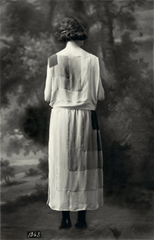
I love the structure of the fashions shown in this review.  The one at the bottom of this page especially caught my eye.  “Wonder why?” she says facetiously. Take a look at the pictures—interesting clothes shown in the review.  The design below may soon be adapted for my purposes.  I’ve been sketching ideas for a series of squares, and this would be more squares within a square.  Still thinking about colors, but that’s were the scanner, computer, and/or tracing paper come in handy.Yeimage

Yesterday I felt inspired, so made several to-scale drawings of future weavings.  Still need to play with color, but it’s a start.  Then today I read about this Captcha Challenge on the Compost & Creativity blog.  I have always believed that restrictions make us more creative.  When I started using natural dyes, I only had four colors that I felt I did well.  Consequently, my designs had to be able to use some of those colors.  Our next guild show will have the theme of Rhythm and Blues: The Music of the Loom.  Each piece has to incorporate blue in some form or amount.  Using blue won’t be a problem for me, so I’ve set myself a challenge of learning a bit about music. I’d like to see if a seed of design inspiration can come from that source.  My knowledge of music is pretty much zilch, so that is my additional restriction.

More Musings…

In the fall, 1986 Shuttle, Spindle & Dyepot, there is an article called A Journey in Progress by Annie Curtis Chittenden. The article follows Ms. Chittenden’s work as it progresses through various styles of weaving, from tapestry to Theo Morman technique. One of the ideas that interested me was her method of designing. After making small sketches, she used an opaque projector to see the design on the wall in various sizes. Choosing the size that seemed to work best for a particular design, she then traces over it for use as a cartoon.

She also uses the original small sketch by placing tracing paper over it and experimenting with color. This is something that I now do with the computer.

I have tried to find information about Ms. Chittenden, but could only find a reference of her tapestries (no pictures) hanging in Mackenzie Dining Hall in Connecticut. I am really enjoying reading the articles in these old magazines, but would love to find current information on the people mentioned in them.

Both of the pictures here are scanned from the Fall 1986 issue of SS&D.

Gardening Last week, when it seemed that spring might actually occur again, I ordered some galvanized metal walls for a raised garden bed. I expect to grow at least a few vegetables this year, although the weather yesterday and today totally belies the whole idea of spring. Black-eyed peas will one of the plants that will be planting. I miss fresh black-eyed peas cooked with snaps. Sometimes fresh peas can be found at farmers’ markets, but not with the sizes needed for snaps. February is around the corner, so March can’t be far behind!

Books While weaving, the book on the iPod is The Swan Thieves, which I got from audible.com. It’s the unabridged version, which makes it 18 hours of listening. The verdict is still out on this one for now, even though I’ve finished the first 12 hours. The pace of the plot does seem to be picking up a bit. As quoted from the NYTimes.

THE SWAN THIEVES By Elizabeth Kostova. 564 pages. Little, Brown & Company. $26.99. Elizabeth Kostova’s first novel, “The Historian,” was the subject of a heated publishing industry auction and went on to spend nearly 20 weeks on The New York Times’s best-seller list. Now she is back with her second novel, which buyers at both Barnes & Noble and Borders put near the top of their lists of hotly anticipated books for 2010. The plot follows the obsessive search by Andrew Marlow, a psychiatrist, to unravel the mystery of a patient who defaces a painting at the National Gallery. The point of view shifts among narrators, and the book goes back in time to the 19th century to explore the lives of the painters Béatrice de Clerval and her uncle, Olivier Vignot, who form a large part of the story. Writing in Publishers Weekly, Katharine Weber said: “Legions of fans of the first book have been waiting impatiently, or perhaps even obsessively, for this novel. ‘The Swan Thieves’ succeeds both in its echoes of ‘The Historian’ and as it maps new territory for this canny and successful writer.” (Publication date: Jan. 12.)

Always interested in color

image Picture from NPR

Just for fun and a look at Crayons and color, check out this NPR article.  Pantone posted this on Facebook Wednesday.  When I looked at the Crayola site, I found bunches of stuff to do with crayons—even video demonstrations.  Maybe it’s time to break out that box of Crayolas! 

Today Pantone posted a link to their summer colors.

Alchemy- an inspirational palette from PANTONE VIEW Colour Planner Summer 2010. This range is rich and full of color with an essential skinny beige in a pivotal spot between the orange/yellow and the pink/purple groups. http://tinyurl.com/y944w4b

While weaving…

imageFrom Kimbell Art Museum 

Even though I’m listening to an audio book while weaving, my mind still wanders.  Lately, I feel kind of in flux as far as where I want to go next with my designs and my weaving.  One of the things I was thinking about was taking a watercolor class (or other art class), but I know I don’t want to devote that much time to it.  I was reminded of the education workshops given by the Kimbell.

The Friday Workshop

Spark your intellectual curiosity and creativity during afternoon programs that combine thematic gallery tours with hands-on art activities for adults of all ages. A light snack from the Buffet Restaurant is included. The materials fee for each workshop is $15 ($12 for Kimbell members). To register, call 817-332-8451, ext. 297.

Picturing Still Lifes
Friday, February 12
2–4 p.m.
Spark your intellectual curiosity and creativity in this program that combines thematic gallery tours with hands-on art activities.

Rhythm in Nature
Friday, March 05
2–4 p.m.
Landscape paintings in the special exhibition “From the Private Collections of Texas: European Art, Ancient to Modern” inspire our investigation of how nature is organized and abstracted by old and modern masters.

Seasonal Change in Asian Painting
Friday, April 23
2–4 p.m.
Snow on blossoming branches or abundant displays of harvest fruits are among the most beloved evocations of seasonal transformation in Chinese and Japanese paintings. Gallery tours highlight examples in the Kimbell’s collection before participants begin a related studio art activity.

Eye for Fashion
Friday, June 11
2–4 p.m.
From Italian brocades to 1930s haute couture, an in-depth exploration of historic dress represented in European paintings sets the stage for a mixed media activity focusing on texture and color.

I think taking a couple of these workshops might be just the spark I need to get me moving again.  Although, today while waiting for the oil change on my car, I did sketch out a couple of designs.  Will need to get out the graph paper and see if I can translate those sketches into something usable. So, all in all, a pretty exciting day!