Category Archives: Design

Dithering-what’s next?

current weaving

current weaving

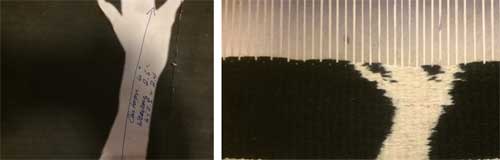
This is what I’m doing in my dithering stage. Using up some of the many greens that I now have. The current weaving is simply throwing a shuttle, using greens in a kind-of-pseudo gradations piece. I have also pulled out many greens that I don’t like to overdye. I think some of them will be dyed by dipping one end of the skein in the dye, seeing what turns out and then dipping the other end to coordinate with it. Others may end up with a loose ikat-tied dyeing. I had an epiphany of sorts about doing some ikat pieces in a very simple way, just to be doing some weaving until the big inspiration sets in.

Below is the ikat board set up and ready to go. You can see the cartoon drawn on vellum, rough though it is. I was too lazy to really color in all those sections, but some squiggles will remind me of the way. This is only one section of many of this piece.

new cartoon, ikat board

new cartoon, ikat board

By the way, if you’re interested in color, you may be interested in this website and a new color wheel. Have you ever pulled out a color wheel, but not been really satisfied with the options? I have done that, but ended up sticking with my gut many times. So check it out and tell me what you think.

What’s next?

Peppers in the grocery store

Peppers in the grocery store

I had to include the picture of the peppers because they make me smile, even though I had already posted it on Instagram. Aren’t they beautiful? I was tempted to bring some home just to look at, not being overly fond of peppers, but they were $5.00/pound. And I’d want a bunch to look good, so…

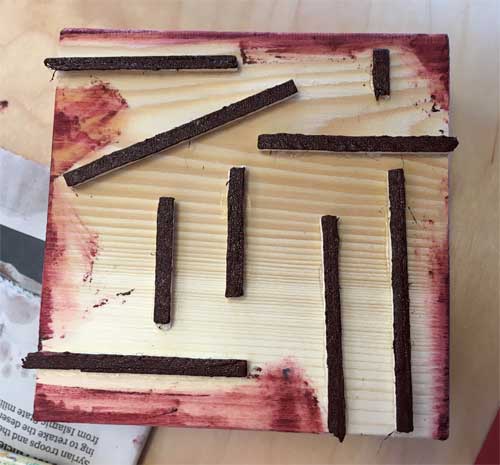
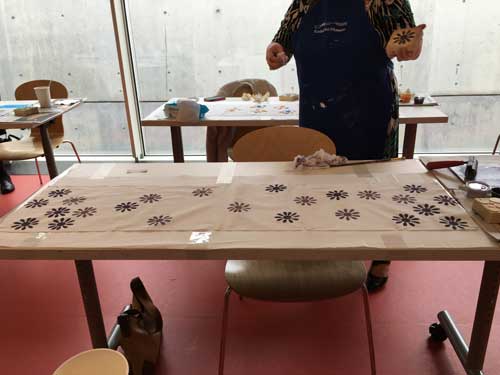
I took a workshop at the Kimbell Art Museum last week related to Japanese printing, although I’m not sure the actual printing actually had anything to do with Japan. We did go into the Asian room and look at all the beautiful screens and looked at slides of others, but they were painted, not printed. Then we had a wooden block and objects to glue onto it to make our printing block. There was a long piece of cotton taped and pinned to the table, so that once we had our blocks ready, we used a brayer to spread paint onto plexiglass. Once the brayer was filled, we rolled it onto the blocks and printed.

Printing block

Printing block

I wanted a random pattern because there’s no way I could get everything to line up, which would frustrate me no end, as that perfection demon sits on my shoulder. Notice how some of the block prints off the “real” fabric. Also notice that the printing looks black, although you can see from the block above that it’s really a dark red. Oh, well. Wonder if it will change if it’s washed.

Cloth pinned on table

Cloth pinned on table

Below is just the fabric. I see there are a few empty spots.

Cloth printed

Cloth printed

Maybe I should have done something like this rug in a Target ad, or the other black and white ones designed by Nate Berkus. I really wish I could include a picture here, but don’t want to violate any laws.

My neighbor took much more care, not only to make her block, but in the printing she uses too close-together colors. Nice job!

My neighbor

My neighbor

Next weaving?

Next weaving?

It’s time to decide what to weave next. This is a part of a cartoon for a weaving. (Ever notice how when you take pictures of paper, it never looks white?) I made the lines right angles but can’s decide if it would be better if they were woven at a different angle. The right angle part was to just keep it simple. Thoughts? Advice?

Frank Stella

©Sherri Coffey-Rhombus

Rhombus Wool, cotton, dyes 54.5 x 29 inches $675 ©Sherri Coffey

Exhibition catalog

Exhibition catalog

FRANK STELLA: A RETROSPECTIVE opened on April 17 at the Modern in Fort Worth. The members’ opening reception was Friday, April 16. Although it started at 6:00 pm, I arrived early because I was concerned about parking. I am so glad I did! The curator’s tour of the exhibition was in progress and was very educational. I have found that when you learn more about a particular piece of art, I can enjoy it more, even if it’s not exactly a favorite. A curator tour is not always available, but a docent tour usually is, with a bit of planning–note to self.

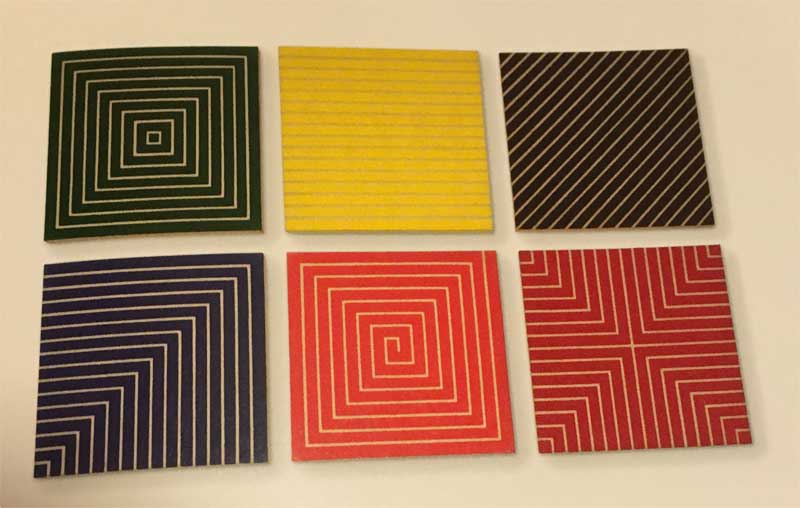
The exhibition is organized into several rooms, sometimes by the type of paint used, sometimes by series–or maybe those are both the same thing, as in the copper series. The Moby Dick series is in a room which can also be viewed from above. In these pieces there is a general feeling of water, which is more evident standing in the room above. The Copper series is in another room. (And as an aside, our group was told that Stella used to have to paint the hull of the family boat with copper paint.) He also used Benjamin Moore paint for a series. Also, look Jasper’s Dilemma, one of his larger Benjamin Moore paintings. It is made up of concentric squares, which draws the eye to the center, but look at the surprise when your eyes get there.

Below is a picture from the book with small Benjamin Moore paintings.

Small group of Benjamin Moore paintings. Each is approximately 12 x 12 in.

Small group of Benjamin Moore paintings. Each is approximately 12 x 12 in.

Frank Stella’s work is colorful and have interesting shapes that draw the eye, but I even like the black series. Maybe the main reason they are so appealing to me is they make me want to immediately get to my design desk and start drawing. And as a girl who discovered that she owned seven protractors when reorganizing the office, how can I resist a series called Protractor?*

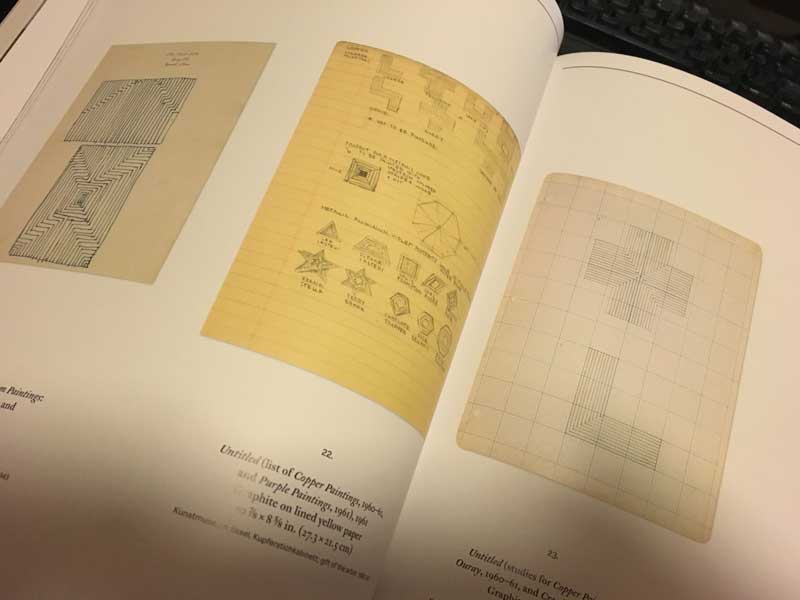
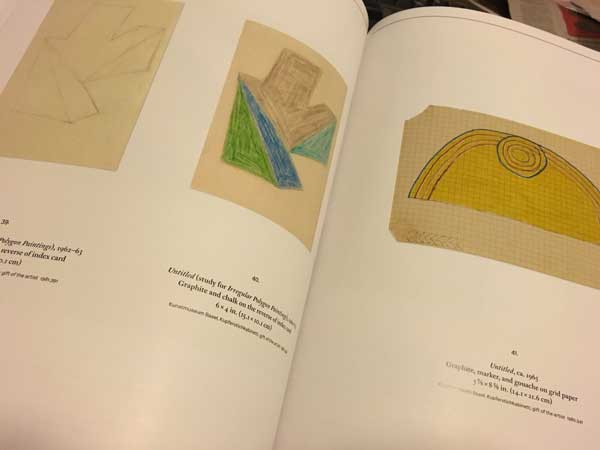
Process is also fascinating to me, so I was pleased to find several plates of studies and maquettes for his various series. All of the pictures here are ones that I took of some of the pages of the catalog of the exhibition. There were no studies for the Protractor series, but MOMA has some online here and here. A whole page of studies and maquettes can be seen here.

Irregular Polygon series maquettes.

Irregular Polygon series maquettes.

Images of the Irregular Polygon series can be seen here.

Planning-3

Studies from the exhibition catalog

Planning-4

Studies from the exhibition catalog. I love that he uses notebook paper and graph paper! I have a whole drawer of graph paper.

more studies

more studies

There is also a large selection of sculptures in the exhibit, not my favorites, but when you know a bit more about the work, they become much more interesting. By the way, we were told that Stella calls them paintings. When you look at those huge pieces, you can see why he would need the large, one acre enclosed studio space he has in upstate New York. Yes, one acre!

I found some great interviews or articles about Stella. One of my favorites is this one from the Wall Street Journal. In fact, WSJ has several articles about Frank Stella,  here and here. Which reminds me, that I enjoyed reading the titles of the pieces, and there’s an article about the wacky titles. Also, if you’ve never checked out WikiArt, it’s worth the effort. They also have an app (for that).

*I use protractors as part of the design process because of angles. Certain angles can be woven as smooth lines, while others will be stair-steppy. I like to weave smooth lines, so use the protractor to make sure the angle is one that weaves smoothly.

As I write this

As I write this, key wat is simmering on the stove, part of the spice-of the-month-dinner for this month. Yes, it was really for November, but we’re behind. I’ve written about these dinners before. I’m also attempting to make injera, not with great success though. It fermented well, but the cooking is a problem. I can’t seem to do what the recipe said.  Update: We ate the injera, which is not much in itself, but really fermented. It really went well with the spicy beef stew I made (key wat) and the spicy lentils and rice dish my sister made.

Greens in an order of some sort

Greens in an order of some sort

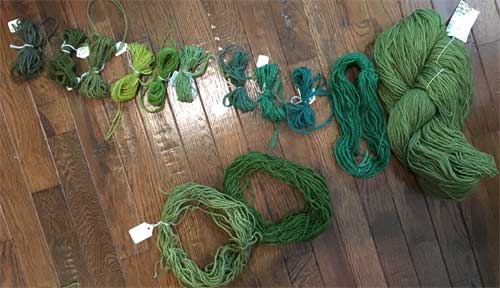
I’ve also been organizing (kind of) the greens I may use for a commission. I labeled each sample with the dye formula, hoping to simplify the process a bit when it’s time to weave. I will be using different yarns for this projects, as it needs to be thinner and more flexible. Since I had these yarns all laid out, I decided to change the picture to black and white, just to see the values. It’s interesting to see those sometimes–there’s nearly always a surprise. From looking at this grouping, which do you think will be the darkest? The lightest?

Greens, same order in gray values

Greens, same order in gray values

Combination of both greens and grays from Instagram

Combination of both greens and grays from Instagram

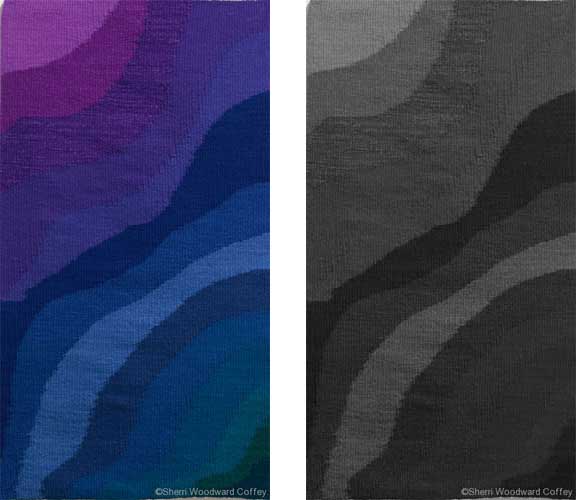
Here the two pictures are combined. I’ve written and drawn on the picture to show which ones surprised me a bit. It’s also interesting that several of the colors are so close in value, although very distinctive in their color form. The same is true for this piece. Some of the grays are so close together that they are hard to distinguish, especially in the lower right section, yet they work. If I had been working with gray scale, I might have woven something completely different–or not.

Deep, Cool Water--gray scale on right

Deep, Cool Water–gray scale on right

I haven’t decide which greens will be used yet, so the color order is also not decided. After the colors have been decided, I will dye all the yarns, then lay them on the floor and make decisions. Of course, there will also be colors in between the skein colors, as some of the colors will be combined to make new colors. That’s the beauty of weaving, right?

Do you pay attention to gray scale? How do you use it?

The saga of cartoon-making

Drawing

Drawing for cartoon

Sometimes the weaving needs a cartoon, sometimes not. On strictly geometric pieces, I usually draw to scale on graph paper and just weave away based on my drawing. With ikat I always need a cartoon to put under the measured yarn as a guide for the ties. This upcoming tapestry needs a cartoon, which leads me to this saga of getting enlargements. The closest place for me to get these made is a FedEx store. When I first started getting these enlargements done, they had a young woman who was very talented in this area, and they came out exactly right every time. I really hated it if I went in there and my favorite person wasn’t. Sometimes, I’ve actually gotten home and found that the enlargement was as much as 6 inches off! Now I carry a tape measure and they probably hate for me to come in.

Friday I went to a different store. After waiting through several unsuccessful attempts, during which the employees spent their time laughing and telling jokes, perhaps flirting, I said thank you for your time, but I’m leaving.


cartoon on the floor

cartoon on the floor

So on Saturday, I tried my usual store. The young lady had the correct measurements in the computer, and it seemed that it should come out correctly, but it didn’t. One of the other employees suggested putting the file on a flash drive and taking that directly to the printer. Glory hallelujah! It worked. Even better, this means I can put my drawing on a flash drive, take it directly to the printer myself and print it out. I don’t have to take in a small drawing that they scan and enlarge manually. The file that I put on the flash drive can be the actual dimensions that I want the final cartoon to be! I can’t tell you how excited this makes me! Trying to not think about the fact that I haven’t actually tried this yet.

Working small

Silk

Silk yarns

Becoming obsessed with projects seems to be my modus operandi; I’ve worked for years to just accept it and produce whatever it might be. As we all know, those projects are either successful, moderately successful, or just downright ugly. Right now, my obsession is working small, especially as Shop Small Saturday is coming up. As ridiculous as it may sound, an “aha” moment hit me. I can work small with the same kinds of designs that I already like. Working small does not always mean a whole new set of designs, although it could. I like color, so I’m going to use color–lots of it! Plus, new techniques (to me) and ideas can be tried out. A kind of sampling, if you will.

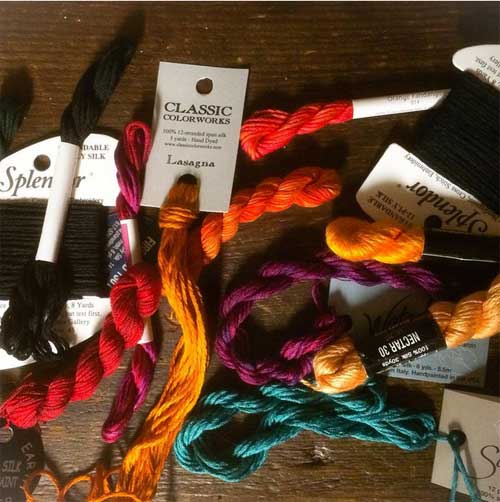
Part of this experimentation is with embroidery floss. Think of all the colors possible there. They’re almost infinite by using a few strands of one color with strands of another (or two) color. At 14 epi, they work pretty well. I also have silks around that I have begged asked for from my silk-weaving friends. These are bobbin ends and amounts that are really not useful to them. Plus, I made a trip to the local needlepoint shop, The French Knot. Boy, this is not your mother’s (or grandmother’s) needlepoint shop! The interior is full of very organized kinds of small skeins of yarn, from cotton, silks, alpaca, and more.  I concentrated on the silks, and even those were available in variety, but the shiny stuff got my attention. They’re all gorgeous! And, I don’t even want to think about how much these yarns might be per pound! A record of each yarn is being kept, with an opinion as to its performance: appearance, weave-ability, and whatever else comes to mind. Once I know what works best for me, I can perhaps dye my own small skeins in Mason jars. We’ll see. Or this current obsession may pass and be supplanted by a new one.

My newsletter went out on Sunday, if you’re interested, sign up here.

Ikat experiments and more

Grocery shopping

Grocery shopping

No, this picture has nothing to do with ikat, I just like it. This is the painting on the refrigerated box for a drink that I don’t remember the name of. Judging from the picture, it must’ve been a fruit drink, right?

Left: cartoon, Right: weaving

Left: cartoon, Right: weaving

So, ikat experiments–You can see it all in the above picture. I’ve recorded the info on the  cartoon; the cartoon is 6 inches, the woven is 2.5 inches. The yarn was measured in 1/4 inch increments for this experiment, so it makes since that this ratio is more than double the ratio for 1/2 inch measuring. The other cartoon with all its angles is not turning out very well. Maybe those need to be measured in 1/8 inch increments, something that I will have to think long and hard about.

spinning and roving

spinning and roving

…and then there’s the spinning. About a pound of Romney roving rests on the floor beside the spinning wheel.

Circular-warped Mirrix

Circular-warped Mirrix

… and the newly warped Mirrix, warped in a circular way without the use of the warp bars. Another experiment.

small pieces

small pieces

… and the small pieces I wove, oh, maybe a year ago. I trimmed them and dumped them in water. Next I’ll hem and stitch them to a canvas. Another experiment….


How to waste time in just a few easy steps

I read a post by artist Karin Olah about how she has her art printed via Spoonflower to use on notecards. Here’s what Karin does:  Spoonflower prints my art image on cotton. Then I sew it to a blank card, adding a few fabric embellishments. Since my artwork is Mixed Media painting with fabric collage – the fabric touch is fun. Here is the example I saw. You can see the fabric touches she added later.

Karin's note card. Notice the fabric embellishments

Karin’s note card. Notice the fabric embellishments

Below is the original image.

Looking Towards Shelter, fabric, gouache, pastel, and pencil on canvas, 6 x 4 inches

Looking Towards Shelter, fabric, gouache, pastel, and pencil on canvas, 6 x 4 inches

Karin has done this before with completely different work. Instead of landscapes, still lifes.

Limited edition series of quilted art cards. These cards start with a high quality print on Kona Cotton; then they are hand stitched with machine embroidered silk leaves and highlights added. Each 5 x 7 inch card is unique, signed, and numbered.

Limited edition series of quilted art cards. These cards start with a high quality print on Kona Cotton; then they are hand stitched with machine embroidered silk leaves and highlights added. Each 5 x 7 inch card is unique, signed, and numbered.

Granted, her work is mixed media, which involves using fabric, paint, gouache, and pastels on paper. Karin’s originals were also 6 x 4 inches, which is the size of her Spoonflower prints. Still, I had to try. This could be addicting!

If I were going to use these on a card, I would then cut out each motif and attach it to a card. A slight warning here…It took me a bit to get the hang of their system. Finally, I reduced all of my images so that the neared a 4 x 6 in. size, then chose to see a full yard of basic cotton.


  • First, upload your image
  • Change the size so that it might be somewhere around 4 x 6.
  • Choose how much fabric
  • Repeat as needed.
©Sherri Coffey-Summer Stripes

Summer Stripes, hand-dyed wool yarns, tapestry, Private collection

Amazing how the design looks so different when used in multiples. The Spoonflower version below is the Summer Stripe from above.
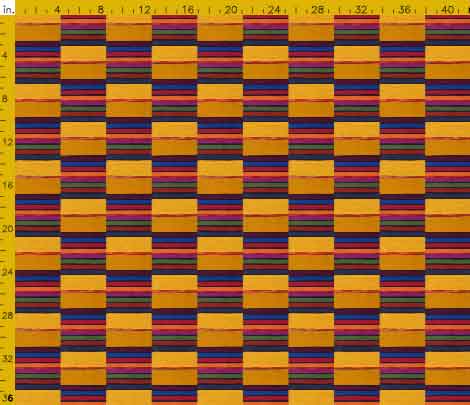
Summer Stripes, used in multiples for fabric design. Original: tapestry, 36.5" x 60", ©Sherri Coffey private collection

Summer Stripes, used in multiples for fabric design. Original: tapestry, 36.5″ x 60″, ©Sherri Coffey

Here are some more Spoonflower designs with their originals.

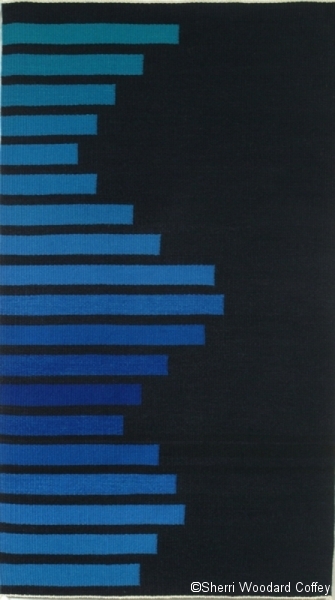
©Sherri Coffey-Deep, Cool Water

Deep, Cool Water, hand-dyed wool yarns, tapestry, 44.5 x 24 inches. ©Sherri Coffey, Private Collection

Deep, Cool Water, hand-dyed wool yarns, tapestry, 44.5 x 24 inches. ©Sherri Coffey, Private Collection

Same as above but used in multiples. Original: Deep, Cool Water, hand-dyed wool yarns, tapestry, 44.5 x 24 inches. ©Sherri Coffey
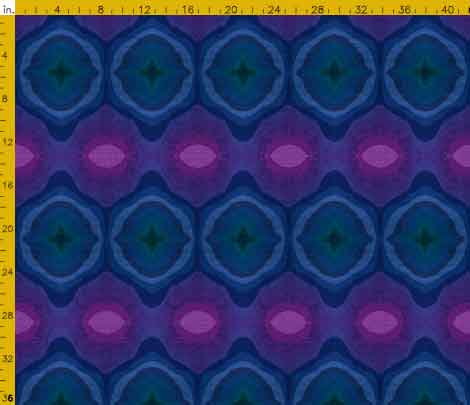
Same as above but used as mirror image. Original: Deep, Cool Water, hand-dyed wool yarns, tapestry, 44.5 x 24 inches. ©Sherri Coffey
Same as above but used as mirror image. Original: Deep, Cool Water, hand-dyed wool yarns, tapestry, 44.5 x 24 inches. ©Sherri Coffey

©Sherri Coffey-Sine Wave

Sine Wave, hand-dyed wool yarns, tapestry, 34″ x 61.75″

Sine Wave, mirror image

Sine Wave, mirror image

Sine Wave, multiples

Sine Wave, multiples

©Sherri Coffey-Wari

Wari, weft-faced ikat, hand-dyed wool yarns, 48 x 27.75 inches ©Sherri Coffey Private collection


Purple Rain, wool ikat, linen, dyes, 60 x 28 in, Private collection ©Sherri Coffey

Will I print these any time soon? Probably not, but the idea is worth pursuing at some point. Maybe I would even embellish with added bits. Try it for yourself, if you haven’t already. Have some fun, waste some time!

Tools and stuff

Weavers use lots of tools. I remember a male visitor to my studio looking around, saying “You get to use lots of good stuff.” Yes, we do. Lots!

Cartoon, but not at the correct angle for the project. Soon! Does this make you dizzy to look at it? It does me.

Cartoon, but not at the correct angle for the project. Soon! Does this make you dizzy to look at it? It does me.

One of the things tapestry and ikat weavers use is a cartoon. I usually take a small drawing to FedEx to get it enlarged to the size I need, and that’s where a problem sometimes happens. The employees don’t always know how to do that, plus they don’t want to listen to what has succeeded in the past. I spent over an hour on Saturday trying to get an enlargement and still did not go home with it. Later in the afternoon, I girded my loins (what does that really mean anyway?) and went to a different store. There the guy actually did what I told him about and I got a perfect cartoon. Plus, he gave it to me! As in free! I was afraid I would have to draw the whole thing myself, which then leads to the next design tool: large graph paper. Acquiring this meant a trip to my local art store, Asel Art. At first we couldn’t find a roll of this paper, and then when we did, it was much shorter length than what I have bought in the past. But that’s okay because this stuff is expensive!

Leaving my local art store. I thought the signs were interesting.

Leaving my local art store. I thought the signs were interesting.

So now I have my enlargement and a way to make my own enlargement. It’s time to get to work, especially after two weeks of doing nothing in the studio or the rest of the house and yard. The list is a mile long, but studio time is plugged in. Yippee!

Graph-paper-roll


Inspiration in June

Leaves

Inspiration again, and I’m grateful to have it. What with going to movies, playing miniature golf in the heat, zoo, etc–all the things that children like to do, I’m kind of blah. BUT…I do like to look at leaf shapes. I keep thinking I’ll use a leaf for an ikat design.

And then we have the color combinations of granite.

Or the colors of the trees. Granite-saturatiions Red-Trees

movie-carpet

Carpet as seen walking into the theater. Do you think it’s fuzzy because it’s carpet, dark when I took the picture, or….?

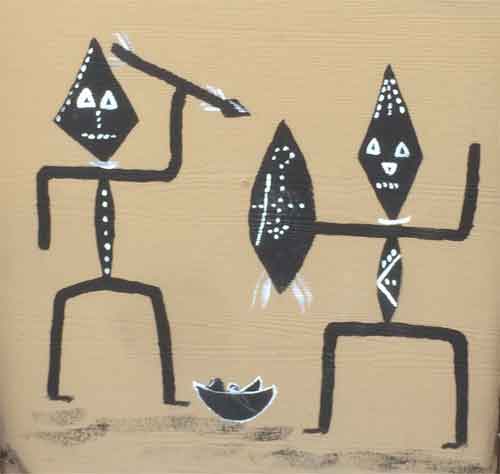
Then the drawings on the buildings at the zoo. These somewhat primitive paintings are always interesting to me. Zoo-drawing Mask-zoo

We’ve seen two good movies, totally different movies. First, Jurassic World, but yesterday we saw Inside Out. Both movies were fodder for discussion. But here’s my inspiration from the movie theater–the floor.