Category Archives: Tapestry

To slit or not to slit

Designs that require slits are to be avoided. And I usually do avoid them, but in a weak moment I started weaving a design when I really knew better. I’ve been sewing them up as I go along, but frankly, I just don’t like the way they look. To make sure I was doing them correctly, I did a small search.

ATA has a very good article by Susan Maffei about slits. Other links led me to articles or pictures were not so informative.

So while weaving, I have been thinking about these angles that end up in slits and a few other types of weaving I want to do. I’m thinking I really need to warp up that baby loom and get to experimenting.

To take a break from slits, I came across this from a publication called My San Antonio. The artist is Anita Valencia, who titled her installation “Sun She Rise Sun She Set and You Ain’t Seen Texas Yet”.

Smiling

I received the nicest handwritten note last Friday. But first a small confession–I picked up my mail at the post office for the first time in a couple of weeks, and I’m not sure if I would’ve done it even then, except that there were packages to send out. And what a surprise was waiting! A couple bought the tapestries above in New Mexico summer before last and took them to Michigan. In this wonderful note, she told me how much they were enjoying these tapestries and that they were placed where they could look at them frequently. Now, isn’t that nice! I know exactly what she means. I have some art that is placed where I can see it often because it makes me smile.

I am so glad she wrote (besides making me walk on air) because I like to send notecards to the owners of pieces. And since the weekend was really cold (I know–it’s all relative), I had time for a nice fire, weaving, and getting cards ready to send out. So, Ellen, if you happen upon this blog post, a small token of appreciation is on its way.

And speaking of art that makes me smile, what art makes you smile?

Tapestry or not?

There’s an article in Sunday’s NYTimes about weaver Sheila Hicks. In the article, notice the quote about tapestry (or not). If you’re a member of any of the tapestry groups, you know that this question comes up quite often. Be sure and take a look at the slide show. Take a look, also, at her website. Go past the home page to see more.

The picture above came from here (not available). There’s another article with pictures here (not available).

Inspiration, Museums, and Computer Lessons

Here in Fort Worth we are very fortunate to have some really great museums. One that I hope to visit soon is the Amon Carter Museum, which, locally, we usually think of as the museum of Western art. The Carter has an extensive collection of Remington and Russell paintings and sculptures. In addition, they have over 45,000 photographs in their collection. Right now, they have an exhibition of Ansel Adams.

Oak Tree, Snowstorm, Yosemite Valley, California
May 29, 2010–November 7, 2010
Ansel Adams: Eloquent Light

This exhibition of forty landmark and lesser-known works by the renowned artist-photographer is drawn from the Carter’s holdings and a private collection.

So, with these kinds of collections, it is always kind of surprising to me when the offerings are somewhat different. Currently, an abstract exhibition has just opened:I love going to museum exhibits, even an exhibit of works that I don’t particularly like. Besides being good for the soul, art frequently inspires me with ideas and/or color combinations.

Joe H. Herrera (1923–2001) 
Untitled, 1951 
Oil on canvas
Jonson Gallery Collection, University of New Mexico Art Museum, Albuquerque, NM

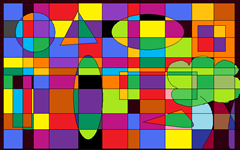
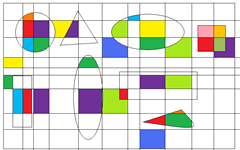
You can see the painting referenced above here. It reminds me of lessons that I used to do with my elementary students in computer class. Using a simple drawing program (Paint in Windows), draw a rectangle, the vertical and horizontal lines.

image

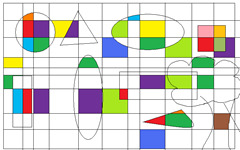
Then use the drawing tools to form ovals, circles, squares, rectangles, triangles, and freeform shapes. This was good exercise for the kids in mouse skills and using some keyboard techniques, like getting a perfect square or circle by holding down the shift key while drawing. The same with lines—straight lines are obtained by holding down the shift key while drawing.
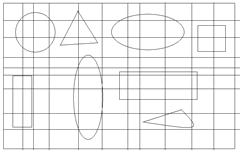
imageNow, for the most fun of the whole thing! Use the paintbucket to “paint” all of the shapes. The example below is not finished, but you get the idea. And sometimes, a good idea comes out of doing mindless exercises like this. You can isolate a part of the whole or use the whole design. This lesson also taught the kids about the curved lines which, if too curved, let the paint leak into places where it’s not supposed to go. That’s another reason for drawing the large rectangle and letting the vertical and horizontal lines extend past the boundaries of the rectangle. Lessons that were hard-earned by some students! Another lesson about using Edit>>Undo. The colors available in Paint are basic, although you can add others.
imageimage

image

Simplified (or not) designs similar to the above can certainly be woven on the Mirrix loom, or any other loom. Look at some of Claudia’s tapestries on the Mirrix Pinterest page or the blog, and you get the idea. They have since redone their website, so warning–many of the links on Pinterest are dead links. You can enjoy the pictures, though!

Today I am going to start on text on my last rectangle-like square. Hopefully I will have some pics tomorrow, but I have to admit, the 4th of July has interfered with my schedule, so if not tomorrow, then Wednesday.

Website: http://sherriwoodardcoffey.com


Tapestry in Shanghai

image

This article about tapestry weaving in China was posted in ShanghaiDaily.com and comes via weavespindye@twitter. In this picture, I immediately noticed the pile of yarns.

image A tapestry work hung in the Shanghai Hall of Beijing’s Great Hall of the People.

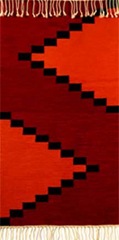
image Old weavers in Yangjing Community today still dye the wool themselves. There are more than 400 kinds of reds.

We took a short road trip to Comanche, Texas yesterday. It’s a fairly old town. and the drive is nice, through some pretty countryside. One of the town’s claims to fame is the fact that John Wesley Hardin, the old west gunfighter, shot and killed a deputy sheriff there in 1874. Until recently, the saloon where the shooting took place was still in business and (I have heard) was the oldest still-in-business saloon in the state. If you read the Wikipedia piece about Hardin, it’s hard to tell the good guys from the bad guys in the wild west days! It’s also interesting that, after prison time, Hardin went on to become a lawyer. As I think about it, maybe it’s still hard to tell the good guys from the bad guys; only the weapons have changed.

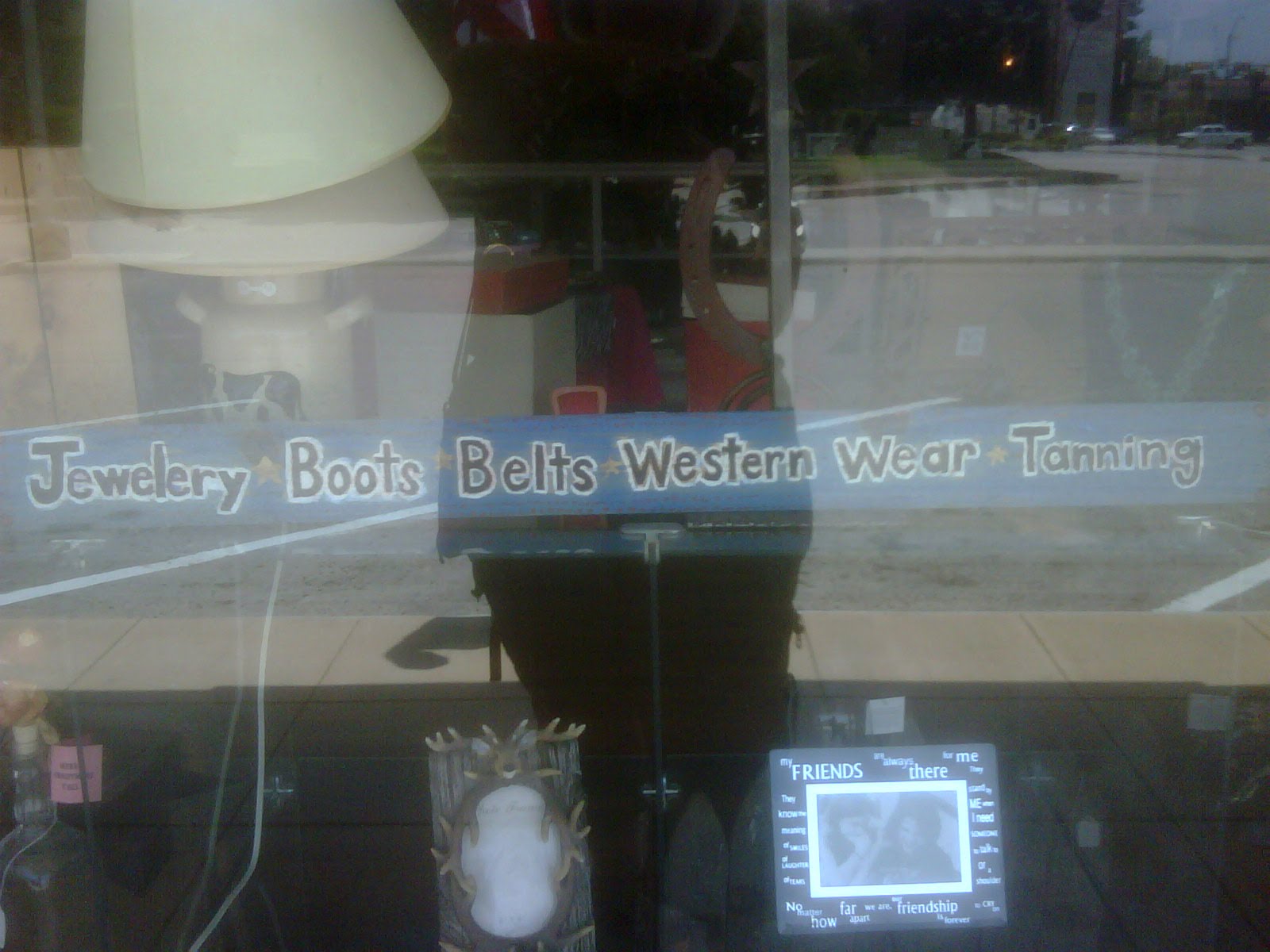
While walking around the square in Comanche, I came across this sign in a window. Love the juxtaposition of available items! But it did make me wonder: Are we talking about tanning of leather goods or human skin? Or is it one and the same?

Summertime temperatures have arrived here. Rainfall was good in April, but now we’re behind for May by 4 inches, a considerable amount. Off to water the vegetable garden and warm up the loom bench. Still listening to Shanghai Girls and finding it very interesting.

Musings on Old Shuttle, Spindle & Dyepot

Zig Zag SquaresDyed with cochineal, madder, indigo

A friend gifted me with some old Shuttle, Spindle, & Dyepot magazines from the 80s.  It’s been very interesting looking through these issues.  Besides the outdated look of the models and the use of thick yarns in their clothing, there are some gems buried in the pages.  I have been surprised at how many articles on natural dyeing there are.  Some seem to be a series by the guru of natural dyeing, Jim Liles.  The other astounding thing, at least to me, is the number of articles on tapestry and the inclusion of so many works of tapestry in the section that is called Fiberscene.  Since I am presenting a program to the Dallas guild on Natural Dyes, it was with great interest that I read these various articles in the magazines, and tapestry is always interesting to me.   And then there’s all the people—I wonder what happened to them, where they are now. More on that later… Right now, it’s time for a fire in the stove and weaving.


The Fun Part

Crosses#2I’m finally at the fun part!  The tapestry part. This is the second piece that will be similar in design to the first one, but with very different colors.  Below is my rough design with color and my working notes.  I estimated my dye formulas and dyed the yarn.  The actual yarn colors aren’t exactly the colors planned, but I just kept laying out my yarns until I found combinations I liked.  After taking Jennifer Moore’s Mathemagical workshop, I realized that what I’d designed was basically a dynamic rectangle. That being said, the drawings got a little truncated in the scanning process.Crosses_scanned