Category Archives: Tapestry

Moving along

Some pictures today… I’ve noticed that the pictures are going up on Facebook and not here. Plus, frankly, there’s just not a lot to write about. It’s cold, and I’m already tired of cold weather. On cold days, my time goes like this:

  • To the studio
  • Start a fire
  • Weave
  • Haul in more wood
  • Stoke the fire
  • Weave
  • Repeat as needed

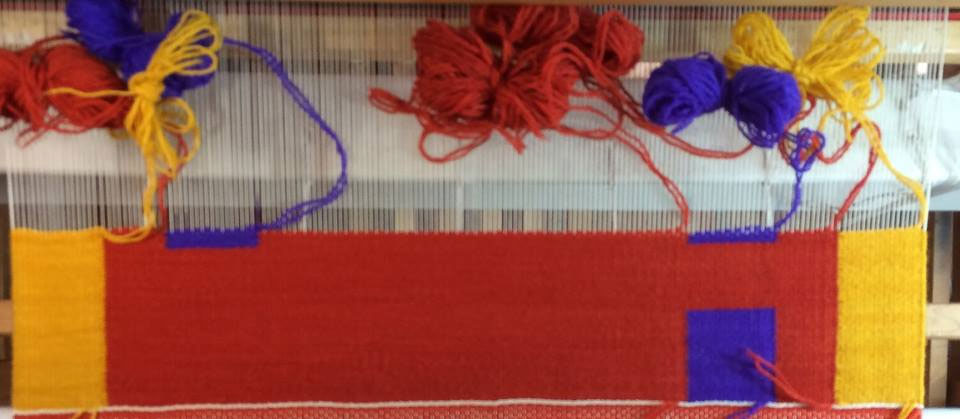
The weaving–I’m weaving two small pieces on the big loom. They are in the neighborhood of 16 inches wide, and the intent is for them to be more or less square. I was having fun weaving one of the pieces and got to the place where the warp needed to be advanced. That means it’s time to work on the other piece. With both of these I am doing something different, at least for me. Untitled-4

Detail

Detail


When I posted the above pictures, I asked if anyone could tell what it is. Untitled-1 The next pic is below.  Yep, here it is in all its glory. You may notice a lot of big slits. I don’t do slits. In theory, I know how to sew them together, but since I don’t do slits, well, you can see where this is going. And that “hair?” That’s what is in the detail above. That’s going to be everywhere, like Little Orphan Annie. Except more colorful.

And this may be the last picture seen of this project, depending on how those slits go. No matter, at least a something that’s been in my sketchbook for a really long time will have been attempted.


On to new things

Since I posted last week about the show I’m not going to in Atlanta, I feel better about my decision. West-Texas-Snowfall It’s all about that trusting your gut thing. Several people have contacted me, some who have actually lived in Atlanta, and told me I made the right decision. So, on to new things!

After a few days of travel, I am going to come back home and do a couple of small weavings on the big loom. Although I am much happier weaving on the Mirrix, I still just enjoy the big loom better. I think it’s the rhythm I get into there, and that might come on a small loom too, given more practice.

So, what’s on tap next? I’m going to weave two-at-a-time faces. They may not be successful at the sett I use normally, but I can certainly stop and move on to something else. The other studio task ahead is how to mount a small piece more successfully, namely the weather pieces. I am definitely not happy with the presentation below.

Side view of gallery wrapped canvas with fabric stapled on to it. West Texas Snowfall sewn onto the fabric.

Side view of gallery wrapped canvas with fabric stapled on to it. West Texas Snowfall sewn onto the fabric.

Glasbrook In Kirsten Glasbrook’s book, she shows how she finishes and mounts shaped pieces by sewing the piece onto a piece of linen, and then stretches the combined linen and tapestry over a piece of block board. I had never heard of blockboard, so had to look it up–here’s a page with pics and definitions. I think I’ll try a thin piece of plywood. Masonite might work, but it’s a dark color. Don’t know about that.

Another tapestry book

Tapestry-Soroka it’s is really embarrassing, but this book has been on my shelf for a while, and I haven’t looked at it. Actually probably not on the shelf for too long because I just organized my books. But still, it’s been in my house. It’s a beautiful book with some gorgeous pictures in it! There’s a bit of instruction, definitions of terms, etc, alternative materials, but one of the things I like is that  the captions under the pictures give the epi of the piece. Why that matters to me I don’t know, but it does. Maybe because I weave at 4 epi, so it’s nice to see what other setts enable one to do. Anyway, check out Tapestry Weaving by Joanne Soroka. There’s a lot of eye candy!

By the way, when I went to Amazon to get a link for the book, they kindly told my that I “purchased this item on May 15, 2012.” So, yes, it has been in my house for a while.


Mirrix again

Mirrix-loom

mirrix

Mirrix-warp

Mirrix with warp

My Mirrix is out again, after a long hibernation. I have decided to conquer this. Others rave about their small Mirrix looms, so I know it’s just me. Practice, practice, practice! I have looked at various sources for information. Of course, Mirrix has a great little PDF booklet about warping your loom. They also have a really good video. But here’s the problem–even though I knew exactly where my loom was, some of it’s vital parts were missing, things like the warping bar and the spring that spaces the warp. Luckily, I had ordered a bottom spring set, so one of those went to the top. Then I looked at alternate ways to warp, something that did not require the warp bar. Kathe Todd-Hooker has written a blog post about warping the Mirrix her way–and that’s what I did. I also ordered the parts that I need for my loom.

Now, what to weave. I have lots of ideas for small pieces, at least I did before I warped up. I’m sure they will come to me. There may even be a list somewhere,


Butterflies everywhere

butterflies Butterflies everywhere. I’m afraid to time how long it takes me to weave one inch. Maybe I’ll get brave today and do that, between all the appointments. I’ve also not timed how long it takes to perform all the physical therapy exercises that I’m doing. No matter, they’re helping. I can raise the harnesses and weave in those butterflies. That’s all that matters.

Last Friday was the opening of

ZigZag, tapestry, hand-dyed wool and mohair on cotton warp 62 x 29 inches ©Sherri Coffey all rights reserved

ZigZag, tapestry, hand-dyed wool and mohair on cotton warp 62 x 29 inches ©Sherri Coffey all rights reserved

the Texas Artists Coalition exhibit. I wish I had taken pictures, but I didn’t. Maybe I’ll go again and take a few. There were also other exhibits that I’d like to see. These are the pieces selected by the juror.

Door, tapestry, hand-dyed wool on cotton warp 50 x 28 inches ©Sherri Coffey all rights reserved

Door, tapestry, hand-dyed wool on cotton warp 50 x 28 inches ©Sherri Coffey all rights reserved

Favorite tools

Navajo-beater One of my favorite weaving tools is broken, and a replacement has not been found yet. I bought this beater/fork a jillion years ago from Weaving Southwest. It’s about 12 inches long–longer than any others that I’ve been able to find. The spaces are perfect for my 4-epi rug weaving. They are out of stock at Weaving Southwest, so I’ve been looking for others. How did this one get broken? It was dropped too many to times. It only got used when I advanced the warp too far, so most of the time it sat on the bench, only to get knocked off constantly. When/if I find a new beater, I am going to drill a hole in the handle, thread a ribbon through the hole, ad wear it around my neck, like some people do with their scissors.

What are your go-to tools? Do you have a beater you love?

Another book-The Thread’s Course in Tapestry

Book-cover After all the talk several months ago in the tapestry group about The Thread’s Course in Tapestry by Mette Lise Rössing, I decided to order it.

I like the fact that it’s spiral bound, Book-inside always handy to keep the right page open. The book is in Danish and English, which takes a little getting used to, at least for me. The illustrations are all hand drawn and are very good.

Soumak Which brings me to this very fuzzy picture below. This soumak may be open, closed, or both–for some reason those terms are confusing to me. But this is what I started an ended the rug with. And have I tried a bunch of ways of doing this beginning and ending stuff. Right now, I like the way this looks. After it’s off the loom, I still do the weaving of warp ends, which leaves them pointing in the right direction for the needle-weaving part.

I like this book, although I haven’t tried very many of the techniques. Might be interesting to do a sampler, starting at the front and working my way to the end.

Weaving and experimenting

Untitled-1 This is what I’m working on right now, and I already think I’m going to have to dye some more yellow. Plus, I made a design error, at least according to my drawing. After going back and redrawing the design, I elected to continue rather than take out four inches of weaving. Wonder why!

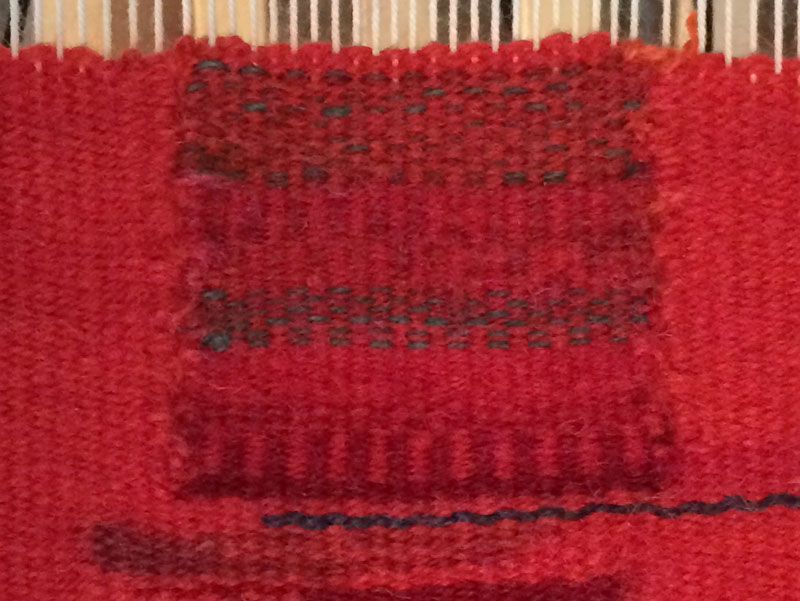
I’ve also been experimenting on the Baby Wolf. Part of the current weaving is going to have a rectangle, and I want it to look kind of like a shadowy door. I’m embarrassed to show these pictures, but I guess I have  no shame. Shading Shading-detail First of all, the Wolf doesn’t get enough tension for this purpose, but it is just a trial and error, so I continued. Originally, the little square was woven by itself. Then I went back in to weave the parts on each side. The sides were then stitched together just to see how these different techniques would look next to the background. The stitching is really messy, but that’s not the point. I’m still not sure what I’ll do when I get to that section of the weaving, but I do know what I don’t like.

Wari

Wari-catalog

My book

Wari and pre-Columbian designs from what is now Peru have long been an interest of mine, so the Friday workshop at the Kimbell was greatly anticipated.

A few of the tables set up for work.

A few of the tables set up for work.

Here is a quote about the workshop:

Up-close examinations of intricate Wari textiles and other luxury goods from ancient  Peru will direct our hands-on exploration of color, repetition, and alternation in symbolic patterns. Offered in conjunction with the exhibition Wari: Lords of the Andes. (The highlighting is mine.)

That is exactly what we did. After a brief introduction of the program, the docents led groups of “students” to particular items, with an emphasis on textiles. I wish I could post pictures about the exhibit, but I will have to post links instead and pictures of my book. (I’ll explain why no pictures at a later date.)

What I wish is that everyone could see how fine the tapestries are. The yarns used must be absolutely tiny! And of course, they were spun with a drop spindle. The other observation about the weaving is how the pattern bands line up perfectly, even though they must have been woven at different times and probably by different weavers. I have Catalog-page trouble with that when the weaving must be symmetrical. The colors are still beautiful even though natural dyes such as cochineal are used.

Here is a link to the Kimbell page about the exhibit. At the top of the page there is a slide show of a few of the pieces. Of interest to us fiber people are the two right and left stationary pictures. That brightly colored piece is really quite large in the exhibit, It is woven in about 6 inch squares, then tie-dyed. Yes, tie-dyed! After the dyeing, it is put back together to form the whole. Here is a picture from my catalog.

From my book

From my book

In order to understand more about the patterns and color repetition, I am going to have to read the catalogue, in which there are drawings to help explain more about the symbols and patterns.


What is tapestry?

At the risk of starting a firestorm, I am mentiioning a “tapestry” that was in ArtDaily today. A quote from the issue:

“Woven on a mechanical jacquard loom, each tapestry repeats four times the image of one quadrant of the painting.”

If you’re planning a trip to London this summer, you can see them here at the Gagosian Gallery.

In the eligibility requirements for entry on the ATA website, tapestry is defined:  …tapestries (defined as “hand-woven, weft-faced fabric with discontinuous wefts”). So, what’s a weaver to do?