Category Archives: Uncategorized

Arts Festival-Not!

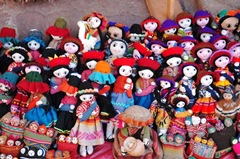
DollsThis picture has nothing to do with anything. I just wanted a cheerful picture. It was taken in a Peruvian market.

Okay, maybe I’m just in a bad mood because getting the new water filter installed on my well did not turn out to be a simple process, and as I write this, I have no water. Running water is a beautiful thing! And I miss it! And I don’t enjoy the inconvenience lack of running water causes—even for a few hours. Grumpy me!

But—I recently received a notice from an arts festival with the following in their artist requirements:

Silent Auction: All artists are required to donate an item (value of donated item must be comparable to artist’s other pieces available in booth) to the Historic Nameless Arts Festival 2010 Silent Auction. Monies raised from this event are used to further promote interest in the Historic Nameless area. Festival staff will come by your booth at 10:00 am on Saturday to collect your auction donation.

I obviously substituted Nameless for the actual name of the arts festival. I also underlined and put in boldface the part about the value of the donated item. Now, admittedly, the booths for this even are not very expensive, especially when compared with other festivals. But even a booth in one of the “expensive” festivals would not be as much as the festival is demanding of the artist. When you consider that some pieces take at least three weeks or more to weave plus finishing time, the booth space is costing the artist a month’s work—or more!

Has anyone else received anything like this? Is it just grumpy me that considers this a ridiculous requirement?
What Does it Madder?

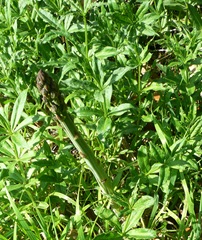
Madder_AsparagusI’m sure this picture is not very clear, but my madder has spread into the asparagus bed. It’s probably time to make a real effort to dig madder this spring. My fear is that the precious roots may have grown so far into the soil that I want be able to get them out without disturbing the lateral lines from the septic system. In fact, I’m not even sure where those lines go. Maybe they’re not even in this area at all. But it does “madder.” However, it’s for sure that digging madder will disturb the asparagus!Madder_Asparagus2
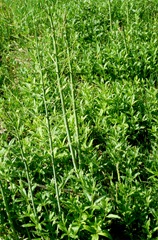
I’m mowing in stages, since everything has grown so much, seemingly overnight. I have a newly re-plumbed shower, of which I used for the first time yesterday after mowing. It was wonderful! I have a well, and ever since I had new hot water heaters installed, the hot water has been rather smelly, which seems to be worse when using the brass shower/faucets in the old clawfoot tub. The plumber could not get the anode rods out of the heaters, so I called my water filter guy. He tells me that I can install a different type of filter on my well that will take care of the problem. I really hope this works. ‘Twill be done Thursday.

The Redbuds are Coming! um…Here!

RedbudI love this time of year when the redbuds peak out—from hidden areas along the side of the road and from the woods. As I write, I am listening to the winds blow at about 27 mph. The forecast for tomorrow is rain. WhiteCrosses_purple_limeThe piece above was cut off the loom Wednesday, and I took this picture without consideration of how it will hang. The lime or purple sections will be top and bottom-or bottom and top—don’t know yet. So, turn your head to the side and help me decide which way it should hang. Here it is with lint, warps needing weaving, and hemming to be done.

I think I’m kind of in a funk weaving-wise. Can’t really focus on what I want to do next, so I think it’s break time. Time to tackle other things that are on the list. Maybe repetitive tasks like mowing, pruning, and—gasp!—cleaning will give my mind time to wander and THE idea will pop into my head. But, boy, do I hate to not be weaving!

My New Best Friends

Clips

Okay, I’m sure everyone has some of these clip things in the house somewhere. I’m also just as sure that you have multiple cables/cords that belong to various devices that go with your computer. Pictured above is the cable that goes with my digital camera. After using it, I would roll it up neatly and put it in its appropriate spot in the drawer next to my computer. But there are more cables than just the one, and invariably, they get tangled. I long ago labeled every cable/cord that comes into the house, so getting the correct one was easy, but also frustrating because when I picked up one, another one came along for the ride. Ta da! The clips moved from the kitchen to the office, and I clipped the neatly coiled cable. Works great!

Designing to Scale

Graph Paper Usually when I design, I use graph paper with the design drawn to scale. After the sketch, idea, whatever, is complete, I use 10 x 10 graph to transfer that idea to a scale drawing. I used to use colored pencils to color the design, mixing colors the best I could to duplicate the colors I wanted to use. I’ve gotten a lot looser with the coloring part but still use that to-scale drawing for the weaving process, clipping it to my loom, taking it down for reference when I come to the next part. Somehow the 10 x 10 grid is more intuitive for me than other sizes. However, I think I’m going to have to change my ways, or at least partly. From now on, I am going to take the design element and draw it out on 4 x 4 grid paper to more closely match the ends per inch that I am using. I am hoping that by doing that, my width in the reed will more closely represent the way I like to weave, that is, starting a design element with the first “up” thread up when I am weaving from the right. Another lesson learned and another work in progress. Life is full of ‘em! So, how do you design? What comes first? Last? Lessons learned?

Mirrix

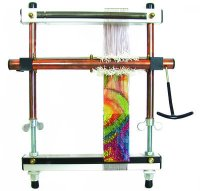
imageThis is the picture that Mirrix uses on their Facebook Fan Page. I’m sure they’d be happy for you to become a fan.

Mirrix is doing a Social Networking experiment. I am very interested in this project because I have looked at their small looms before, but have held off, trying to find out from other folks how they liked to use their Mirrix looms for tapestry projects. I have several small project ideas floating around in my head that I would like to try out. Some would be 4 x 4 inch pieces that would be displayed together. Others are in the range of 12 x 12 inches. I would like to explore using slits as design elements in a small format—why use a big loom and all that warp for a project that might not work? A small format would be easier to undo and/or start fresh when adapting an idea. I have a couple of photographs that would benefit from a closer sett than my usual 4 epi and I would like to experiment with those. And silk! I have bits and pieces of silk to use by themselves or combine with the many butterflies hanging around in jars—good forButterflies these small projects.

Sometimes, the color of the yarn itself inspires the design. Using a small portable loom would be great for that type of experimentation. I keep thinking there must be some small weaving loom suitable for traveling and vege-ing out in front of the TV after a long day. I have tried making frame looms out of stretcher bars and have even used looms specifically made for small works, but the shedding device (or lack thereof) has discouraged me. I like the shedding device on the Mirrix, or, rather, I should say, I like the way it looks and what I read about it. Until I actually use it, I won’t know.

Summer Exercise Program

I began my summer exercise program today, which consists of mowing at least once a week. Under normal conditions, it takes at least an hour to mow both front and back. One time I used a pedometer to count steps, or miles, but no longer remember the numbers.

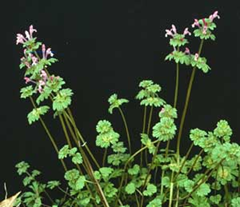
imageFor some reason the henbit is having a glorious season this year. Now, henbit is kind of attractive when it’s out in a pasture, and it looks like a wave of lavender. But when I have to walk through a crop that’s 18 inches to get from one place to another—forget it! It holds moisture and I get wet.

Every year, I am always surprised when I come across this little patch of muscari hyacinths. I didn’t plant them. They have bloomed every year since this house was put here, and every year, I wonder where they came from. And, yes, I do know about birds!

imageSomething else that suddenly cropped up a few years ago is hairy vetch. This is a good plant in that it is a legume and enriches the soil. But it clings to everything, and I would be happy to let it go somewhere else.

image

Maybe you can tell from this post that yards with perfectly manicured lawns are not really important to me. In fact, I mostly think that they are a huge waste of resources. If I could, I’d plant a prairie of native grasses and wildflowers.

For another kind of plant harvest, go here. You can read about the willow harvest of Donna Kallner. Look at the sorting process here. Here is a portfolio of Donna’s work.

I will be weighing some skeins of yarn tonight while vegetating in front of the TV. I hope to mordant tomorrow and do some natural dyes. I have been inspired to do this again, after a long hiatus. There’s a big container of handspun and other “specialty” yarns that will be used for this project.

Spring

SunflowersThe vegetables are planted, except for the blackeyes, which require MUCH warmer weather. The henbit in the backyard needs mowing. The madder is coming back. One asparagus shoot has been discovered. Guess it’s spring. Yeehaw! I’ll be glad when it gets warm enough that I can start complaining about the heat! That’ll be when it stays at 102 for several days. The picture above has nothing to do with anything, just flowers because it’s spring.

I’m taking a sort of break from weaving so that I can get caught up on other things—like getting the plumber out, yard work, etc. image

I went to a Redenta’s, a local garden store yesterday and found something I would really like to have. Not sure I can explain it, but it was made of willow, with crosspieces, designed so that it can expand or collapse, about 4 feet tall, to be used for vines. They told me it was willow, but the color was kind of coppery. Wonder if my plum thicket trimmings can become useful like that? The one in the picture above came from Gardener’s Supply. Any gardening going on out there?

imageIf you’re going to be doing any traveling and like to find art stuff along the way, you might try The Arts Map. Or just look and see what’s listed in your local area. Here’s their Facebook link.

Working

Here’s the current work as of March 24. I wanted to get a picture before the green went around the bend, so to speak. In the enlarged version, you may be able to discern a row of knots in the green section. Since this piece is fairly small (30 inches), I decided to hem it. The knots mark the line for turning up the hem. Below the real picture is the computer-generated drawing of what the design should look like. As you can see, I am working from top to bottom this time. You may also realize that I decided against doing these in weft-faced ikat. I wanted to get to work weaving right away, not wrap ikat first.WhiteCrosses3_24_10  White_crosses_finalBelow is a picture I saw that appealed to me—totally gratuitous—just like the picture.

Crosses_magazine

John Marshall

BluebonnetsOn the drive to Johnson City, I saw my first wildflowers of the year! Very exciting after the winter we’ve had this year.

imageFrom the Wildseed web page, depicting what most of us call Indian Paintbrush.

Many years ago I went to a conference of the Florida Tropical Weavers Guild. I think I will forever have the picture in my mind of students in John Marshall’s class standing on chairs to dip their large pieces of fabric in a garbage can indigo vat. Later all of their wonderful variety of pieces were hanging on a line under the trees to dry. It really was a wonderful sight!

On Monday, I had the opportunity to take a one-day pigment workshop with John Marshall, and it was also a wonderful day. John is very generous with his knowledge and a very well-organized instructor. Most of us are probably familiar with his work, but here’s the gallery for his art. I only took these two pictures of the many pieces that he brought to show. Please click on the picture for a better look at the work.Indigo_JacketJacket


We learned how to make soy milk, rice paste resist, and pigments. He explained about the way soy milk works to bind the color to the fiber. He is such a practical man, giving us pointers on what to do with the leftover soy beans, where to find materials more inexpensively, recommending feed stores and garden shops where appropriate. He also has many products on his website, which is especially helpful for hard-to-find items. And if he can’t get them cheaper, he has links to where items may be purchased. Here is his pigment page.

So that we could get started quickly on the process, we had two previously prepared pieces to work with: one for use with pigments and soy milk, the other for use in the indigo vat.

Working

The piece at the top is in the process of being “painted” with pigments. The newspaper is to catch anything that bleeds through the fabric, shown at the bottom of the picture.

Pieces_drying_pigment


Pigment-painted pieces are hanging to dry.

The next pictures are of the indigo vat. Indigo We used instant indigo for our work.Indigo2John_indigo2 John_indigo

Thanks to Deb McClintock for organizing this workshop! She did a great job of putting everything together and is an inspiration herself.