Category Archives: Uncategorized

Odds and Ends and Design Ideas

I have always wanted to go to Perú to see Machu Picchu. I love pre-Columbian Peruvian art, so a trip to Perú seems to be in order. However, after trekking over ruins lately, I have, unfortunately, come to some conclusions. My sense of balance, which has never been good, is going to have to improve. I am also going to have to build up stamina for walking difficult terrain. Machu Picchu will have the additional stress of high altitude.

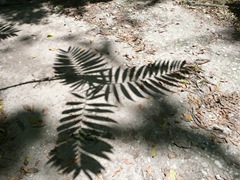
First of all, for anyone who does any natural dyeing, here’s a picture of a Logwood tree. The sawdust from this tree produces some nice purples, grays, and almost black.LogwoodTree I am always interested in possible design ideas. I took these pictures at the Museo Cerámica on the Tikal grounds before I saw the NO CAMERAS sign.Ceramics3Tikal Ceramics1 Then there are these oddities. Not sure if they’ll come in handy or not, but I liked the possibilities. Don’t you think these palm leaves look interesting in shadow?Shadows_leaves
SpiralRocksAltunHa YellowBark

The rocks above were at the ruin of Altun Ha in Belize. They are “talking” to me a lot. The yellow on the tree trunk was a beautiful color.

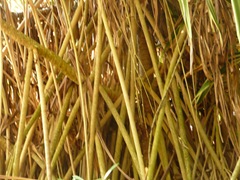
I looked at these stalks every evening at dinner. Love the graphics. I’m having a “conversation” with this picture, too.
Stalks

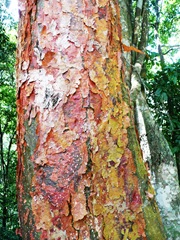
This may be the bark of the Tourist Tree on the left. Tree roots were a walking hazard. The ruins were built on bedrock, so the roots don’t have many places to go except out on the surface.
TreeBarkTreeRoots

Belize and Guatemala

Interesting vocabulary in Belize, where Creole is the lingua franca, but English is spoken by everyone and is all the signage. One of the interesting phrases is for the gumbo limbo tree—Tourist Tree—called that because the bark turns red and peels. Then, there’s the Jesus Christ lizard, which I think lives in many places in Central America. Below is a YouTube video of the lizard in action.

<\/param><\/embed><\/object><\/div>“;” alt=”” />

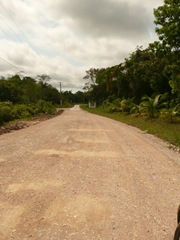
PanAmericanHiWay2We drove on what is left of the Pan American Highway. It is partially paved in places, completely potholed in all places. This is the road we took daily to go to any other locations from our resort. It took an 45 minutes to get to the intersection with the Northern Highway, where the going was much smoother. I was worried about the daily rains and this road, but with the exception of a few puddles in the potholes, the rain was not a problem. One day we turned in the other direction from our resort to go to Orange Walk Town. There was NO pavement at all in that direction, and even though the distance was shorter, the drive was much longer and harrowing. We never made that mistake again! On all roads, even major ones, one has to be on the lookout for bicycles and children. Belize is a bicycle country. Unless you’re on a bus, another problem on these one- lane roads.

I’ll have to look up these birds later, because I forget what they’re called, except for Yellowtail. They build these hanging nests, supposedly by the male. Needs more research on my part.Yellowtail_nest Nests The Hibiscus Fairy came every night and placed beautiful red hibiscus flowers along the various paths where we stayed. They would be placed on the trunks of trees or all over various other plants. Each day, they would be placed in our room, on the pillows and bath towels. The place settings at dinner had one of the palm fronds as a placemat—beautiful! HibiscusFairy At Tikal, along the path leading to the Museo Ceramica, orchids were growing in the balustrade (I guess you could call it that). Very interesting. I would imagine they would be beautiful when blooming. Enlarge the picture to get a better idea.Orchids_along_walkway Below are two trees with bromeliads. One is the kind with very large leaves. They collect water around their base inside their leaves, where you can always find something to drink—along with the poison frog if you’re not careful. The other smaller variety have completely covered this ceiba tree. Notice the base of the tree in the bottom picture. This tree was used for many things by the Maya.

Brommeliads_in_tree

Brommeliad


P1010183

So, maybe it’s time to start thinking about weaving and art again…  It’s hard to get back in the swing of things after being out of sync for so long, but one has to start sometime. As they say, take the first step, right?

From this ….

WiFi-Spot and this …

Howler-monkeys

to this ….Roses-in-Front

We took a little 10-day jaunt to Belize and Guatemala, returning home last night. The first picture is where I sat to check e-mail in the middle of the jungle. We had no phone service, but that table and chair was my WiFi hotspot. The second picture is of Robert at the misnamed Baboon Sanctuary near Burrell Boom in Belize. It is a sanctuary for an endangered species of howler monkeys. The last picture is the thank-goodness-I-didn’t-miss-it rose bush in front of the house. It smells so wonderful and looks very pretty—and much different from all the jungle vegetation that I’ve been seeing for the last ten days.

Most of our time was spent trekking over Maya ruins from Caracol in Belize to Tikal in Guatemala. Oh, and in case you didn’t know it, those temples have LOTS of steps to climb!Tikal 

Above is a view of one of the sites at Tikal, looking through the trees—a truly amazing site in person. Below is the view from the lanai at Maya Mountain in Belize, where we stayed the first couple of nights. Look closely for the thatched roof of one of the cabanas.MayaMountainLanaiView Now it’s back to real life—a mountain of laundry, errands, and groceries. But I’ve got a notebook of ideas and hopefully, some pictures for more inspiration. Lots to do and looking forward to it all!

Photography and Seeds

Photograph from NYTimes

In a cold, cold region many, many hours away, lies the Global Seed Vault. I have heard about the Global Seed Vault before, but this interview caught my interest in an artistic way. It is an interview with Dornith Doherty, a professor of photography at the University of North Texas in Denton. She had the opportunity to visit this vault and take pictures. The resulting pictures are mostly highly manipulated, but, for me, it is most interesting to see where inspiration comes from. If you look at her other photographs, you can tell that she has an interest in the environment, takes that interest, and uses it creatively. To take creativity in a different direction, think about the idea that someone, or many “someones” had to save our seeds.

Go to Dornith Doherty’s website and read her essay available under the picture for the portfolio Archiving Eden.

NYTimes article about Global Seed Vault. This is interesting stuff!

Listening to Books

image

Hoag

image

Mankell

I have been listening to Deeper than the Dead while weaving and for my drive to Johnson City in March. I get my audio books from audible.com. I have found it interesting how some authors that I enjoy reading don’t seem to translate so well to the audio format. Tami Hoag’s books can be a little gruesome, but that doesn’t seem to bother me;they keep my mind occupied. This one is written from the perspective of 1985, before DNA and so much of the other forensic science that we have come to rely on via television, was more than a glimmer in the eye. I enjoy reading James Lee Burke and Harlan Coben, but their writing does not appeal to me in audio, so I will only read the written word from those authors. Other authors that I read seem to shine in audio format. Their descriptions are quite vivid and inspire reflection on the actual writing. Hmm, when I think about it, James Lee Burke’s writing falls into this category, so I really can’t tell you why I prefer reading his novels rather than listening to them. I plan to listen to Henning Mankell’s The Man From Beijing next. He is a Swedish author that I have enjoyed in the past. I think his work has enough “meat” to it to keep me engrossed for the duration of the book.

I seem to choose books for various reasons—locale, author, culture, and just plain who knows. I may try the latest Kingsolver  after the Mankell. Sometimes I feel like I should choose to listen to books that are “good for me.” I tried that for a long trip one time. I had to get something else so as to stay awake! While driving, it is necessary for me to have something that engages my mind so that it doesn’t wander. A wandering mind, in my case, is a wandering car!

Does anyone else listen to books while working or otherwise? How do you choose which ones to listen to?

Textile Enchantress

Lynne Bruning is a textile enchantress.

I love this dress constructed of contractor’s survey string. Don’t you love creativity? It’s always so interesting to me how someone can see a material and envision something completely different for that material.

I have also been interested in woven fabrics that incorporate LED lights or other modern technology. Take a look at this evening gown with this materials list:

angelina fiber, silk organza, conducive thread, UV LEDs, beads, silk flowers

You can read more about the evening gown here on the blog of ArsalanMKhan.


Why Blog?

I found this on Bonnie Tarses blog about why she blogs. Then I listened to this podcast about why Marget Short blogs. Margret is an oil painter and you can see her blog here. I really love Bonnie’s phrase that

Blogging creates “the spiral of creativity”.

Margret talks about blogging during her project to create and use pigments as the old Dutch Masters did. She now has a new project involving pigments that would have been used in Ancient Egypt. She gets clarity on what works, and doesn’t work, by blogging about her painting adventures.

Here’s what Alyson Stanfield has to say about blogging:

1. Blogs allow you to interact with your fans.
You’re not just talking AT your readers on your blog. You’re starting a conversation the minute you post and open your blog up to comments. You respond to comments and let them know that someone is listening. In short, blogging makes you new friends and . . .  the more people you know, the more people there are to buy your art.

2. Blogs bring a little more lovin’ from the search engines.

Search engines love blogs because blogs have (or should have) fresh content regularly. This doesn’t mean that you can start a blog and it will take off immediately. It means that steady posting and building your readership will put you in better favor with search engines than if you maintained a static website. (It’s really not as simple as this, but this is a start. I would say linking and commenting are also important.)

3. Blogging can help you grow as an artist.
You learn a lot about your art and your goals as an artist when you blog and interact with people. Almost every artist who blogs regularly has shared with me that this is their #1 reason for blogging. It may not have been their most important reason for starting a blog, but it’s a big incentive to keep it up. Listen to my
interview with artist Margret Short about what blogging did for her.

4. Blogging can make you an expert.
If you post lots of how-to content, demonstrations, and videos, you can quickly become known as an expert in your field. This is particularly valuable if you who want to lead workshops or have your own radio show.

I enjoy blogging. Sometimes I think, desperately, that there is nothing left for me to blog about. But then something happens with my weaving, or I see a museum exhibit, or hear about some kind of interesting (to me) tidbit of news, and off I go again.

Why do you blog?

Picking Up Our Tools

image

This is a picture of a Bluster Bay shuttle from their website.

I heard a quote attributed to Chet Atkins: “If I don’t pick up that guitar, it forgets who I am”. I think that applies to all of us who aspire to be an artist, whatever form that takes. We need to pick up that paintbrush, that needle and thread, that chef’s knife, that whatever. If I don’t pick up that shuttle or butterfly of weft yarn, my loom may forget who I am!

<\/param><\/embed><\/object><\/div>“;” alt=”” />

Green

Green Square, part of triptych (Private Collection) Interesting article in NY Times about the toxic side of green, both as a movement and the color. No mention of indigo in the article, but does mention how so many of the older greens faded to blue. Below is a quote from the article.

Even if they succeeded, the results often faded or discolored, as did green dyes. When the 19th-century British designer William Morris created wallpapers inspired by medieval tapestries, he copied the blue hues in the originals. But most of those “blues” were really greens, which had changed color over the years.

Exciting News

imageThe picture above is from the Mirrix Blog page. Just wanted you to see what they look like, except that i think everyone in the world is familiar with these looms.

I’m going to write more about this later, but after commenting about possibly making some smaller pieces in today’s blog comment section, I thought I should mention that I am going to have the perfect opportunity to do that. As part of the Mirrix Social Media project, I won a Mirrix loom, (Yippee!) so will have the perfect opportunity to work on smaller pieces. Because of previous commitments, I won’t be able to actually start until later this month, but the brain is whirling and thinking of the possibilities. Stay tuned for the list of weaving experiments that I’m considering.

Here’s the Mirrix Facebook page.