Category Archives: Dyeing

From this to….this

Dyeing was to begin, and it did, but not without a snafu first. The yarn was in the dye pots, burners turned on, and I went back inside and set the timer. When I went out again, the burners were off and the propane tank empty. I attached a new tank (which I know was full because it was so heavy) and nothing happened. A bit of flame, then nothing. So, off to the propane place to refill the first tank. By then it was too late in the day, so everything was started again the next morning.  I untied the first sections so that I can weave even it the other sections are not dyed yet.  My big fear now is that the sections are going to be in different dye baths. Even if everything is done carefully, each dye bath will vary somewhat in color.

Stretched yarn tied

Stretched yarn has been tied with the design. The cartoon is visible beneath the stretched yarn.

Ikat-tied yarn pile

Ikat-tied yarn pile

Dyed-ikat-ties

Dyed

Dyed-ikat-no-ties

Ties removed

Drying-ikat

Hanging to dry. From here, the sections are wound into balls and then put on a rug shuttle. The labels will remain until the section is ready to be woven.


And the winner is … and grayscale again

253g The first ball of yarn on the new Nancy’s Knit Knack’s ball winder. I love it! No grinding of plastic gears. This skein was 253 g and wound on easily. You can also get a motor for the winder, which I had rejected because of my tangled hand-dyed skeins. I’ll try a few more skeins on this hard worker and possibly reconsider that decision.

The piece that I’m currently working on is made up of green and blue yarns. Below are small pictures of the work, first in color, then black and white. I think it’s interesting that the 4% blue square is still visible in black and white, but the 2% blue is not. Which only means that the value (or tone) of the two colors is very close to the same of is the same. I admit that, not being an art major, I don’t know a lot about this, but there are resources online. Here’s one that I thought was good.  There is a previous post about value and some tools to use, but I think Photoshop wins overall.

Green-blue-squares

Two shades of blue, green background. 2% blue on right. Combination of 2% blue and 1% blue on left.

Green-blue-squares-Black

Two shades of blue, green background-black and white. The first section of blue disappears.


Preview


Blue-4-percent

4% blue on green background

Blue-4-percent-black

4% blue on green background-black and white


Ice, work, ice, work, repeat as needed

Ice-pack

That’s frost on the ice pack.

Yep, it’s been a fun week! Somehow I injured my knee and could hardly walk–seriously, not an exaggeration. So, after looking up whether to use ice or heat, I sat with an ice pack on my knee. After 30 minutes of that, I was able to work for a bit. Then it was back to the chair and the ice.

But, I still got some stuff done. Lots of dyeing, Yarns and the linen warp is on the back beam. Tomorrow I will start tying it on the old warp. This is the first time I’ve put on a long warp (18 yards) of linen. That’s a fiber that really has a mind of its own! I also discovered that my careful calculations were for naught. I thought a warp of this length would take more tubes of linen, but Linen only used about half of that. Back to the drawing board/spreadsheet.

I also got a surprise on my doorstep with a book delivery. This is the third book I’ve won in the last year. Weird. This is the latest by Taylor Stevens, called The Catch. I first read one of her books when I picked Book2 up The Informationist from the library. not really expecting much. Wow! I couldn’t put it down until I finished the book. Now, whether that’s a real testament to the book or the mood I was in… who knows?

One of the other Book books is The Signature of All Things by Elizabeth Gilbert. Now that one is a long one, but I enjoyed it and found it very interesting because of the subject matter.


Natural dyeing

Dye sheet

Notes on dyeing with madder and osage.

I spent way too much time on Saturday searching for plants and/or seeds for natural dyeing. Long ago I bought madder plants from Richter Seeds in Canada. The madder plants did very well until the drought. Richter’s no long has madder plants or seeds, and evidently no one has plants. Looks as though I’ll have to start some from seeds myself. I’ve grown weld from seed relatively easily, but the leaves of the weld plant are used for dyeing. With madder, the roots are used, and it takes several years for them to get to a good size to harvest. So, is it worth it to grow them from seed?

I’ve also wanted to grow indigo, another plant to start from seed. I ran across a Donna Hardy’s blog about growing indigo in South Carolina, where there was an indigo industry a century ago. Until I read the blog, I had no idea that indigo could get so tall–9-10 feet! Botanical Colors is hosting a 3-day indigo retreat in Charleston, South Carolina. Check it out here. Donna is a part of the retreat. Botanical Colors has some interesting topics in their blog also.

Something I ran across while trying to find dye plants and seeds is this article from the NYTimes. Check it out. It includes many pictures with the article.

What’s going on

Wood-Stove

The stove has been working over time in the studio

Yes, it was 29° here yesterday. Yes, I did some dyeing. Yes, my brain must have been frozen because I really messed up this session. Instead of the sort of ochre color I was aiming for, I weighed my dyes without changing the weights back on my scale. That means instead of putting in, say 1 gram of magenta, I put in 11

Mustard and magenta yarns

Mustard and magenta yarns

grams. Not really a disaster, but I needed the ochre color. So, to try and spread the dye love, I added two skeins that were already dyed mustard. I can’t tell that it made much of a difference.

The two on right were mustard

The two on right were mustard

So now I will rethink my plan for the next weaving. At least I tied on the warp and am ready to go, and I got out the small loom to prepare for warping. I made a spreadsheet for the warp calculations–I was probably trying to delay the warping, but it does come in handy, and I don’t have to reinvent the wheel.

As I was looking a photos of the yarns I found another one that I took on the day of the wall-restaurant natural dyeing program. It is of the wall in the restaurant where we went to lunch. I love the patterns and texture of this wall. What do you take pictures of? Patterns? Colors? All of the above?

If the ice on the streets disappears, I will go out and get a saw and miter board. An experiment to see if I can make better cuts.

Experimenting, part 2

Ikat

Even my weaving is an experiment. I really should be “sampling,” but I just go all out, so weaving is not the refuge that it usually is. I took out all the weaving that I pictured last week and started again. It seems to be going better this time around. I’ve decided I’ll complete the first section and then make a decision—cut off or continue.

Giving up?

I told myself that I would experiment with this for three months, so giving up is not a good option. However, I could go back to only rectangular shapes until I have a better handle on what is measured on the ikat board and what actually weaves up. Hmmm…

What I’ve learned this go-round

Detail-center

Weaving

Detail

Woven

Section-1

Woven

One of the things that I’ve learned is to try to center the next pick with the one before it. That means forgetting those marked warps and trying to weave the design according to those. By centering the wefts in this way, they make the shape they’re supposed to make. On the left is a section woven in this manner. Now, that doesn’t mean they’re as good as I would like, but an improvement over the bottom picture–which I took out.

Dyeing

Yellow-yarns

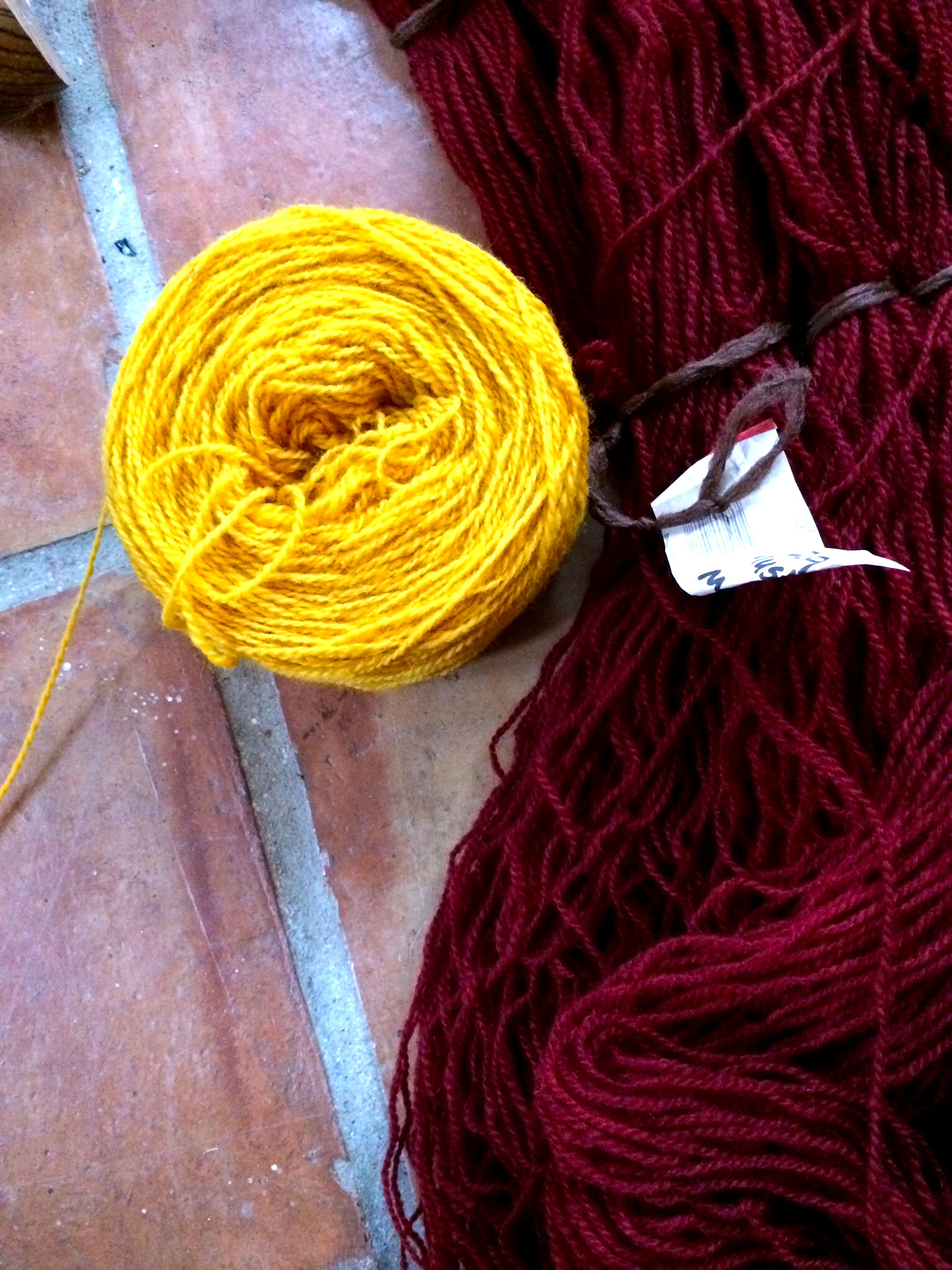
Trying all of those WashFast colors that I have is another experiment. After my initial disappointment, I’m really liking the colors. I’ll put them all in a pile and take a picture soon. Also need to make sample sheets, since the samples that I received are dyed at different percentages. Above are two yellows. The skeins are WashFast and the ball is the yellow from my usual dyes. The new yellow has a greenish cast, although not as severe as in this picture. Below is an adjusted picture. Not much better after all….just believe me!

Yarns-adjusted

Photo adjusted

Ikat Dyeing

More on this later, but experimentation here also. I’m not even dyeing the other tied sections until I decide the fate of this piece.

Winter, books, museum, ball winders

Shibori-book

Shibori book

Something I’ve never done before–used the interlibrary to request a book from my local library. Wow! Worked great and fast! I can’t remember why now, because I’m probably not going to do shibori any time soon, but I put the Karen Britto book Shibori: Creating Color & Texture on Silk in one of my wishlists in Amazon. The book may be out of print, which may explain the price, but before spending $35, I wanted to see it. Thus the interlibrary. After looking at the book, I may spring for the $$$. Ms. Britto talks about the two kinds of dyes I’m currently using, but more importantly for me, there’s a chapter on using the Munsell color system. I already have those chips and would like to use them effectively. The problem for me is the dye samples. I will have to figure out some way to dye small batches of possible colors with the equipment I have. Well, and find time too.

Seems I spoke too soon about our fall weather–winter is scheduled to arrive with a vengeance tomorrow. I hope it doesn’t bring that “wintery precipitation” with the winds. The Kimbell Museum is set for members’ tours of the new Piano Pavilion. I have listened to a couple of programs about this new space on the radio. Evidently the concrete used for the walls is a special type and seems to be a better background for many of the artworks. Doens’t that sound strange? Something I’ve never thought of. Maybe I’ll get to see for myself soon.

And a totally off topic question–Do you have a ball winder recommendation? I have a really old plastic one that works, but frequently the gears click as I wind, so the writing in so on the wall. Some of these ball winders are REALLY expensive, so I want to hear feedback from anyone about ball winders.

Fall, finally!

Fall

Fall colors at my mother’s.

It’s pretty boring around here–dye, weave, dye, weave, … and work on getting outdoor clean-up projects done. Boxes of shred material will go to the shredder soon, too. The weather is nice right now, so those things are the priority.

I know we don’t have fall color like the northeastern part of the country does, but our fleeting color is still pretty. A couple of hours after taking this picture I loaded it on my computer and realized that for me, the grasses are almost as pretty as the trees. I love trees, but I’m a prairie girl. When I take road trips to the east, claustrophobia sets in. It’s so frustrating to not be able to see areas off to the side of the road!  Here we have wide open spaces, not like farther west, but still mostly open. In fact, I’ve heard visitors from the northeast say that they feel so exposed. By the way, to get the full effect of the picture, click on it. And speaking of grasses and prairie, that’s my next weaving project.

Yarns

What about these colors!

So, here are the fruits of my labor so far. The WashFast dye colors from left to right are:Turkey Red, Magenta, Red, Tiger Lily, Chinese Red, Deep Purple. All were dyed at 1%. I dyed the red and magenta first, and they were disappointing to me. But I continued on and gradually came to like these colors. The really interesting part will be to start mixing colors. The blues and another purple will be next. Dyeing in this way means that I can use the same water over and over, which not only saves on water, but also on all the additives that go into the pot.

Research? Of course not!

Magentss I’m doing some dyeing with new-to-me dyes. I know of other weavers who use these WashFast dyes (labeled Nylomine), so I thought I’d give them a try, but that wasn’t the main impetus. It was because of the pairing of WashFast dyes and the Pantone forecast for spring 2014. It’s a PDF, so I can’t post the exact link, but it’s first on this page.

I’ve ordered the dyes, made a plan for getting samples done, and started Sunday. Right away, I was concerned. But first, going back a bit, I have the wool color card from ProChemical for these dyes and had noticed that nearly all of the colors were dyed at a 1.5-2% solution. Most all of the dyeing I do is at 1%, so that’s how I’m doing my samples. From the first weighing of the dyes, I noticed that it seems to take more dye to reach that 1% amount. I also noticed that when the dyes are added to the water in the pots, they look anemic. So, I decided to do a little research about the difference between WashFast dyes and the Lanaset-type I’ve been using (ProChem calls them Sabraset). That led me to Paula Burch and her All About Dyeing website. What I have discovered is that these dyes may not be as washfast and lightfast as the Sabraset dyes. I’m going to forge on though. Dyeing all the reds now, but then I’m going to clean out those pots and start with yellows, moving up the list to darker colors.

By the way, I knew about Paula’s dyeing website but had forgotten about what a wealth of information it is, from descriptions of dyes to methods to book reviews, it runs the gamut. Check it out.

Death of a Dyer

I wrote about Death of a Dyer here. Briefly, the book is a mystery set in 1796 in which the main character is a traveling weaver. That fact and the title compelled me to check the book out and start reading.

Within the first chapter or two, I had to do a little research, and that always takes me down a few rabbit holes. Here’s what I’ve learned:

Nankeen-a quote from Wikipedia. If you follow the link, you will see a picture and a bit about stencils and indigo on nankeen cloth.

Nankeen, also called Nankeen cloth, is a kind of pale yellowish cloth, originally made at Nanjing from a yellow variety of cotton, but subsequently manufactured from ordinary cotton which is then dyed. Also in the plural a piece or variety of this cloth.

Southern Exposure Seed Exchange had nankeen cotton seeds before they were destroyed by a fire. I was glad to be reminded of this company because they have lots of interesting seeds there—worth a look.

As the title says, there is the death of a dyer, so dyestuffs are mentioned, like Spanish Red. I’ve heard of Turkey Red, but not this one. That is, until I looked it up. Spanish Red is actually cochineal. The Spanish settled in the Americas long before the pilgrims came to North America, so the red dye was already in use. Like cacao becoming a desired food, cochineal was a valuable dye material. So, even though I am familiar with cochineal, I still found some articles that are interesting. There are a few of them below.

This Washington Post article by Diane Ackerman is really a book review, but it’s still interesting. The book is A PERFECT RED: Empire, Espionage, and the Quest for the Color of Desire by Amy Butler Greenfield.

I recently was in Arizona (I spent one night with Barb Nelson) and saw a type of prickly pear that’s purple. I wish I had taken a picture of one that was covered with cochineal bugs, but we were driving down the street. If you’re interested, you can see a picture here..

Scutching was mentioned, and I was pretty sure that it has something to do with linen, or rather flax. But scutching knife? There was one that was sold on eBay.

I finished the book, although I really did not enjoy it very much. Turns out that a travelling weaver has a loom that breaks down quickly. Hmm… One small complaint—the dyer had been using local plants to find a green that was all the rage. That’s a problem since most greens from natural dyes are actually a two-step process using indigo (or woad) and overdyeing with weld or another yellow dye. Again, Wikipedia has a nice article about natural dyeing.