Category Archives: Dyeing

Lessons

You know that old rock and roll song, There’s a Whole Lotta Shakin’ Going On? Unlike Jerry Lee Lewis, I need more than one take to get it right. Around here, it’s been a whole lotta learning going on. By the way, the link above takes you to an NPR program, and a really clear recording of the song. Get your energy level up!

While weaving the last piece, my beating seemed to be a bit off, like maybe 1/4 inch from one side to the other. Loom-front Loom-front-closeup I looked at the notches where the beater hangs and all seemed fine and good, both sides in the seemed to be in the same notch. So, I got out some string and attached to pieces diagonally in the frame. I made sure to mark exactly in equal places on both strings. When I untaped them and compared, they were exactly alike. This was very puzzling, but then I looked at the notches for the beater bar from the side. This is what I found. Loom-side-wrong  You may be able to tell that the bar is not actually resting in a notch, but behind the notches. Loom-side-notches This is what it should look like.

In my ikat world, I am doing some cross shapes in varying shades of rust to be over-dyed. Rust-tied After making the cartoon, I remembered that I am measuring this in what will be 1/2 inches of weaving. Therefore, all the vertical elements of the design needed to be stretched. Added to the cartoon. Then I ran out of one of the rusts that I was going to use. I had some samples of rust that were exactly what I wanted. Rust-samples These are baby skeins that I had experimented with several years ago. This photo doesn’t do the colors justice. Anyway, I dyed some skeins in the same formula. Rust-yarns Rust-yarns-close-up Believe it or not, both photos are of the same yarns. You can see the tied part. Next to it is the skein that should match the left skein in the sample. So lots more dyeing had to be done. I think I’ve got it now, and have decided that I don’t care if I don’t. So there!

Wari

Wari-catalog

My book

Wari and pre-Columbian designs from what is now Peru have long been an interest of mine, so the Friday workshop at the Kimbell was greatly anticipated.

A few of the tables set up for work.

A few of the tables set up for work.

Here is a quote about the workshop:

Up-close examinations of intricate Wari textiles and other luxury goods from ancient  Peru will direct our hands-on exploration of color, repetition, and alternation in symbolic patterns. Offered in conjunction with the exhibition Wari: Lords of the Andes. (The highlighting is mine.)

That is exactly what we did. After a brief introduction of the program, the docents led groups of “students” to particular items, with an emphasis on textiles. I wish I could post pictures about the exhibit, but I will have to post links instead and pictures of my book. (I’ll explain why no pictures at a later date.)

What I wish is that everyone could see how fine the tapestries are. The yarns used must be absolutely tiny! And of course, they were spun with a drop spindle. The other observation about the weaving is how the pattern bands line up perfectly, even though they must have been woven at different times and probably by different weavers. I have Catalog-page trouble with that when the weaving must be symmetrical. The colors are still beautiful even though natural dyes such as cochineal are used.

Here is a link to the Kimbell page about the exhibit. At the top of the page there is a slide show of a few of the pieces. Of interest to us fiber people are the two right and left stationary pictures. That brightly colored piece is really quite large in the exhibit, It is woven in about 6 inch squares, then tie-dyed. Yes, tie-dyed! After the dyeing, it is put back together to form the whole. Here is a picture from my catalog.

From my book

From my book

In order to understand more about the patterns and color repetition, I am going to have to read the catalogue, in which there are drawings to help explain more about the symbols and patterns.


The dyeing blues

Color-aid-box

Color-aid box

Not the color blue…colors that I want to dye. I’ve got a project on the loom, using the colors I have, although they aren’t totally what I want. So, in an effort to try and match the colors, I took the RGB colors and went on a web search for find color chips. Well, if I’m not going to buy a Pantone set for bunches of money, it’s back to the drawing board. A couple of the skeins that I dyed were tied with an orange yarn. I love the color that resulted from the over dye of turquoise and blue. Maybe that’s where I should start. But as I have been writing this, I remembered the Color Aid papers. Gonna give that a shot. Then some of those skeins of orange and yellow are going to get over dyed.  Oh, and just as an aside, it’s really hot here. My dye room is like a sauna–really.

Colors-color-aid

Color-aid paper practice

Later–I got out my itty bitty set of Color-aid papers and searched for the right colors. I was able to find some that are pretty close. Let me clarify why I wanted to do this. I took my very simple design and added color to it on the computer. The printout did not print the colors as accurately as I wanted, and it is hard to take the computer picture and match it to my yarn samples. That’s why I wanted “chips” to carry around with me. I was able to do that with these colored papers. Here are the matches I came up with, although the photo of these colors is not spot on. Those blues look more purple-y than in the picture. There are 314 color chips in this small set–that makes for a lot of sorting through for just the right color. And these sets are not cheap. This small box of 2 x 3 chips is $34.50.

Goals for the week:

  • studio hours-20
  • clear brush by driveway
  • dye more yarn
  • steam press one more piece

A tale of two blues…

The next piece has been decided, yarns chosen, and warp tied. In fact the first couple of inches have been woven. After the first section, will be two broad (9-inch) stripes of some sort of blues. I finally decided that they are in the turquoise category and planned what to dye. Turquoisse-yarns One of the stripes will be a darker, turquoise-y color as in the top left in the picture. I want the other color to be lighter. On the bottom left is a color that appears lighter, but also may be too blue to suit me. It’s dyed with a 50/50 combination of turquoise and blue, so I decided to up the turquoise and dye a 60/40 combination. The darker turquoise has a bit of black in it, so I’ve got another pot going with that combination of colors in the same proportions, but instead of a 1% dye, I’m going with 1/2 of that. In decimal land, a place where I pretty much remain a stranger in a strange land, that would be 0.005 instead of 0.01–I think. At least it will be easy to over dye the experiment if needed. Oh, and that other ball of yarn on the lower right–it was dyed just like the top left one, but in a different pot. That’s what they mean when “they” say make sure you get enough yarn in the same dye lot.

June

Lizard Gosh, it seems like a long time and not long enough. The boys went home yesterday. It was really hard to send them off, but now it’s time to get back into some kind of routine. It seems that everything we did was hot and sweaty!

One of the things we did while they were here is ride the train to the Dallas World Aquarium. The creature left Reading-the-paper is one of the many pictures I took. The boys wanted one last trip to Benito’s before heading to the airport. They waited for me outside as I paid the bill. Waiting for me with newspapers in hand was a joke for me.

On the way home from the airport yesterday, I took a detour to Olla buy an olla, which I’ve been trying to find for a couple of years.

I dyed part of the ikat yarns while they were here, and my night hours are spent cutting the wraps off of those yarns. I put them on a towel because they’re still damp. This ikat Ikat-Yarns-partially-unwrapped tape makes a mess, even though I try to be careful. You can see just a couple of the bits that get scattered (marked by the arrows). Multiply that by about a thousand. There’s still one more section to dye. I decided to dye them in sections because of probable dye lot variations. My evenings in the near future will be spent cutting off ikat tape–a mindless activity to be done while watching a movie.

Question–does anyone know of a way to convert treadles on a loom to treadles for a standing loom? Maybe there’s an engineering type out there that can think of a way. I really wish there was some way to stand and weave on my Cranbrook. I get really tired of sitting!

A reason to blog

YarnsDyedApril-2013

Yarn and more yarn

Yes, I was pretty excited about having some newly dyed yarns, but after starting the weaving yesterday, I realized that I will need more of some of the other colors. When I first sorted the yarns that I was going to use, I just eyeballed them instead of actually weighing these leftover bits and pieces. Not a good practice! So it’s off to the dye pots today! While the yarns are doing their thing, I will be mowing, stopping only to do a little stirring. I set my time to remind me that pots need attention. I love seeing those colors coming out of the dye pots!

Record keeping is not one of my strengths. I keep really good records of the dyeing and the warp left on the loom, but not of the finished pieces. Late last year, I started putting a date in the spreadsheet I keep for finished pieces, but that means many pieces on that list are unattached to a year. Recently, I was asked for a date on a piece, so what did I do? My memory certainly was not going to help! Blogging! Did a search, and, yes, there it was!

The list

As the to-do list grows longer and longer, I can at least look at my dyed yarns with a YarnsDyedApril-2013 sense of accomplishment. Somehow many of the hanging boards are not with their respective weavings and are missing. A few did not come home from the gallery with them, but I don’t know what happened to the others. So, to the lumber store to buy boards, paint, and maybe more Velcro–they’ve got the strong industrial stuff there.  Grrrrrr…..But look at these yarns!

Wheel goes ’round and ’round—not!

The continuing saga of the spinning wheel, well, continues. I read that this wheel is yarn driven or bobbin driven or something. No matter—I can’t get it to spin and really don’t have time to fool with it now. I did check with Ravelry, though. I seldom go there–did you know there’s a whole group of Country Spinner 2 spinners? Plus, about a million other groups.

The warp is on, header woven, and the loom is waiting. I dyed yarn yesterday and washed a bunch more. I am ready to weave, that is if the grass weeds will stop growing. Today I’m going through my available pieces and make sure all the hanging paraphernalia is there. I do have this little show coming up! On the other hand, I’m getting pretty excited about a possible series I’ve been thinking about. It’s been way too long being lost in the creative desert!

Recently I was reminded again about how much I like the work of Forest Bess. I mentioned him once before, but I read about an exhibit in Houston in WSJ. The caption with this painting is: The Menil Collection The 1949 painting ‘Bodies of Little Dead Children.’ That’s a little confusing since the Menil Collection and Mr. Bess’s website call this painting Dedicated to Van Gogh. Maybe I’m just not seeing right. What do you think? Which title best describes or goes with this painting?

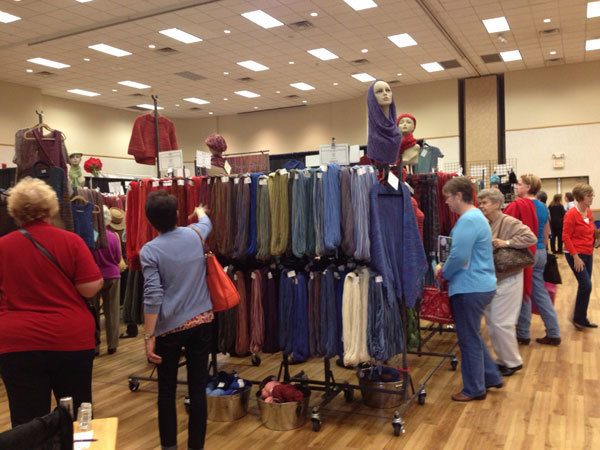
DFW Fiber Fest 2013

Overall So, how do you go to FiberFest and come home with a spinning wheel? You try it out and get hooked. Saturday my sister and I went to FiberFest DFW. She bought yarn
(we spent lots of time in the Madtosh booth–gorgeous yarns!) and I was feeling rather proud of myself for not buying any.The Madelaine Tosh yarns are wonderful! Creatively dyed, great fibers.

Then I tried out the Country Country-spinner Spinner. Even though this wheel is designed for bulky yarns, it worked just fine for finer yarns that I want to spin. And the bobbin holds over two pounds of yarn! spinning-wheel I bought the wheel from Gritty Knits, a vendor located near Houston. Since this wheel comes in a box, I am grateful that Natasha has been willing to answer questions. spinning-wheel-parts2

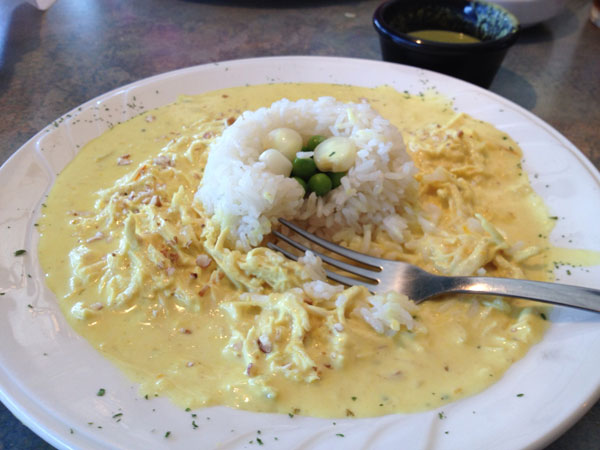
Aji-de-gallina On the way home from our outing, we stopped by a new place to both of us, a Peruvian restaurant called Ñusta’s Café. Because G and I used to like to try out new places, I would put possibilities in my Evernote file, making them handy when we were out and about. Mariscos The food was delicious! We’re going to go again to try other menu items.

Today I am sorting through colors of already dyed yarns so that I can make a list of what colors I need to dye for the next project. I also have to go back to Fedex because the enlargements they made for me are all the wrong size. It was written on each page what the size should be. That’s what I get for leaving them there instead of waiting for them. Such a waste of paper!

What a summer we could have

Warping

Warping

Okay, right off the bat here, I’m just going to say that I was one of the last people in the world to get an iPhone. I was happier many years ago with a Windows based phone, but my previous phone was a Blackberry. The syncing really drove me nuts with the Blackberry. So, I’ve got this iPhone, I can take a picture, send it to my Photostream, and voila! there it is on my computer. Now I’m not going into any of the privacy concerns that this makes me think about, and I am pretty careful about what I post, names, etc, ‘cause this stuff never goes away. All of that verbiage gets me to the photo on the right. I took it, sent it to PS, walked to my computer and posted it. About the photo–Do you see all those empty spaces just waiting to get a warp coat? The last bout I wound on the warp beam just tells me that I have the attention span of a gnat! There are mistakes. I’m only putting on 30 yards, which means I have to count ten revolutions of the wheel. And I have to do that 12 times because each section is 2 inches and I’m warping 6 epi. But even with that simple count to 10, my mind goes walk-about. Which brings me to the next part…

Workshops. There are so many good workshops this summer, and I have been tempted mightily. But I finally decided that the money for a workshop could better be spent getting a “real” dye place set up, one that I wouldn’t be embarrassed to take home to my mother. The following are some of the workshops I have considered:

Sarah Swett

THE VALUE OF VALUE How do images come alive on a warp? What gives things the appearance of volume? How can a collection of woolen shapes exude energy, movement and mood? In this workshop we will look at yarn, light and color as we try to answer these questions and more. The class begins with a series of exercises in blending and value progression, exploring how these can be manipulated to model form. We then apply these principles, each person designing and beginning to weave a cartoon based tapestry. Students will work with pencils, paper and wool as they train mind, eyes and hands to develop and weave flat objects that come alive on a weft faced surface.
Plus as a bonus we will learn to incorporate a “4-selvedge” warping technique, for those that would like an additional challenge.

By the way, if you haven’t seen it, take a look at this news bit with Swett’s tapestries and an interview. Absolutely amazing work!

Mary Zicafoose at Tapestry Weavers South

You can read about it on Tapestry Share. The descriptions below came from Mary’s website. Mary is an excellent teacher, and this was so tempting. I took an ikat workshop with her in Nebraska.  If you’re interested, read here, although it seems I wrote more about the trip than actual workshop. And just as an aside–I think I need the last one on this list, The Zen of Weaving….

The Language of Art: COLOR

This one-day intensive dip into color will saturate your palette and provide courage at the loom and dye pot. In referring to the work of colorist, Josef Albers, students create a color workbook of 24 personal studies. After cutting and pasting through the rules, you will brave into bending theory, pigment and hue, striving to speak with a new frequency in your work.

Class Size: 40
Level: All
Equipment & Supplies: Separate attachments
Lab Fee: $25 (workshop folder and a 240 pack of color-vu silk screen papers)

The Language of Art: DESIGN

This one-day class will focus on the sequential steps required to develop your unique visual ideas into dynamic tapestry and rug designs. We will spend the day looking at images, drawing, and developing hunches into plans for a series. This is an ideal “time-out” to collect your thoughts, expand your design tools, talk about your work, and transform ideas into workable blueprints.

Class Size: 40
Level: All
Equipment & Supplies: Separate attachments
Lab Fee: $5

The Zen of Weaving: Getting Inspired, Staying on Track & Reflections on the Making of Fabric

This one-day workshop abounds with handouts and resources to nourish and nurture the busy artist, spinner and weaver. This unique fiber class provides stimulating exercises to aesthetically recharge and ample food for thought about unraveling the threads of life. Focus is on creative purpose, goal setting, stress management and staying in the flow of production and inspiration. There will be time for specific Q & A, and portfolio consultation.

Class Size: Unlimited
Level: All
Equipment: Slide projector, screen, CD player, flip chart

Indigo with Botanical Colors

Description below is from the email I received. Again, so tempting. While you’re there, read about Pigments of Provence with John Marshall and Kathy Hattori.

We will work with a number of different indigo preparations and specialty indigo powders procured from small cooperatives and organic producers. You will learn how to create, maintain and revive your own indigo vat using both the organic fermentation and the chemical lye-hydrox vat method. You’ll explore dipping and color strategies and techniques such as resists, overdyes, underdyes and surface effects and gain confidence and ease with working in your own studio by practicing vat observations, troubleshooting and problem solving with a skilled mentor.

We will experiment with the following indigo varieties:
* Organic indigo powder
* Bangladeshi fair trade indigo
* Salvadorean fair trade indigo
* Instant indigo
* Saxon Blue converted indigo
* Plus a few surprises if the weather and crops cooperate

Each student receives a notebook of indigo recipes and techniques, a set of pH indicator strips, plus yarn, paper and fabrics for dipping including ribbons, silk, velvet, and handwovens. Students are encouraged to bring their own fibers to dip; guidelines will be sent with registration.

Each student will tend their own personal vat that they will build, balance and maintain.