Evolution of a design, part 3

Grass-ikat-design change

Prairie Fire

Grass-ikat-1

Prairie fire

©Sherri Coffey-Prairie Grass

Prairie Fire woven

For the last couple of posts, I’ve been dissecting a design process that happens sometimes. The piece was originally intended to have three sections, each dyed a gradation of the previous one. When I decided a design change had to happen, it was back to the drawing board, or in this case, the computer. At least I could get a bit of an idea about proportions, etc that way. The purple stripes in the drawing? Those were added as I wove. Some things just have to be decided on the fly, so to speak. The sections just needed a bit of separation, but the actual purple is only a few picks.

A name change was definitely in order. Meet Prairie Fire.
Evolution of a design, part 2

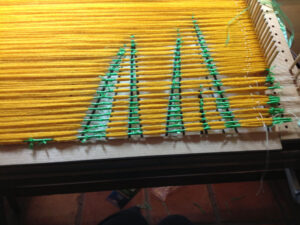
1.5-hours The design I wanted to have is shown in the previous post here.  Executing the design is a different matter entirely. Grass-ikat The plan was to do this in ikat, which presents its own set of problems, at least in the learning stage I’m in. (About this supposedly being yellow grass–that decision came about because of the ikat portion of this equation. The yarns need to be a color that can be overdyed nicely)  After enlarging the cartoon, I started tying the weft yarns, which is not a problem, just time-consuming. The yarns are then dyed Shuttle again, ties removed and it’s ready to start weaving. And that’s where the problems begin.

In order to weave the design that’s tied into the yarn, the warp needs to be the right width. Unweaving and reweaving happened over and over before the “real weaving” could begin. And I wasn’t really happy with the real weaving result, so a design change was in order. Two sections of this design was ready, and I was not going to spend more time tying more ikat yarns if I wasn’t happy with the weaving. So, another design was born.

Do you have a weaving project that just didn’t work after you stated weaving? Did you change the design, leave it as is, or what? Sometimes I envy quilters who have design walls where they pin up their design. I do the next best thing I can think of, but maybe there’s a better way. Next time…


Evolution of a design

Grass-ikat-drawing

Prairie Fire drawing

Grass-ikat-1

Prairie Fire

Prairie…what do you think about when you hear that word? Most people think of vast, flat land that goes on forever. That prairie is probably a tall grass prairie on the Great Plains. You can read a little about the Tall Grass Prairie here, and there’s a really interesting article about preserving the Tall Grass Prairie by setting fires here.  I recommend that one. Where I live here in Texas is the mid-grass prairie, although the Texas Parks and Wildlife Department calls it the Cross Timbers region.

Frankly, I never considered the prairie at all, and if I did consider it, probably thought it boring. That was before I actually studied it and came to appreciate it. Our prairie is not that vastly flat Great Plains. We have hills. Low hills, but hills. And this brings me to my real topic today.

A few months ago, I went to a lecture at the Kimbell Art Museum during the Picasso to Matisse exhibit. The lecture was really quite interesting, but as I was sitting there, I started thinking about possible weavings about the prairie. Before I left the lecture, I had thumbnails of many of my ideas and a list of more possibilities. Since that time, I have been trying to decide how to actually execute my ideas. My first attempt was not a total success, maybe not even a fractional success. The two drawings above show what I wanted to do in terms of depicting grasses. Yes, I know, it’s yellow. The rest of the story next time…

Colors and mental floss

Have you heard of the magazine called Mental Floss? It’s a magazine that has “random, interesting, amazing facts,” according to their website. I don’t have an opinion about the amazing part, but it really does have random and interesting down pat, and I am not a trivia person. Just don’t see the need to have all that extraneous cluttering up my mind.

The magazine also has its own Facebook page, where I saw this little nugget of information–11 Colors That You’ve Probably Never Heard Of. Now we weavers are all about color, so of course I had to check it out. And they were right, I had never heard of most of these colors: sarcolene, coquelicot, smaragdine, mikado, glaucous, wenge, fulvous, xanadu, falu, eburnean, and amaranth. I’ve known that amaranth grain was used by ancient peoples, and you can still buy the seeds today, but I did not know about the color, which makes sense when you look at the picture of the flower.

Another example of random, interesting (weird?) facts from Mental Floss: The Dirty Etymology of 9 Everyday Words Etymology. Gotta love it!

Where does the time go?

Painted-boards Where does the time go? Already the middle of April–can you believe it? Of course, we are still having cold weather for us, 33 in the mornings. That’s cold for us. I used to plant my garden, except for tomatoes, in the middle of March. We still need rain, lots of rain, but the teeny bit we did get really got things growing, so I’m cutting brush again. And mowing. And still hauling bags of compost.

In my weaving world, not much is happening. I decided that I would take some time and prepare for the Fayetteville, Texas show. Although the pieces have all the finish work done, they don’t yet have their hanging boards. Outside is windy, but I sprayed those suckers. Tomorrow, it’ll be Vecro time, drilling holes, and labeling each board for its “owner.”

Today I signed up for a monoprint class. I’m excited! Who knows if I’ll like it, but it sounds like fun. I’ve got a few ideas rolling around for things to try. Talking to Lynne today, she explained a bit about what we’ll do in the class. Check out her work here. When I looked at the image on her homepage, at first I didn’t see everything. Then I noticed the reflection in the car mirror. Very interesting.

Favorite tools

Navajo-beater One of my favorite weaving tools is broken, and a replacement has not been found yet. I bought this beater/fork a jillion years ago from Weaving Southwest. It’s about 12 inches long–longer than any others that I’ve been able to find. The spaces are perfect for my 4-epi rug weaving. They are out of stock at Weaving Southwest, so I’ve been looking for others. How did this one get broken? It was dropped too many to times. It only got used when I advanced the warp too far, so most of the time it sat on the bench, only to get knocked off constantly. When/if I find a new beater, I am going to drill a hole in the handle, thread a ribbon through the hole, ad wear it around my neck, like some people do with their scissors.

What are your go-to tools? Do you have a beater you love?

Geez!

Door-card
Not a great picture because of the angle being wrong, so parts look weirdly odd sized. Forgot I need to get to the photographer.

Ever had those days when you sit down to do a project, and before you know it, it’s getting close to 5:00 PM? Welcome to my world! I decided that, since I had ArtWalk coming up, I would feel so much better if I crossed some things off the to-do list. You know, little things Illusion-card like the hanging boards, postcards, etc.

One of the things I noticed last year was that visitors to my booth would take a postcard but not a business card. So getting postcards done was one of my goals for the day. And as it turns out, the only goal for the day.

I’ve heard great things about Moo, so I gave it a try. For me, there was a learning curve in the designing my own process. Postcards (and other printing projects) have safe areas, bleed areas, cutting line, etc. I would get a design done, upload it and realize the words are too close to something or other. So, a do-over. Another thing that I’ve heard folks talking about is that you can get a mix of designs with one order, but I finally gave up on that idea, and just ordered cards. There comes a point….

Tomorrow? Cut and paint boards. Woo hoo!

DFW Fiber Fest 2014

What's on the loom

What’s on the loom

It was about this time last year, the time of DFW Fiber Fest, when I bought a new spinning wheel. I only wish I had known how stressful it would have been to put together. I had everything together but one pin that was supposed to go through the spinning-wheel-parts2 hub of the wheel and a hole in the crank (or whatever that’s called). I could not get it to go in. I finally had to put it aside because of all the other stuff going on. And it stayed aside for a year. Until Saturday. I took the wheel and the very kind husband of the couple who own the shop, fixed it. And there was a special trick to it. So there! Country-spinner

I also took some fleeces to Gail of Ozark Carding Mill, so that she can turn it into roving. There’s something sad about this, though. After my fleeces (2 churro and 2 mohair) are prepared, the mill equipment will be dismantled. Although this mill has Ozark in it’s name, it is located in Oklahoma, not too far from the Texas border. I wish there was a mill in Texas. Gail was there as Gail’s Fiber Delights, and she does have some really beautiful fibers.

Now for part three of this Fiber Fest saga. I met a really nice couple who are the owners of Mohair and More. Mohair-and-more I was excited to see their booth because they had ball winders that I’ve been wanting to try out. These ball-winder guys are expensive, and I certainly did not want to spend a bucket of money for one without trying it out. They forgot their business cards, so I took a pic of a label on a swift. This particular swift is metal with pegs that slide for different sizes of skeins. If I didn’t like my squirrel cage so much, I’d be tempted. Fiber-Fest

Botanic Gardens

Botanic-Garden-Butterfly The Botanic Gardens of Fort Worth are a beautiful treat close to downtown in Fort Worth.

Enriching people’s lives since 1934…

The Fort Worth Botanic Garden, the oldest botanic garden in Texas, is a lush 110-acre tapestry of dappled shade and vibrant splashes of color. A peaceful haven nestled in the heart of Fort Worth’s Cultural District, the Garden is home to over 2,500 species of native and exotic plants that flourish in its 23 specialty gardens.

Currently they have a special event, Butterflies in the Garden. Several years ago when I went, the conservatory was filled with beautiful butterflies.  When I drove in last week for my qigong class, the entire road to the gardens was strewn with giant, pansy-covered butterflies. Another treat. Quite a sight with the dead grass below them.

In other news, the outside stuff continues, which means I am feeling the effort by the end of the day. Plus, I have decided what to weave. More about that later.