Doo wah didlies

Do you ever get in that state of mind where you just can’t focus on anything because nothing is appealing to you? That’s where I am. And I think I’m going to take a week off of weaving and get some work done in other areas, the clean-out-the-garage kind of stuff. Maybe it’s because this time of year has always been a new year kind of feeling, left over from the many years of being in school. Besides, and I don’t know why I fight it so, but I’m an all or nothing kind of person. In my head I can spend part of the day weaving, part of the day doing finish work, and another part doing tasks around the house. Well, nope, that doesn’t work for me! However, I have been doing some weaving-related tasks.Ikat-drafting

Here’s the code for the numbered arrows:

  1. ikat measuring boards with pegs
  2. spacer board to keep the ikat boards a certain distance apart while stretching the yarn
  3. smaller boards to gain more distance since board #2 isn’t long enough
  4. The arrow is actually upside down. The base of the arrow indicates where the pencil rail is on the drafting table.
  5. These arrows are also upside down. The base of each arrow indicates the clamps used to hold things in place. There are others out of sight.

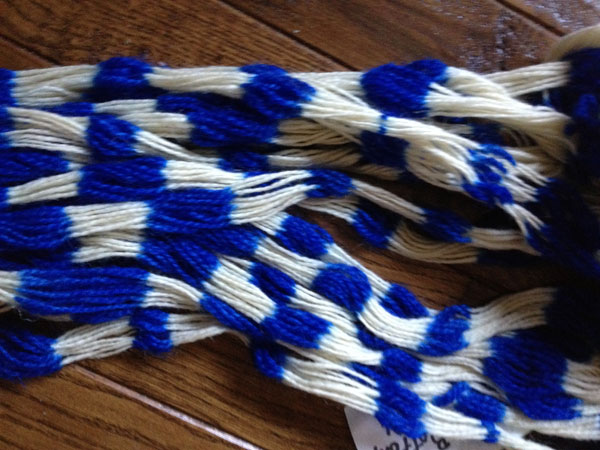
Ikat-in-progressHere are the boards in use with some of the same parts labeled. It was a real trick to get this project to function as needed. I had to go on a hunt for more clamps and bought nearly everything the local store had. Trial and error. And lots of measuring to make sure all distances are the same on both sides. By the way, there is a cartoon under the yarn that is not visible. Another experiment. If one practices enough (and keeps good notes) there should be a project manual of best practices. Right?

Textiles, textiles

Wari-catalogBeing a little obsessed about it, I went back to the Wari exhibit on Friday, this time getting the recorded tour that goes with the exhibit. Every weaver would enjoy seeing the tapestries in this exhibit, although there are many artifacts to amaze you. For instance, the picture on the cover of the catalogue is actually of a bag of soft leather. You can see the whole bag here. The face is of a stiffer leather that has been molded to the shape of a three-dimensional face. And the little statuette that is kind of THE artifact used most often to publicize the exhibit, is only a few inches tall. The colors of his tunic, face, etc. is made of stones and shells. Truly amazing.

I’ve mentioned before that the weaving is so fine that it is almost impossible to see the joins. The recording said that the warp is horizontal and weft is vertical. Frankly, I’m having a bit of a hard time picturing this since they used backstrap-type looms. The weft is alpaca and is spun very fine, and according to the recording, one centimeter has 100 vertical inches. The colors are still very vibrant. I’m hoping that when I finally get around to studying the catalogue, things will become clearer.

For one more textile related tidbit, the WSJ magazine had an article about a design library with more than seven million textile designs. Although it would be interesting to see, I also think it would be overwhelming. Where to start? Take a look at the slide show for a better idea of what’s there.

In the weaving part of my life, I have made the cartoons for the next ikat piece. In fact, the colors for this piece seem a little Wari-like.

Getting ready

The Show-postcard-frontguild biennial show is coming up soon. The gallery reception will be September 7, Gallery Night. The theme of the show this year is In the Eye of the Beholder. Each item in the show is to include a photo of the inspiration for the weaving. Should be interesting. I love seeing inspiration and process.

Drafting-tablePlywood-tableWhen I decided to take these pictures and, I really didn’t realize that they would appear almost identical. They are very different though. Trust me! On the left is the plywood that was being used as my ikat table. After the last measuring/wrapping session of days, I decided something has to change. On the right is the drafting table that has finally been assembled. It’s tall enough that I can stand and work or sit. The top slants to make it easier to reach the back sections more comfortably. This is the desk from World Market–the one the directions said two adults are needed for assembly. I hate that, not being able to do things by myself.

The next batch of yarns are out and ready to be measured in a palette much different than my usual. No bright colors, some shades of beige, rust, and black.

Busy, busy

blue-ikat

Blue ikat unwrapped

This week has been crazy busy–lots of finish work, steaming, completing a weaving, making hanging boards–and the house is a wreck. Unwrapping the ikat doesn’t help with the house. That ikat tape clings to everything, so it gets walked to other parts quite easily. And then there’s the party this weekend. And regular stuff, you know, housework, laundry, normal stuff.

Skull stencilThe picture on the left has nothing to do with anything, I just liked it. I ran in to get a couple of art things and saw stencils. This one called my name. All the stencils are 6-inch squares and come in everything from swirly whatevers to geometric designs. Have no idea what to do with this one. Guess it might make a cute Día de los muertos card. That would be in my spare time.

Socializing

One of my current goals is to get out and socialize more. Frankly, I really don't want to do that, but the logical part of my brain tells me that I should. As weavers/artists, we work alone. And I like that. The Wari workshop that I went to was a great day for socializing. One of the participants was a friend who was in tap dance classes with me years ago. It was fun catching up with her and meeting her other friends. We had a great table for socializing!***

My sisters and I are giving a party for our niece soon, so there’s the prep for that, but after the party, I am going to make myself get out on a Friday and join a docent tour of the Wari exhibit.

The Kimbell has been showing films about Peru in conjunction with the Wari exhibit. Sunday there were films about weaving and music which were very interesting. Of course I wanted the weaving film to be longer! The weavers in the film use a warp dominant weave structure on their backstrap looms, which involves pick up to make the pattern. One of the weavers used a discontinuous warp method, using a center bar to wrap the warp. One half of the warp is wound onto the front bar to the center. Then the weavers move to the other side and wind the warp from what might be the back bar to the center bar, inserting the new warp ends into the previously wound warp. This warp is a different color than the first warp. Here is a You Tube video of the pick up weaving, but not with the discontinuous warp. You can see a project on Weavolution here that illustrates the discontinuous warp technique very well and another more detailed explanation is here. The weavers in the film are a group that still utilizes the ancient methods and designs from centuries ago. They live in a very isolated part of Peru close to the coast, taking their alpacas into the mountains daily.

***I have no idea what happened with the text here, but I’m not going to puzzle over solving it any longer. :))

Wari

Wari-catalog

My book

Wari and pre-Columbian designs from what is now Peru have long been an interest of mine, so the Friday workshop at the Kimbell was greatly anticipated.

A few of the tables set up for work.

A few of the tables set up for work.

Here is a quote about the workshop:

Up-close examinations of intricate Wari textiles and other luxury goods from ancient  Peru will direct our hands-on exploration of color, repetition, and alternation in symbolic patterns. Offered in conjunction with the exhibition Wari: Lords of the Andes. (The highlighting is mine.)

That is exactly what we did. After a brief introduction of the program, the docents led groups of “students” to particular items, with an emphasis on textiles. I wish I could post pictures about the exhibit, but I will have to post links instead and pictures of my book. (I’ll explain why no pictures at a later date.)

What I wish is that everyone could see how fine the tapestries are. The yarns used must be absolutely tiny! And of course, they were spun with a drop spindle. The other observation about the weaving is how the pattern bands line up perfectly, even though they must have been woven at different times and probably by different weavers. I have Catalog-pagetrouble with that when the weaving must be symmetrical. The colors are still beautiful even though natural dyes such as cochineal are used.

Here is a link to the Kimbell page about the exhibit. At the top of the page there is a slide show of a few of the pieces. Of interest to us fiber people are the two right and left stationary pictures. That brightly colored piece is really quite large in the exhibit, It is woven in about 6 inch squares, then tie-dyed. Yes, tie-dyed! After the dyeing, it is put back together to form the whole. Here is a picture from my catalog.

From my book

From my book

In order to understand more about the patterns and color repetition, I am going to have to read the catalogue, in which there are drawings to help explain more about the symbols and patterns.


The dyeing blues

Color-aid-box

Color-aid box

Not the color blue…colors that I want to dye. I’ve got a project on the loom, using the colors I have, although they aren’t totally what I want. So, in an effort to try and match the colors, I took the RGB colors and went on a web search for find color chips. Well, if I’m not going to buy a Pantone set for bunches of money, it’s back to the drawing board. A couple of the skeins that I dyed were tied with an orange yarn. I love the color that resulted from the over dye of turquoise and blue. Maybe that’s where I should start. But as I have been writing this, I remembered the Color Aid papers. Gonna give that a shot. Then some of those skeins of orange and yellow are going to get over dyed.  Oh, and just as an aside, it’s really hot here. My dye room is like a sauna–really.

Colors-color-aid

Color-aid paper practice

Later–I got out my itty bitty set of Color-aid papers and searched for the right colors. I was able to find some that are pretty close. Let me clarify why I wanted to do this. I took my very simple design and added color to it on the computer. The printout did not print the colors as accurately as I wanted, and it is hard to take the computer picture and match it to my yarn samples. That’s why I wanted “chips” to carry around with me. I was able to do that with these colored papers. Here are the matches I came up with, although the photo of these colors is not spot on. Those blues look more purple-y than in the picture. There are 314 color chips in this small set–that makes for a lot of sorting through for just the right color. And these sets are not cheap. This small box of 2 x 3 chips is $34.50.

Goals for the week:

  • studio hours-20
  • clear brush by driveway
  • dye more yarn
  • steam press one more piece

A tale of two blues…

The next piece has been decided, yarns chosen, and warp tied. In fact the first couple of inches have been woven. After the first section, will be two broad (9-inch) stripes of some sort of blues. I finally decided that they are in the turquoise category and planned what to dye.Turquoisse-yarns One of the stripes will be a darker, turquoise-y color as in the top left in the picture. I want the other color to be lighter. On the bottom left is a color that appears lighter, but also may be too blue to suit me. It’s dyed with a 50/50 combination of turquoise and blue, so I decided to up the turquoise and dye a 60/40 combination. The darker turquoise has a bit of black in it, so I’ve got another pot going with that combination of colors in the same proportions, but instead of a 1% dye, I’m going with 1/2 of that. In decimal land, a place where I pretty much remain a stranger in a strange land, that would be 0.005 instead of 0.01–I think. At least it will be easy to over dye the experiment if needed. Oh, and that other ball of yarn on the lower right–it was dyed just like the top left one, but in a different pot. That’s what they mean when “they” say make sure you get enough yarn in the same dye lot.

Washout!

Steaming

Ready to steam/press.

This week is going to be a great week! It’s so nice to feel good! Do you ever feel grateful for feeling good after a spell of not feeling good? That’s where I am right now.

Last week was pretty much a washout. After a night with coughing spasms, an appointment with the doctor seemed in order. Now have allergy stuff AND a cough, along with no voice–isn’t it amazing how exhausting having no voice can be? All of this goes along with the fact that the to-do list went no where last week. I did get invitations for a party designed and mailed, though. A couple of things that I had planned to go to were laid aside because I was afraid I’d cough too much.

So, main goals for this week:

  • Steam and press two pieces
  • Dye yarns
  • Clean studio–Does anyone else make a huge mess in the studio? I seem to like to have all the colors I’m considering out on the floor so that I can see them together. Now it’s time to put them back, roll up and label the cartoons used, and just general cleaning. Amazing how much lint and dust is generated during the weaving process!

    I can't believe I'm actually posting this! How embarrassing!

    I can’t believe I’m actually posting this! How embarrassing!

What’s your process in the studio? Do you make a mess? Are you one of the neat people? It’s funny, the whole time I have been feeling bad, I’ve wanted the comfort of going out and weaving–not chicken soup–weaving!


Well, darn!

Wari magnet

Wari magnet

As today is the 22nd, I am already behind, knocked out by a summer cold or allergies, can’t tell for sure. Better now, but it sure affected my bottom line, task-wise. Mainly only a yucky cough left.

First, last week’s to-do list, and it’s not too bad overall.

July 12-18-I knew this list was too ambitious

  • –Finish piece on loomDone
  • –Clean studio
  • –Do finish work on two pieces (not my favorite thing to do)–Started
  • Clean off table, sort and put away stuff currently on table—required for the above
  • –Begin dyeing yarns for next piece
  • ·         Plan colors
  • ·         Weigh yarns
  • ·         Print spreadsheet with formulas for each batch
  • –Set alarm—didn’t need to, just started waking up earlier
  • –3 hours yard work—only 1 hour
  • Extras:
  • –Design—worked a little on designs
    –Socializing—visited with friends
    One thing that was not on my list except in my head—plan menus and actually cook—Done!

July 19-25 This week I have some family obligations, so I’m not sure about my list, but here it is. And my lists start on Friday, contrary to the calendar, but that means I have already lost two days with the darn cold. AND I plan to get back down to the Wari exhibit one day this week.

  • –Clean Studio—2 half-days
  • –Continue finish work-One piece down, 2 more to go. Then there will be the steaming. Finishing
  • –Dyeing
  • –Wash yarns-Obviously this should be ahead of dyeing.
  • –Clean dye pots
  • –Yard work—maybe I’ll just aim for 2 hours???  A gradual improvement :))
  • –Continue gratitude journal

Extras

  • –Decide on next piece and tie on warp
  • –Put the drafting desk together so I can stand to do some chores (dreading this one–you know, some assembly required)